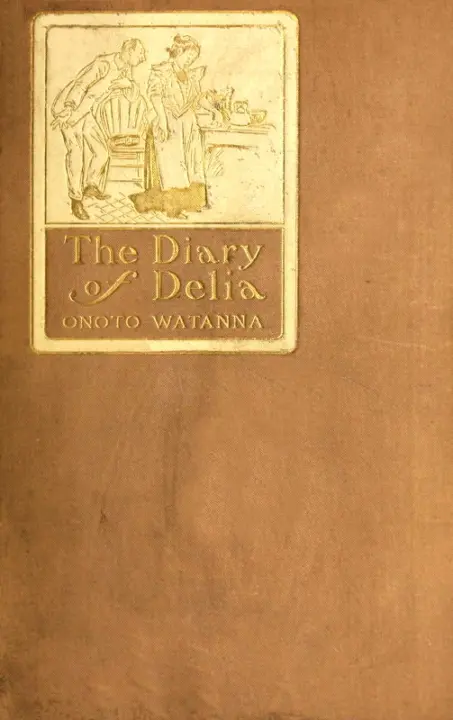
The diary of Delia : Being a veracious chronicle of the kitchen, with some side-lights on the parlour
Onoto Watanna
THE CLASSIC COLLECTION · 1902
"The Wooing of Wistaria" by Onoto Watanna is a novel written in the early 20th century. The story centers on Lady Wistaria, a young Japanese woman navigating the complexities of love, family duty, and societal expectations against the backdrop of a feudal Japan fraught with political intrigue and personal vendettas. Through her interactions, particularly with her lover, Keiki—whose identity as a member of the rival Mori clan complicates their romance—the narrative explores themes of loyalty, identity, and the impact of familial obligations. At the start of the novel, we are introduced to Lady Wistaria as she reflects on her tumultuous childhood, marked by tragedy and loss, particularly the memory of witnessing her father's anger towards a nobleman he deemed responsible for her mother's death. This early trauma shapes not only her personality but also her subsequent experiences at the court. As she matures into a beautiful young woman, Lady Wistaria is prepared for court life under the watchful eye of her strict aunt. However, a chance encounter with Keiki ignites a forbidden romance that leads her into the throes of political drama and familial conflicts as her father demands her to betray her lover for personal vengeance against the Mori clan. The opening chapters set the stage for a story steeped in emotional turmoil and the looming threat of conflict between love and duty.
Introduction adapted from the source catalogue; source summaries may be automatically generated.
Free to read · English · 76,023 words · No account needed
MAKE TIME FOR A GOOD BOOK
On by default. Untick to stop anonymous reading totals. Each page counts after 10 seconds in view. How this works.
Anonymous counting is on unless you have switched it off.
“My daughter, your highness, shall never accompany her Mori husband to
his home.”
“Very well, then. I will remain here with her. I am quite satisfied to renounce all my worldly ambitions and possessions for her sake, if such is the command of her august father,” and the Prince bowed to his father-in-law in the most filial and affable manner.
“If you remain here you will not be permitted to live.”
A low cry, half moan, came from the new Princess of Mori, who lay against her uncle’s breast. Keiki turned to her at that cry. He was seized with a foreboding of events to come. Again he turned to the samurai.
“Will it please you, honored father-in-law, to speak more plainly to
me?”
“Very well. This marriage, your highness, has been consummated not for the purpose of uniting a pair of lovers, but to fulfil a pledge which was made to one who was murdered by your parent—a pledge of vengeance.”
“But I cannot perceive how this is accomplished,” said the Prince, now
pale as Wistaria.
“You have married an Eta girl.”
“I am aware of that,” said the Prince, somewhat proudly.
“I have not finished,” said Shimadzu. “Are you aware that you are at present under sentence of death?”
The Prince made a contemptuous motion.
“By order of the bakufu (shogunate). Yes, I am aware of the fact.”
“Very well. I am the executioner!”
“You!”
“It was I who caused your arrest, and afterwards brought you hither with the intention of executing you.”
A flood of horrible thoughts rushed across the Prince’s mind, bewildering him. As if to press them back, he clasped his hands to his head. Shimadzu continued in his cold and monotonous voice:
“After your arrest, it was brought to my attention that a more subtle revenge against your parent could be gained by marrying you into that very class of people so despised by your father, and forcing you to become guilty of the same offence for which I was exiled.”
Stirred as he now was, Keiki’s faith in Wistaria still remained unshaken. That her father had had a hand in betraying him he was assured, but he could not yet recognize in the deed the delicate hand of the woman he loved.
“Through the agency of my daughter,” went on the samurai, “I was soon able to learn sufficient concerning the workings of the Imperialist party of which you are the head—”
“The Imperialist party!” repeated the Prince, and he bounded towards the samurai with the cry of a wounded animal. His hand sprang to his hip, where his sword had been restored to its sheath.
Your reading position is saved on this browser. Take it to another device with a library code. Reading pages adapt to text, rather than matching a printed edition.
Onoto Watanna
Onoto Watanna
Onoto Watanna
Onoto Watanna
BEHIND THE BOOK
This eBook is for the use of anyone anywhere in the United States and most other parts of the world at no cost and with almost no restrictions whatsoever. You may copy it, give it away or re-use it under the terms of the Project Gutenberg License included with this eBook or online at www.gutenberg.org. If you are not located in the United States, you will have to check the laws of the country where you are located before using this eBook. Read the source licence.
The original source file, including credits and licence, is retained by this library. Request an original-format copy at no charge. Please include the book title and Project Gutenberg identifier #59413.
KEEP YOUR CURIOSITY GOING
Cécile Tormay

Moritz Busch
Coulson Kernahan
John L. Ransom

Maurice Baring
Frances Wright