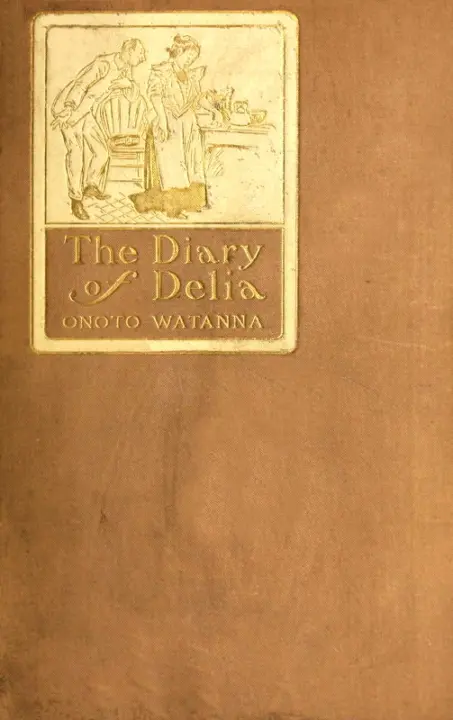
The diary of Delia : Being a veracious chronicle of the kitchen, with some side-lights on the parlour
Onoto Watanna
THE CLASSIC COLLECTION · 1902
"The Wooing of Wistaria" by Onoto Watanna is a novel written in the early 20th century. The story centers on Lady Wistaria, a young Japanese woman navigating the complexities of love, family duty, and societal expectations against the backdrop of a feudal Japan fraught with political intrigue and personal vendettas. Through her interactions, particularly with her lover, Keiki—whose identity as a member of the rival Mori clan complicates their romance—the narrative explores themes of loyalty, identity, and the impact of familial obligations. At the start of the novel, we are introduced to Lady Wistaria as she reflects on her tumultuous childhood, marked by tragedy and loss, particularly the memory of witnessing her father's anger towards a nobleman he deemed responsible for her mother's death. This early trauma shapes not only her personality but also her subsequent experiences at the court. As she matures into a beautiful young woman, Lady Wistaria is prepared for court life under the watchful eye of her strict aunt. However, a chance encounter with Keiki ignites a forbidden romance that leads her into the throes of political drama and familial conflicts as her father demands her to betray her lover for personal vengeance against the Mori clan. The opening chapters set the stage for a story steeped in emotional turmoil and the looming threat of conflict between love and duty.
Introduction adapted from the source catalogue; source summaries may be automatically generated.
Free to read · English · 76,023 words · No account needed
MAKE TIME FOR A GOOD BOOK
On by default. Untick to stop anonymous reading totals. Each page counts after 10 seconds in view. How this works.
Anonymous counting is on unless you have switched it off.
WITHOUT the Imperial city of Kioto, in an open field, lay encamped a little army of thirteen hundred men. It was some months following the decisive action of Mori at Shimonoseki. Imperialists of the neighborhood could not have told who the commander of this force was. They were known simply as the “Irregulars.”
Small as was the force, it was admirably trained and drilled in all three of its divisions of cavalry, infantry, and artillery. Each division was the flower and choice of some larger body. The force, which had remained in inaction for a considerable period, showed nevertheless a state of ruling vigilance, whether for attack or defence could not have been told from its appearance.
The camp was in the shape of an elongated circle, whose circumference was regularly defined by field-pieces set at regular intervals, and trained to oppose any invading force. Near each cannon were tethered the horses furnishing the motive power. Hard by, stretched upon the ground, or lounging within the scant shadows of the gun-carriages, were the artillerymen. Infantry guards, in armor, and for the most part armed with rifles, patrolled the space without the circle. Other soldiers and samurai, armed only with swords, sat in the openings of tents assigned to their division, or occupied the time in sword exercise in the open spaces between their shelters. Near the centre of the encampment were assembled the horses of the cavalry division, saddled and in complete readiness for their riders, who lounged near by.
Within a short stone’s-throw of the horsemen was pitched what seemed, from its commanding position on a little eminence, the tent of the commander of the “Irregulars.” Close by its entrance stood an enormous samurai, whose naked sword was held lightly, carelessly, in his hand. In conversation with him stood a hardy youth, attired as a cavalryman.
The curtains of the tent on the eminence were parted deftly, and the slight figure of a boy hastened towards the two.
“My Lord of Catzu,” he said, “the Prince Mori desires your presence, and that of you also, Sir Genji.”
Toro smiled at the youth’s ceremoniousness.
“Is there news, my Jiro?” he asked.
“Oguri, as you know, has arrived from the south, and our enemies have reported concerning the condition of the city.”
The three hastened within, where they found Oguri and Mori.
“Now, then, Oguri, your news,” commanded Mori.
“Your highness,” said Oguri, “the British have bombarded Kagoshima as a result of our attack upon the foreign fleet.”
“Kagoshima!” exclaimed Mori—“the capital of our old friend Satsuma. Then, indeed, have we brought trouble upon our allies.”
Your reading position is saved on this browser. Take it to another device with a library code. Reading pages adapt to text, rather than matching a printed edition.
Onoto Watanna
Onoto Watanna
Onoto Watanna
Onoto Watanna
BEHIND THE BOOK
This eBook is for the use of anyone anywhere in the United States and most other parts of the world at no cost and with almost no restrictions whatsoever. You may copy it, give it away or re-use it under the terms of the Project Gutenberg License included with this eBook or online at www.gutenberg.org. If you are not located in the United States, you will have to check the laws of the country where you are located before using this eBook. Read the source licence.
The original source file, including credits and licence, is retained by this library. Request an original-format copy at no charge. Please include the book title and Project Gutenberg identifier #59413.
KEEP YOUR CURIOSITY GOING
Cécile Tormay

Moritz Busch
Coulson Kernahan
John L. Ransom

Maurice Baring
Frances Wright