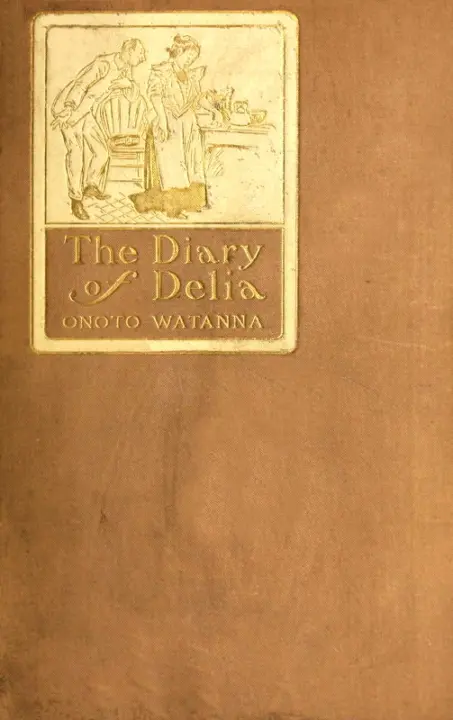
The diary of Delia : Being a veracious chronicle of the kitchen, with some side-lights on the parlour
Onoto Watanna
THE CLASSIC COLLECTION · 1902
"The Wooing of Wistaria" by Onoto Watanna is a novel written in the early 20th century. The story centers on Lady Wistaria, a young Japanese woman navigating the complexities of love, family duty, and societal expectations against the backdrop of a feudal Japan fraught with political intrigue and personal vendettas. Through her interactions, particularly with her lover, Keiki—whose identity as a member of the rival Mori clan complicates their romance—the narrative explores themes of loyalty, identity, and the impact of familial obligations. At the start of the novel, we are introduced to Lady Wistaria as she reflects on her tumultuous childhood, marked by tragedy and loss, particularly the memory of witnessing her father's anger towards a nobleman he deemed responsible for her mother's death. This early trauma shapes not only her personality but also her subsequent experiences at the court. As she matures into a beautiful young woman, Lady Wistaria is prepared for court life under the watchful eye of her strict aunt. However, a chance encounter with Keiki ignites a forbidden romance that leads her into the throes of political drama and familial conflicts as her father demands her to betray her lover for personal vengeance against the Mori clan. The opening chapters set the stage for a story steeped in emotional turmoil and the looming threat of conflict between love and duty.
Introduction adapted from the source catalogue; source summaries may be automatically generated.
Free to read · English · 76,023 words · No account needed
MAKE TIME FOR A GOOD BOOK
On by default. Untick to stop anonymous reading totals. Each page counts after 10 seconds in view. How this works.
Anonymous counting is on unless you have switched it off.
As she thought thus sadly, the gentle voice of her lover brought the tears to her eyes. But she held them back, almost feverishly placing a greater distance between herself and the Prince. In that moment when his tender eyes held hers in their gaze, while he trustfully waited for her to speak, she was ready to tell him everything.
“You are about to tell me all,” he said, as though he understood her unspoken volition. “Do not mistrust me. Believe in my adoration for you. Give me thy heart completely.”
A sudden shivering took possession of Wistaria. Instead of speaking, she drew her sleeve across her face, a characteristic habit with her when in despair. Gradually her head sank forward, until she knelt at his feet in an attitude of humility.
“Nay, do not kneel,” he cried, “nor hide thy face from me. Do not so, I
beseech thee.”
Having permitted his assistance in rising, she freed herself from his
encircling arm.
“Look at me, my lord,” she cried. “Tell me, what do you see?”
“A maiden as beautiful as the sun-goddess and as good—”
“Nay, then, do not speak so. Look at me again, my lord. Have you then found such pleasure in my beauty that you have not even remarked my garments?”
“Your garments?”
Bewilderment was in his face.
“Yes. Are these the silks, my lord, worn by the ladies of your rank?”
“Nay, but though I cannot conceive why you should be garbed in cotton, yet I see no disgrace in the fact. Perchance the samurai Genji is honorably poor, and you are so courteous as to dress in homely garments while a guest of his honorable household.”
“I am not a guest of his household, my lord.”
“But—”
“I know it has been told you so. Nevertheless, this is the house of my
father.”
“I do not understand,” he exclaimed.
He added immediately, “If it is that your honorable father is poor—”
“You are wrong, my lord. My father is in the service of the government. His remuneration is ample.”
“Then do explain to me the reason why you are so garbed and situated.”
“Because it is so enacted by the law,” she said.
“The law!”
“I am an Eta woman.”
“An Eta! Impossible!”
“That was the offence for which my father was banished—because of his marriage to an Eta maiden.”
The Prince stared at her aghast. She stood as still as if made of stone. Her lover’s silence was due to his repugnance at this revelation, she thought. Seeing his effort to speak, she prayed a little prayer to the gods that he would spare her. The Prince found his voice.
Your reading position is saved on this browser. Take it to another device with a library code. Reading pages adapt to text, rather than matching a printed edition.
Onoto Watanna
Onoto Watanna
Onoto Watanna
Onoto Watanna
BEHIND THE BOOK
This eBook is for the use of anyone anywhere in the United States and most other parts of the world at no cost and with almost no restrictions whatsoever. You may copy it, give it away or re-use it under the terms of the Project Gutenberg License included with this eBook or online at www.gutenberg.org. If you are not located in the United States, you will have to check the laws of the country where you are located before using this eBook. Read the source licence.
The original source file, including credits and licence, is retained by this library. Request an original-format copy at no charge. Please include the book title and Project Gutenberg identifier #59413.
KEEP YOUR CURIOSITY GOING
Cécile Tormay

Moritz Busch
Coulson Kernahan
John L. Ransom

Maurice Baring
Frances Wright