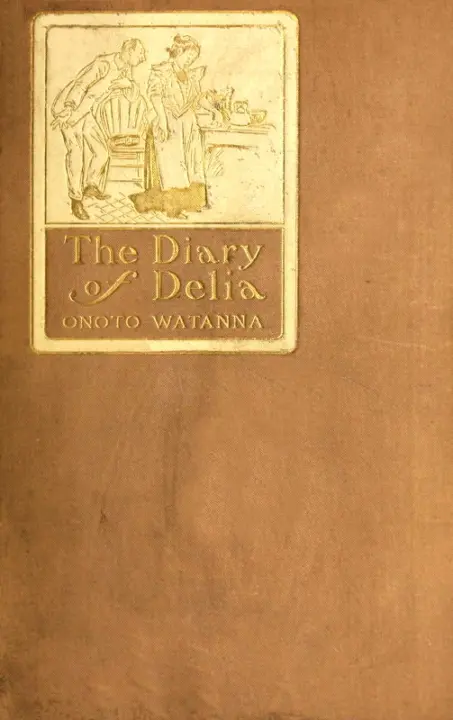
The diary of Delia : Being a veracious chronicle of the kitchen, with some side-lights on the parlour
Onoto Watanna
THE CLASSIC COLLECTION · 1902
"The Wooing of Wistaria" by Onoto Watanna is a novel written in the early 20th century. The story centers on Lady Wistaria, a young Japanese woman navigating the complexities of love, family duty, and societal expectations against the backdrop of a feudal Japan fraught with political intrigue and personal vendettas. Through her interactions, particularly with her lover, Keiki—whose identity as a member of the rival Mori clan complicates their romance—the narrative explores themes of loyalty, identity, and the impact of familial obligations. At the start of the novel, we are introduced to Lady Wistaria as she reflects on her tumultuous childhood, marked by tragedy and loss, particularly the memory of witnessing her father's anger towards a nobleman he deemed responsible for her mother's death. This early trauma shapes not only her personality but also her subsequent experiences at the court. As she matures into a beautiful young woman, Lady Wistaria is prepared for court life under the watchful eye of her strict aunt. However, a chance encounter with Keiki ignites a forbidden romance that leads her into the throes of political drama and familial conflicts as her father demands her to betray her lover for personal vengeance against the Mori clan. The opening chapters set the stage for a story steeped in emotional turmoil and the looming threat of conflict between love and duty.
Introduction adapted from the source catalogue; source summaries may be automatically generated.
Free to read · English · 76,023 words · No account needed
MAKE TIME FOR A GOOD BOOK
On by default. Untick to stop anonymous reading totals. Each page counts after 10 seconds in view. How this works.
Anonymous counting is on unless you have switched it off.
“Well,” she said, “if my honorable aunt or august uncle were to learn of his boldness, I fear me they would command that the curtains of my insignificant norimon be drawn so tightly that I should surely suffocate.”
“Fear not,” said Genji, “I shall take immediate measures to prevent such an occurrence, my lady.”
Wistaria pouted, and frowned as heavily as it is possible for bright eyes and rosy lips to do. She toyed with her fan, opening and closing it several times.
“You are honorably over-zealous, Sir Genji,” she said.
“My lady,” he replied, “know you aught of this stranger?”
“He has a pretty grace,” said Wistaria, “and the bearing of one of noble rank. Have you not noted, Sir Genji, the beauty and richness of his magnificent attire?”
“I have, my lady. It is of that attire I would speak.”
“Do so at once, then.”
“It is the attire, my lady, of the Mori family.”
“The Mori! What! Our honorably hostile neighbors?”
“Exactly,” said Genji.
“Oh, dear!” murmured Wistaria, as she sank back in her cushions in troubled thought. After a moment her little black head again appeared.
“Gen,” she cried, “come hither once more.”
“My lady?”
“A little closer, if you please. So! Know you not, Sir Gen, that my lady aunt, and indeed also my own august father, once served this odious Mori prince?”
“I have heard so, my lady.”
“Well, then, truly all of the members of this honorable clan cannot be
augustly bad!”
Sir Genji could not restrain a smile.
“Indeed, my lady, this Choshui people have many worthy and admirable
qualities.”
“You are a very clever fellow, my dear Sir Gen,” said Wistaria, smiling engagingly now, “and I shall bespeak you to my honorable uncle. And now—now—if you would really wish to serve me, do you pray show some kindness—some little insignificant courtesy to this unfortunate Mori courtier. Perhaps he may have some good attributes.”
“Undoubtedly, my lady.”
“And do be careful to allow my lady aunt to know naught concerning him, for she, having come from this Mori, is actually more sour against them than we, you and I, Sir Gen, who have not indeed.”
Just then my lady heard a familiar tramp to the left of her norimono. There were but few horses in the cortège, and most of them had gone ahead with her father’s samurai. Consequently the beat of a horse’s hoofs was plainly to be heard. The Lady Wistaria wavered between lying back in her carriage and drawing about her discreetly the curtains, or sitting up and feigning indifference to the horseman.
Your reading position is saved on this browser. Take it to another device with a library code. Reading pages adapt to text, rather than matching a printed edition.
Onoto Watanna
Onoto Watanna
Onoto Watanna
Onoto Watanna
BEHIND THE BOOK
This eBook is for the use of anyone anywhere in the United States and most other parts of the world at no cost and with almost no restrictions whatsoever. You may copy it, give it away or re-use it under the terms of the Project Gutenberg License included with this eBook or online at www.gutenberg.org. If you are not located in the United States, you will have to check the laws of the country where you are located before using this eBook. Read the source licence.
The original source file, including credits and licence, is retained by this library. Request an original-format copy at no charge. Please include the book title and Project Gutenberg identifier #59413.
KEEP YOUR CURIOSITY GOING
Cécile Tormay

Moritz Busch
Coulson Kernahan
John L. Ransom

Maurice Baring
Frances Wright