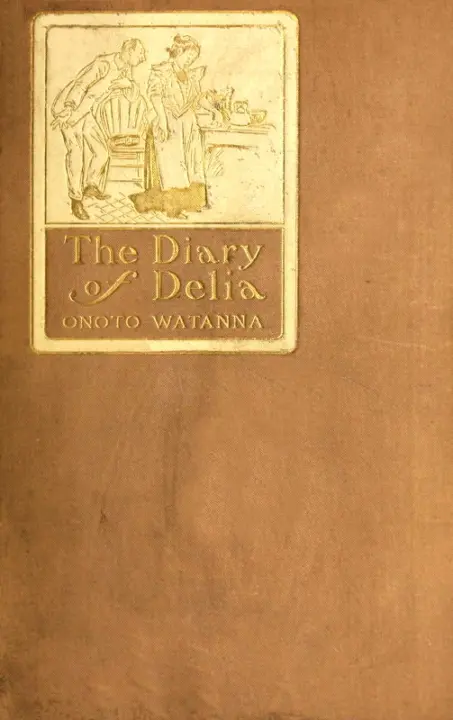
The diary of Delia : Being a veracious chronicle of the kitchen, with some side-lights on the parlour
Onoto Watanna
THE CLASSIC COLLECTION · 1902
"The Wooing of Wistaria" by Onoto Watanna is a novel written in the early 20th century. The story centers on Lady Wistaria, a young Japanese woman navigating the complexities of love, family duty, and societal expectations against the backdrop of a feudal Japan fraught with political intrigue and personal vendettas. Through her interactions, particularly with her lover, Keiki—whose identity as a member of the rival Mori clan complicates their romance—the narrative explores themes of loyalty, identity, and the impact of familial obligations. At the start of the novel, we are introduced to Lady Wistaria as she reflects on her tumultuous childhood, marked by tragedy and loss, particularly the memory of witnessing her father's anger towards a nobleman he deemed responsible for her mother's death. This early trauma shapes not only her personality but also her subsequent experiences at the court. As she matures into a beautiful young woman, Lady Wistaria is prepared for court life under the watchful eye of her strict aunt. However, a chance encounter with Keiki ignites a forbidden romance that leads her into the throes of political drama and familial conflicts as her father demands her to betray her lover for personal vengeance against the Mori clan. The opening chapters set the stage for a story steeped in emotional turmoil and the looming threat of conflict between love and duty.
Introduction adapted from the source catalogue; source summaries may be automatically generated.
Free to read · English · 76,023 words · No account needed
MAKE TIME FOR A GOOD BOOK
On by default. Untick to stop anonymous reading totals. Each page counts after 10 seconds in view. How this works.
Anonymous counting is on unless you have switched it off.
“Yes, I will tell you, little Wistaria,” he said, “though I fear you are already acquainted with my secret.”
“I am not, indeed,” she denied.
“You do not know,” he asked, sadly, “that I am of the Mori clan?”
“Of the Mori clan! And is that all that troubles you, my lord?”
“And is not that sufficiently serious?”
“No.”
“But surely you must be aware of the feud existing between the Mori and
Catzu clans?”
“My lord, you and I do not constitute the Mori and Catzu clans.”
“You and I,” he repeated, slowly, “do not constitute the Mori and Catzu clans.” Then, after a silent moment: “Alas, my lady, I fear we do!”
Wistaria snatched her hands quickly from his and arose. Certainly he could not love her, she thought, if he allowed so small a thing as that to distress him.
“If that be so—if that is what you think, my lord, deign to inform me why you have condescended to make suit to me?”
“I was forced to make my suit in secret,” he said, almost bitterly.
“But your love is honest, is it not?”
“Oh, my flower-girl, can you ask that?”
She was contrite in a moment. Once more she was at his feet, kneeling, and pressing both his hands with her little, slender, nervous fingers.
“Nay, then, do not look so sad, my Keiki. It troubles me that you should allow so silly a thing as the differences of our respective clans even for a fraction of a moment to come between us.”
“They cannot truly come between us,” was his fervid reply, “for no power on earth can actually separate us now. Are we not sworn to each other for all time—for all eternity?”
“Then why be so sad? You, who are so brave, cannot fear the dangers that may beset our union.”
“No, no, it is not that. But—I sigh for the tears of others—our honorable ancestors and parents.”
“Then do cease to sigh at once, if you please. Why, it is not such a terrible crime to marry a Mori, surely!”
“No, I hope not,” said Keiki, smiling now.
“No, indeed, for my own honorable uncle committed that same fault.”
“Fault?”
“And I believe that if we were to go to him, and tell him the honorable truth, he would gladly assist us.”
“Not if he knew all,” said Keiki, sadly. “No, he must know nothing yet.”
“Indeed,” said Wistaria, “I did not know the feeling of the Mori was so bitter against us, and I do assure you that in Catzu the prejudice exists not so much against your clan, as against your lord and prince.”
Your reading position is saved on this browser. Take it to another device with a library code. Reading pages adapt to text, rather than matching a printed edition.
Onoto Watanna
Onoto Watanna
Onoto Watanna
Onoto Watanna
BEHIND THE BOOK
This eBook is for the use of anyone anywhere in the United States and most other parts of the world at no cost and with almost no restrictions whatsoever. You may copy it, give it away or re-use it under the terms of the Project Gutenberg License included with this eBook or online at www.gutenberg.org. If you are not located in the United States, you will have to check the laws of the country where you are located before using this eBook. Read the source licence.
The original source file, including credits and licence, is retained by this library. Request an original-format copy at no charge. Please include the book title and Project Gutenberg identifier #59413.
KEEP YOUR CURIOSITY GOING
Cécile Tormay

Moritz Busch
Coulson Kernahan
John L. Ransom

Maurice Baring
Frances Wright