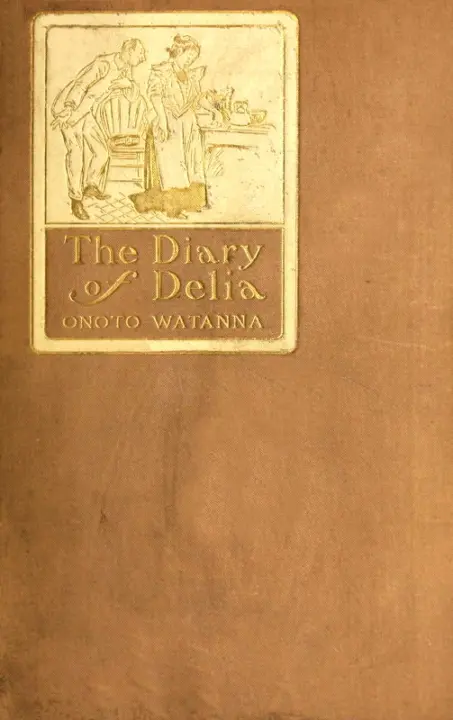
The diary of Delia : Being a veracious chronicle of the kitchen, with some side-lights on the parlour
Onoto Watanna
THE CLASSIC COLLECTION · 1902
"The Wooing of Wistaria" by Onoto Watanna is a novel written in the early 20th century. The story centers on Lady Wistaria, a young Japanese woman navigating the complexities of love, family duty, and societal expectations against the backdrop of a feudal Japan fraught with political intrigue and personal vendettas. Through her interactions, particularly with her lover, Keiki—whose identity as a member of the rival Mori clan complicates their romance—the narrative explores themes of loyalty, identity, and the impact of familial obligations. At the start of the novel, we are introduced to Lady Wistaria as she reflects on her tumultuous childhood, marked by tragedy and loss, particularly the memory of witnessing her father's anger towards a nobleman he deemed responsible for her mother's death. This early trauma shapes not only her personality but also her subsequent experiences at the court. As she matures into a beautiful young woman, Lady Wistaria is prepared for court life under the watchful eye of her strict aunt. However, a chance encounter with Keiki ignites a forbidden romance that leads her into the throes of political drama and familial conflicts as her father demands her to betray her lover for personal vengeance against the Mori clan. The opening chapters set the stage for a story steeped in emotional turmoil and the looming threat of conflict between love and duty.
Introduction adapted from the source catalogue; source summaries may be automatically generated.
Free to read · English · 76,023 words · No account needed
MAKE TIME FOR A GOOD BOOK
On by default. Untick to stop anonymous reading totals. Each page counts after 10 seconds in view. How this works.
Anonymous counting is on unless you have switched it off.
Mori, attended at a distance by his staff, rode in the centre of the infantry division. The entire direction of the current routine he left to his subordinates, riding moodily apart from all. The men marched with firm and light step. On their own soil they were more assured and hopeful of the issue.
“Oguri,” asked Toro, as in perfect quiet they advanced with their cavalry—“Oguri, how may I atone for Kioto?”
“By following my orders closely,” answered the serious Oguri. “You, with the cavalry, are upon no account to charge before cannonading begins.”
“I swear by the god of war I will not,” promised Toro.
“You must move to the west at least four miles, throwing out your scouts
regularly.”
“I will. Only give me the chance. Was not I responsible for the failure at Kioto?” said Toro, his face quivering in spite of himself.
“Yes and no,” said Oguri; “but, at all events, his highness has not held it against you. He told me that after-events justified you, since the enemy had artillery at your gate.”
“But he allowed me no chance to explain that I ordered the pioneers back when I heard their artillery being brought up. I wanted to check them at once.”
“The Prince has nothing but affection for you,” said Oguri.
“Ah!” cried Toro, in delight.
The other smiled, half paternally, half reprovingly, at the enthusiasm
of youth.
“But you must restrain yourself during the first half of your manœuvre,” said the chief lieutenant; “during the latter part you may give free rein to your impetuosity.”
As the first sharp light of the September day began to make visible objects along the highway, Oguri held out his hand to Toro.
“Now go,” he said, “and remember all I have said to you. Now is your
opportunity.”
Toro dashed a sleeve to his face. Then, turning to his cavalry, he
raised his sword in command.
“Forward!”
Sharply turning, the six companies wheeled due east, to disappear in the distance. The main body advanced for two hours. Then Oguri saw that Toro had reached the spot settled upon in their plan of battle.
Mori, leaving the centre, came briskly up with his staff, to assume the ordering of the formation. The infantry were set out in two close ranks. Back of them, in the centre, the sixty field-pieces were assembled, their horses tethered close by.
“Scouts!” called Mori to Oguri.
Scouts and skirmishers were thrown out. All rested upon their arms.
Your reading position is saved on this browser. Take it to another device with a library code. Reading pages adapt to text, rather than matching a printed edition.
Onoto Watanna
Onoto Watanna
Onoto Watanna
Onoto Watanna
BEHIND THE BOOK
This eBook is for the use of anyone anywhere in the United States and most other parts of the world at no cost and with almost no restrictions whatsoever. You may copy it, give it away or re-use it under the terms of the Project Gutenberg License included with this eBook or online at www.gutenberg.org. If you are not located in the United States, you will have to check the laws of the country where you are located before using this eBook. Read the source licence.
The original source file, including credits and licence, is retained by this library. Request an original-format copy at no charge. Please include the book title and Project Gutenberg identifier #59413.
KEEP YOUR CURIOSITY GOING
Cécile Tormay

Moritz Busch
Coulson Kernahan
John L. Ransom

Maurice Baring
Frances Wright