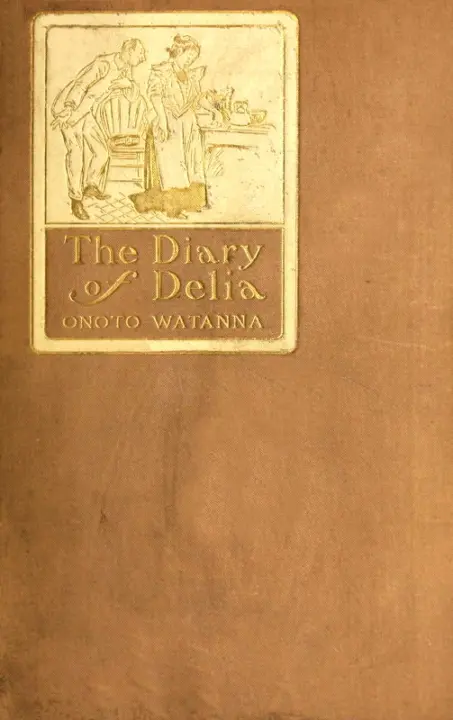
The diary of Delia : Being a veracious chronicle of the kitchen, with some side-lights on the parlour
Onoto Watanna
THE CLASSIC COLLECTION · 1902
"The Wooing of Wistaria" by Onoto Watanna is a novel written in the early 20th century. The story centers on Lady Wistaria, a young Japanese woman navigating the complexities of love, family duty, and societal expectations against the backdrop of a feudal Japan fraught with political intrigue and personal vendettas. Through her interactions, particularly with her lover, Keiki—whose identity as a member of the rival Mori clan complicates their romance—the narrative explores themes of loyalty, identity, and the impact of familial obligations. At the start of the novel, we are introduced to Lady Wistaria as she reflects on her tumultuous childhood, marked by tragedy and loss, particularly the memory of witnessing her father's anger towards a nobleman he deemed responsible for her mother's death. This early trauma shapes not only her personality but also her subsequent experiences at the court. As she matures into a beautiful young woman, Lady Wistaria is prepared for court life under the watchful eye of her strict aunt. However, a chance encounter with Keiki ignites a forbidden romance that leads her into the throes of political drama and familial conflicts as her father demands her to betray her lover for personal vengeance against the Mori clan. The opening chapters set the stage for a story steeped in emotional turmoil and the looming threat of conflict between love and duty.
Introduction adapted from the source catalogue; source summaries may be automatically generated.
Free to read · English · 76,023 words · No account needed
MAKE TIME FOR A GOOD BOOK
On by default. Untick to stop anonymous reading totals. Each page counts after 10 seconds in view. How this works.
Anonymous counting is on unless you have switched it off.
“Thou art,” said Catzu, “truly a vicious product. Hast thou forgotten all the precepts of honor taught thee from childhood? Thou art no son of mine, nor indeed of Japan, for what man can be a patriot with honor who sets his father at defiance? It is admitted by even those more ignorant than thou that a true son owes his first allegiance in life to his parent.”
“Nay, my lord,” replied Toro, quickly. “You do labor under a mistake. The first allegiance a son of Japan owes to any man is that claimed of him by his supreme master, the Emperor. Banzai, the Mikado!”
Mori stepped quietly before the enraged Catzu.
“Now, my Lord of Catzu,” he said, “you shall have my answer.”
As he spoke, he caught up a light rifle from a guard at the gate and fired into the air. Instantly the crews, with hoarse cries, elevated their pieces until their muzzles stood above the breastworks; carefully they trained them upon the ships.
“Ready, my lord,” shouted Toro.
“Ready, my lord,” echoed Oguri.
Mori made a sign. Instantly a heavy discharge rent the air and shook the ground whereon they stood.
Jiro, at his gun, directly before Mori and Catzu, himself applied the match, and then, stepping back, squinted along the piece to see the effect of his fire. The ball broke a foremast on the leading vessel. In consternation Catzu left the place, the design of the crafty Mori to embroil him with the enemy through his accidental presence dawning upon him.
For upward of an hour the firing continued. At the end of that period the ships drew off from range. Mori, elated at having held his own against the foreigners, and now certain of the consequences of his action, withdrew his people from the batteries. That night the army rested, for Mori knew that the foreigners would lay the cause of the bombardment to the shogunate and make new demands upon it.
The next day a courier from the Kioto court entered his works.
“It is some new mark of the Mikado’s regard,” cried Toro, impulsively.
Sadly Mori smiled.
“I fear me it is,” he said.
With a calm face and firm hand Mori opened the despatch. His face
darkened.
“What is it?” cried Toro.
“We are branded as outlaws,” answered Mori, his spirit quite gone, a deathly pallor creeping over his face. “We are forbidden to approach the Imperial city.”
“Aidzu?” whispered Jiro, almost in tears.
“Yes, Aidzu,” repeated Mori.
Your reading position is saved on this browser. Take it to another device with a library code. Reading pages adapt to text, rather than matching a printed edition.
Onoto Watanna
Onoto Watanna
Onoto Watanna
Onoto Watanna
BEHIND THE BOOK
This eBook is for the use of anyone anywhere in the United States and most other parts of the world at no cost and with almost no restrictions whatsoever. You may copy it, give it away or re-use it under the terms of the Project Gutenberg License included with this eBook or online at www.gutenberg.org. If you are not located in the United States, you will have to check the laws of the country where you are located before using this eBook. Read the source licence.
The original source file, including credits and licence, is retained by this library. Request an original-format copy at no charge. Please include the book title and Project Gutenberg identifier #59413.
KEEP YOUR CURIOSITY GOING
Cécile Tormay

Moritz Busch
Coulson Kernahan
John L. Ransom

Maurice Baring
Frances Wright