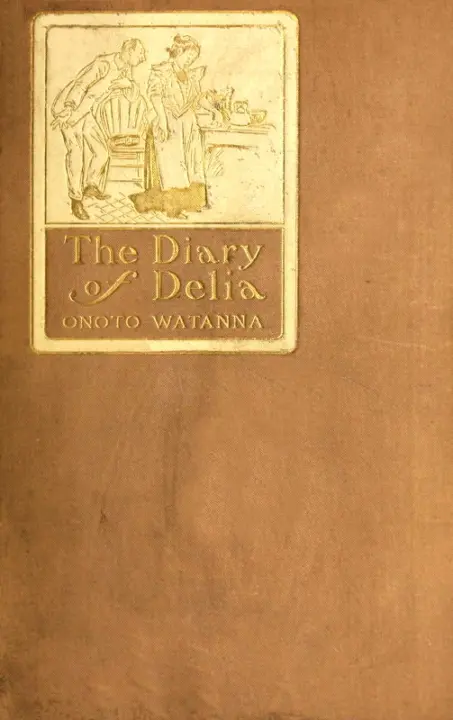
The diary of Delia : Being a veracious chronicle of the kitchen, with some side-lights on the parlour
Onoto Watanna
THE CLASSIC COLLECTION · 1902
"The Wooing of Wistaria" by Onoto Watanna is a novel written in the early 20th century. The story centers on Lady Wistaria, a young Japanese woman navigating the complexities of love, family duty, and societal expectations against the backdrop of a feudal Japan fraught with political intrigue and personal vendettas. Through her interactions, particularly with her lover, Keiki—whose identity as a member of the rival Mori clan complicates their romance—the narrative explores themes of loyalty, identity, and the impact of familial obligations. At the start of the novel, we are introduced to Lady Wistaria as she reflects on her tumultuous childhood, marked by tragedy and loss, particularly the memory of witnessing her father's anger towards a nobleman he deemed responsible for her mother's death. This early trauma shapes not only her personality but also her subsequent experiences at the court. As she matures into a beautiful young woman, Lady Wistaria is prepared for court life under the watchful eye of her strict aunt. However, a chance encounter with Keiki ignites a forbidden romance that leads her into the throes of political drama and familial conflicts as her father demands her to betray her lover for personal vengeance against the Mori clan. The opening chapters set the stage for a story steeped in emotional turmoil and the looming threat of conflict between love and duty.
Introduction adapted from the source catalogue; source summaries may be automatically generated.
Free to read · English · 76,023 words · No account needed
MAKE TIME FOR A GOOD BOOK
On by default. Untick to stop anonymous reading totals. Each page counts after 10 seconds in view. How this works.
Anonymous counting is on unless you have switched it off.
Hasuda, in the shadow of the gate and the farther shadow of the cedars which bent their branches over the walls, raised his sword.
“Now,” he whispered, in a soft, penetrating voice, insistent as the hiss of a serpent. From the shadows of the walls against which they had stood ronins leaped upon the samurai and attendants about the norimon of Ii. These gave way instantly, some were killed outright, others wounded, while still others were left engaged in deadly strife with ronin adversaries.
“Quick! Forward!” urged Hasuda.
A chosen body sprang out from the ronin ranks, and surrounding the norimon of the Regent, drew him with rough hands out into the road. They dragged him before Hasuda. Within the palace a cry of alarm rang through the night, followed by the hurried mustering of troops.
Outside the Sakurada gate, however, the numerous ronins, showing no sign of fear, proceeded leisurely. Ii had fallen upon his knees. His mute lips moved in prayers for mercy, though no sound escaped them. His lips were livid, his eyes glazed.
At what seemed this manifestation of cowardice the ronins, outlawed samurai as they were, laughed scornfully. They would have died unflinchingly. Ii was not of samurai blood.
“Death to the traitor!” roared a ronin chorus.
“Ay,” replied Hasuda—“death!” Then to the Regent: “Ii, thou art a traitor. Rise and receive sentence.”
Ii seemed paralyzed with fear.
“Let him die,” said Hasuda.
“Let him die,” growled the ronins.
Hasuda sent a keen glance over his ranks. He said, quickly:
“Let a samurai volunteer as executioner, but let him remember that he, too, must die, that no Shogun follower may punish him.”
A grim, middle-aged ronin pushed forward.
“I was of Satsuma,” he said; “that is all you need know of me.”
“Do thy office,” commanded Hasuda.
The samurai thereupon forced the Regent to his knees, where he cringed trembling and shivering. The sword of the samurai hissed, curved, shone, shot through the air. The head of Ii lay upon the ground.
Hasuda then spoke:
“That no malice may be imputed to us, use thy second sword.”
Without a word the Satsuma samurai drew his second sword from his belt. The hilt he rested upon the ground. In an instant he fell upon its point.
The ronins left the vicinity of the palace, carrying the head of Ii with them. This they nailed to a post in a public place of the city.
In a short time, from the newly established foreign quarter of Yedo, flames leaped forth in destruction of the legations. Many foreigners found Japanese graves that night.
Your reading position is saved on this browser. Take it to another device with a library code. Reading pages adapt to text, rather than matching a printed edition.
Onoto Watanna
Onoto Watanna
Onoto Watanna
Onoto Watanna
BEHIND THE BOOK
This eBook is for the use of anyone anywhere in the United States and most other parts of the world at no cost and with almost no restrictions whatsoever. You may copy it, give it away or re-use it under the terms of the Project Gutenberg License included with this eBook or online at www.gutenberg.org. If you are not located in the United States, you will have to check the laws of the country where you are located before using this eBook. Read the source licence.
The original source file, including credits and licence, is retained by this library. Request an original-format copy at no charge. Please include the book title and Project Gutenberg identifier #59413.
KEEP YOUR CURIOSITY GOING
Cécile Tormay

Moritz Busch
Coulson Kernahan
John L. Ransom

Maurice Baring
Frances Wright