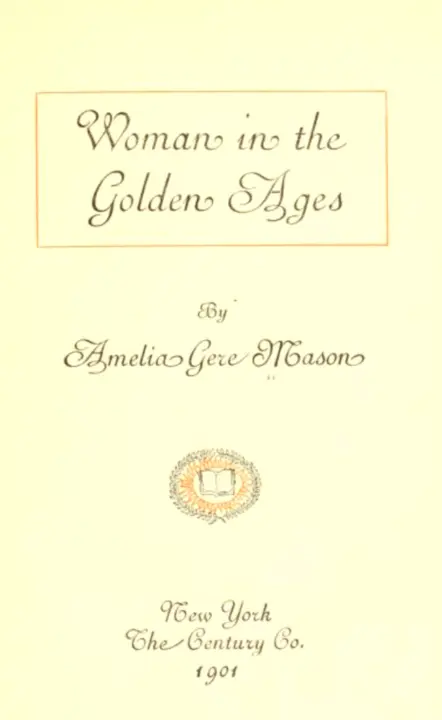
Woman in the golden ages
Amelia Gere Mason
THE CLASSIC COLLECTION · 1891
"The Women of the French Salons" by Amelia Gere Mason is a historical account written in the late 19th century. The book explores the influential roles of women in French salons, highlighting their contributions to society and culture over two centuries. It delves into the dynamic social gatherings where literary, philosophical, and artistic discussions thrived, showcasing the women who shaped and inspired intellectual thought in their era. The opening of the work provides a preface that sets the stage for an exploration of women's roles in salons, emphasizing their significant yet often understated contributions to civilization and social evolution. Mason reflects on the allure of these women, noting their mental vigor and societal influence, as well as the need to revisit this facet of history. The narrative acknowledges the works of male contemporaries who have documented these social circles while asserting its own premise of bringing forth a narrative that highlights women’s intellectual legacies. Mason establishes a framework for discussing the salons, indicating that her studies will focus on the women who represented the cognitive essence of their times, capturing how their interactions helped mold the rise of the modern woman.
Introduction adapted from the source catalogue; source summaries may be automatically generated.
Free to read · English · 91,802 words · No account needed
MAKE TIME FOR A GOOD BOOK
On by default. Untick to stop anonymous reading totals. Each page counts after 10 seconds in view. How this works.
Anonymous counting is on unless you have switched it off.
But Napoleon, who, like Louis XIV, sought to draw all influences and merge all power in himself, could not tolerate a woman whom he felt to be in some sense a rival. He thought he detected her hand in the address of Benjamin Constant which lost her so many friends. He feared the wit that flashed in her salon, the satire that wounded the criticism that measured his motives and his actions. He recognized the power of a coterie of brilliant intellects led by a genius so inspiring. His brothers, knowing her vulnerable point and the will with which she had to deal, gave her a word of caution. But the advice and intercession of her friends were alike without avail. The blow which she so much feared fell at last, and she found herself an exile and a wanderer from the scenes she most loved.
We have many pleasant glimpses of her life at Coppet, but a shadow always rests upon it. A few friends still cling to her through the bitter and relentless persecutions that form one of the most singular chapters in history, and offer the most remarkable tribute to her genius and her power. We find here Schlegel, Sismondi, Mathieu de Montmorency, Prince Augustus, Monti, Mme. Recamier, and many other distinguished visitors of various nationalities. The most prominent figure perhaps was Benjamin Constant, brilliant, gifted, eloquent, passionate, vain, and capricious, the torturing consolation and the stormy problem of her saddest years. She revived the old literary diversions. At eleven o'clock, we are told, the guests assembled at breakfast, and the conversations took a high literary tone. They were resumed at dinner, and continued often until midnight. Here, as elsewhere, Mme. de Stael was queen, holding her guests entranced by the magic of her words. "Life is for me like a ball after the music has ceased," said Sismondi when her voice was silent. She was a veritable Corinne in her esprit, her sentiment, her gift of improvisation, and her underlying melancholy. But in this choice company hers was not the only voice, though it was heard above all the others. Thought and wit flashed and sparkled. Dramas were played--the "Zaire" and "Tancred" of Voltaire, and tragedies written by herself. Mme. Recamier acted the Aricie to Mme. de Stael's Phedre. This life that seems to us so fascinating, has been described too often to need repetition. It had its tumultuous elements, its passionate undercurrents, its romantic episodes. But in spite of its attractions Mme. de Stael fretted under the peaceful shades of Coppet. Its limited horizon pressed upon her. The silence of the snowcapped mountains chilled her. She looked upon their solitary grandeur with "magnificent horror." The repose of nature was an "infernal peace" which plunged her into gloomier depths of ennui and despair. To some one who was admiring the beauties of Lake Leman she replied; "I should like better the gutters of the Rue du Bac." It was people, always people, who interested her. "French conversation exists only in Paris," she said, "and conversation has been from infancy my greatest pleasure." Restlessly she sought distraction in travel, but wherever she went the iron hand pressed upon her still. Italy fostered her melancholy. She loved its ruins, which her imagination draped with the fading colors of the past and associated with the desolation of a living soul. But its exquisite variety of landscape and color does not seem to have touched her. "If it were not for the world's opinion," she said, "I would not open my window to see the Bay of Naples for the first time, but I would travel five hundred leagues to talk with a clever man whom I have not met." Germany gave her infinite food for thought, but her "astonishing volubility," her "incessant movement," her constant desire to know, to discuss, to penetrate all things wearied the moderate Germans, as it had already wearied the serious English. "Tell me, Monsieur Fichte," she said one day, "could you in a short time, a quarter of an hour for example, give me a glimpse of your system and explain what you understand by your ME; I find it very obscure." The philosopher was amazed at what he thought her impertinence, but made the attempt through an interpreter. At the end of ten minutes she exclaimed, "That is sufficient, Monsieur Fichte. That is quite sufficient. I comprehend you perfectly. I have seen your system in illustration. It is one of the adventures of Baron Munchhausen." "We are in perpetual mental tension," said the wife of Schiller. Even Schiller himself grew tired. "It seems as if I were relieved of a malady," he said, when she left.
Your reading position is saved on this browser. Take it to another device with a library code. Reading pages adapt to text, rather than matching a printed edition.
Amelia Gere Mason
BEHIND THE BOOK
This eBook is for the use of anyone anywhere in the United States and most other parts of the world at no cost and with almost no restrictions whatsoever. You may copy it, give it away or re-use it under the terms of the Project Gutenberg License included with this eBook or online at www.gutenberg.org. If you are not located in the United States, you will have to check the laws of the country where you are located before using this eBook. Read the source licence.
The original source file, including credits and licence, is retained by this library. Request an original-format copy at no charge. Please include the book title and Project Gutenberg identifier #2528.
KEEP YOUR CURIOSITY GOING
Cécile Tormay

Moritz Busch
John L. Ransom
Frances Wright
Cécile Tormay

Mabel Potter Daggett