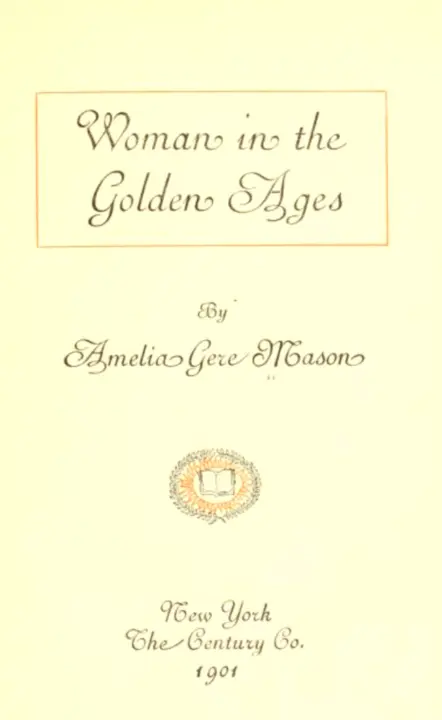
Woman in the golden ages
Amelia Gere Mason
THE CLASSIC COLLECTION · 1891
"The Women of the French Salons" by Amelia Gere Mason is a historical account written in the late 19th century. The book explores the influential roles of women in French salons, highlighting their contributions to society and culture over two centuries. It delves into the dynamic social gatherings where literary, philosophical, and artistic discussions thrived, showcasing the women who shaped and inspired intellectual thought in their era. The opening of the work provides a preface that sets the stage for an exploration of women's roles in salons, emphasizing their significant yet often understated contributions to civilization and social evolution. Mason reflects on the allure of these women, noting their mental vigor and societal influence, as well as the need to revisit this facet of history. The narrative acknowledges the works of male contemporaries who have documented these social circles while asserting its own premise of bringing forth a narrative that highlights women’s intellectual legacies. Mason establishes a framework for discussing the salons, indicating that her studies will focus on the women who represented the cognitive essence of their times, capturing how their interactions helped mold the rise of the modern woman.
Introduction adapted from the source catalogue; source summaries may be automatically generated.
Free to read · English · 91,802 words · No account needed
MAKE TIME FOR A GOOD BOOK
On by default. Untick to stop anonymous reading totals. Each page counts after 10 seconds in view. How this works.
Anonymous counting is on unless you have switched it off.
The Swiss Pastor's Daughter--Her Social Ambition--Her Friends--Mme. de Marchais--Mme. d'Houdetot--Duchesse de Lauzun--Character of Mme. Necker--Death at Coppet--Close of the most Brilliant Period of the Salons.
There was one woman who held a very prominent place in the society of this period, and who has a double interest for us, though she was not French, and never quite caught the spirit of the eighteenth-century life whose attractive forms she loved so well. Mme. Necker, whose history has been made so familiar through the interesting memoirs of the Comte d'Haussonville, owes her fame to her marked qualities of intellect and character rather than to the brilliancy of her social talents. These found an admirable setting in the surroundings which her husband's fortune and political career gave her. The Salon Helvetique had a distinctive color of its own, and was always tinged with the strong convictions and exalted ideals of the Swiss pastor's daughter, who passed through this world of intellectual affluence and moral laxity like a white angel of purity--in it, but not of it. The center of a choice and lettered circle which included the most noted men and women of her time, she brought into it not only rare gifts, a fine taste, and genuine literary enthusiasm, but the fresh charm of a noble character and a beautiful family life, with the instincts of duty and right conduct which she inherited from her simple Protestant ancestry. She lacked a little, however, in the tact, the ease, the grace, the spontaneity, which were the essential charm of the French women. Her social talents were a trifle theoretical. "She studied society," says one of her critics, "as she would a literary question." She had a theory of conducting a salon, as she had of life in general, and believed that study would attain everything. But the ability to do a thing superlatively well is by no means always implied in the knowledge of how it ought to be done. Social genius is as purely a gift of nature as poetry or music; and, of all others, it is the most subtle and indefinable. It was a long step from the primitive simplicity in which Suzanne Curchod passed her childhood on the borders of Lake Leman to the complex life of a Parisian salon; and the provincial beauty, whose fair face, soft blue eyes, dignified but slightly coquettish manner, brilliant intellect, and sparkling though sometimes rather learned conversation had made her a local queen, was quick to see her own shortcomings. She confessed that she had a new language to learn, and she never fully mastered it. "Mme. Necker has talent, but it is in a sphere too elevated for one to communicate with her," said Mme. du Deffand, though she was glad to go once a week to her suppers at Saint-Ouen, and admitted that in spite of a certain stiffness and coldness she was better fitted for society than most of the grandes dames. The salon of Mme. Necker marks a transition point between two periods, and had two quite distinct phases. One likes best to recall her in the freshness of her early enthusiasm, when she gave Friday dinners, modeled after those of Mme. Geoffrin, to men of letters, and received a larger world in the evening; when her guests were enlivened by the satire of Diderot, the anecdotes of Marmontel, the brilliancy or learning of Grimm, d'Alembert, Thomas, Suard, Buffon, the Abbe Raynal, and other wits of the day; when they discussed the affairs of the Academy and decided the fate of candidates; when they listened to the recitations of Mlle. Clairon, and the works of many authors known and unknown. It is interesting to recall that "Paul and Virginia" was first read here. But there was apt to be a shade of stiffness, and the conversation had sometimes too strong a flavor of pedantry. "No one knows better or feels more sensibly than you, my dear and very amiable friend," wrote Mme. Geoffrin, "the charm of friendship and its sweetness; no one makes others experience them more fully. But you will never attain that facility, that ease, and that liberty which give to society its perfect enjoyment." The Abbe Morellet complained of the austerity that always held the conversation within certain limits, and the gay little Abbe Galiani found fault with Mme. Necker's coldness and reserve, though he addresses her as his "Divinity" after his return to Naples, and his racy letters give us vivid and amusing pictures of these Fridays, which in his memory are wholly charming.
Your reading position is saved on this browser. Take it to another device with a library code. Reading pages adapt to text, rather than matching a printed edition.
Amelia Gere Mason
BEHIND THE BOOK
This eBook is for the use of anyone anywhere in the United States and most other parts of the world at no cost and with almost no restrictions whatsoever. You may copy it, give it away or re-use it under the terms of the Project Gutenberg License included with this eBook or online at www.gutenberg.org. If you are not located in the United States, you will have to check the laws of the country where you are located before using this eBook. Read the source licence.
The original source file, including credits and licence, is retained by this library. Request an original-format copy at no charge. Please include the book title and Project Gutenberg identifier #2528.
KEEP YOUR CURIOSITY GOING
Cécile Tormay

Moritz Busch
John L. Ransom
Frances Wright
Cécile Tormay

Mabel Potter Daggett