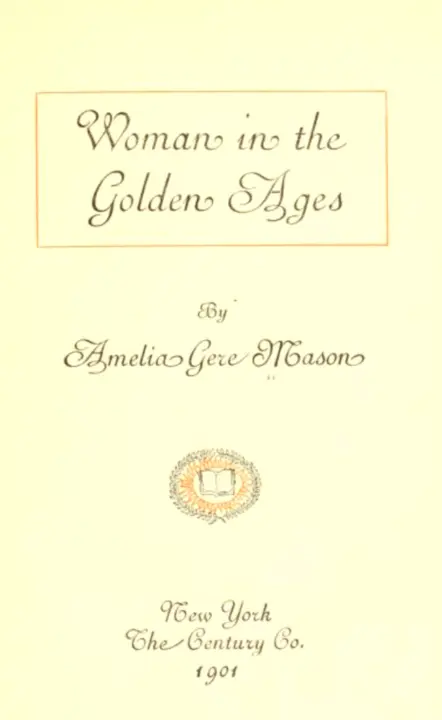
Woman in the golden ages
Amelia Gere Mason
THE CLASSIC COLLECTION · 1891
"The Women of the French Salons" by Amelia Gere Mason is a historical account written in the late 19th century. The book explores the influential roles of women in French salons, highlighting their contributions to society and culture over two centuries. It delves into the dynamic social gatherings where literary, philosophical, and artistic discussions thrived, showcasing the women who shaped and inspired intellectual thought in their era. The opening of the work provides a preface that sets the stage for an exploration of women's roles in salons, emphasizing their significant yet often understated contributions to civilization and social evolution. Mason reflects on the allure of these women, noting their mental vigor and societal influence, as well as the need to revisit this facet of history. The narrative acknowledges the works of male contemporaries who have documented these social circles while asserting its own premise of bringing forth a narrative that highlights women’s intellectual legacies. Mason establishes a framework for discussing the salons, indicating that her studies will focus on the women who represented the cognitive essence of their times, capturing how their interactions helped mold the rise of the modern woman.
Introduction adapted from the source catalogue; source summaries may be automatically generated.
Free to read · English · 91,802 words · No account needed
MAKE TIME FOR A GOOD BOOK
On by default. Untick to stop anonymous reading totals. Each page counts after 10 seconds in view. How this works.
Anonymous counting is on unless you have switched it off.
As the child who inherited the rather formidable name of Anne Theresa de Marguenat de Coucelles was born during the last days of the Hotel de Rambouillet, she doubtless cherished many illusions regarding this famous salon. Its influence was more or less apparent when the time came to open one of her own. Her father was a man of feeble intellect, who died early; but her mother, a woman more noted for beauty than for decorum, was afterward married to Bachaumont, a well-known bel esprit, who appreciated the gifts of the young girl, and brought her within a circle of wits who did far more towards forming her impressible mind than her light and frivolous mother had done. She was still very young when she became the wife of the Marquis de Lambert, an officer of distinction, to whose interests she devoted her talents and her ample fortune. The exquisitely decorated Hotel Lambert, on the Ile Saint Louis, still retains much of its old splendor, though the finest masterpieces of Lebrun and Lesueur which ornamented its walls have found their way to the Louvre. "It is a home made for a sovereign who would be a philosopher," wrote Voltaire to Frederick the Great. In these magnificent salons, Mme. de Lambert, surrounded by every luxury that wealth and taste could furnish, entertained a distinguished company. She carried her lavish hospitalities also to Luxembourg, where she adorned the position of her husband, who was governor of that province for a short period before his death in 1686. After this event, she was absorbed for some years in settling his affairs, which were left in great disorder, and in protecting the fortunes of her two children. This involved her in long and vexatious lawsuits which she seems to have conducted with admirable ability. "There are so few great fortunes that are innocent," she writes to her son, "that I pardon your ancestors for not leaving you one. I have done what I could to put in order our affairs, in which there is left to women only the glory of economy." It was not until the closing years of her life, from 1710 to 1733, that her social influence was at its height. She was past sixty, at an age when the powers of most women are on the wane, when her real career began. She fitted up luxurious apartments in the Palais Mazarin, employing artists like Watteau upon the decorations, and expending money as lavishly as if she had been in the full springtide of life, instead of the golden autumn. Then she gathered about her a choice and lettered society, which seemed to be a world apart, a last revival of the genius of the seventeenth century, and quite out of the main drift of the period. "She was born with much talent," writes one of her friends; "she cultivated it by assiduous reading; but the most beautiful flower in her crown was a noble and luminous simplicity, of which, at sixty years, she took it into her head to divest herself. She lent herself to the public, associated with the Academicians, and established at her house a bureau d'esprit." Twice a week she gave dinners, which were as noted for the cuisine as for the company, and included, among others, the best of the forty Immortals. Here new works were read or discussed, authors talked of their plans, and candidates were proposed for vacant chairs in the Academy. "The learned and the lettered formed the dominant element," says a critic of the time. "They dined at noon, and the rest of the day was passed in conversations, in readings, in literary and scientific discussions. No card tables; it was in ready wit that each one paid his contribution." Ennui never came to shed its torpors over these reunions, of which the Academy furnished the most distinguished guests, in company with grands seigneurs eager to show themselves as worthy by intelligence as by rank to play a role in these gatherings of the intellectual elite. Fontenelle was the presiding genius of this salon, and added to its critical and literary spirit a tinge of philosophy. This gallant savant, who was adored in society as "a man of rare and exquisite conversation," has left many traces of himself here. No one was so sparkling in epigram; no one talked so beautifully of love, of which he knew nothing; and no one talked to delightfully of science, of which he knew a great deal. But he thought that knowledge needed a seasoning of sentiment to make it palatable to women. In his "Pluralite des Mondes," a singular melange of science and sentiment, which he had written some years before and dedicated to a daughter of the gay and learned Mme. de La Sabliere, he talks about the stars, to la belle marquise, like a lover; but his delicate flatteries are the seasoning of serious truths. It was the first attempt to offer science sugar-coated, and suggests the character of this coterie, which prided itself upon a discreet mingling of elevated thought with decorous gaiety. The world moves. Imagine a female undergraduate of Harvard or Columbia taking her astronomy diluted with sentiment!
Your reading position is saved on this browser. Take it to another device with a library code. Reading pages adapt to text, rather than matching a printed edition.
Amelia Gere Mason
BEHIND THE BOOK
This eBook is for the use of anyone anywhere in the United States and most other parts of the world at no cost and with almost no restrictions whatsoever. You may copy it, give it away or re-use it under the terms of the Project Gutenberg License included with this eBook or online at www.gutenberg.org. If you are not located in the United States, you will have to check the laws of the country where you are located before using this eBook. Read the source licence.
The original source file, including credits and licence, is retained by this library. Request an original-format copy at no charge. Please include the book title and Project Gutenberg identifier #2528.
KEEP YOUR CURIOSITY GOING
Cécile Tormay

Moritz Busch
John L. Ransom
Frances Wright
Cécile Tormay

Mabel Potter Daggett