
Mother of Pearl
Anatole France

THE CLASSIC COLLECTION · 1922
"The Wicker Work Woman: A Chronicle of Our Own Times" by Anatole France is a novel written in the late 19th century. The story opens with M. Bergeret, a professor of literature, who reflects on his life and surroundings while preparing his lesson on Virgil's "Æneid". Through his introspective thoughts, we catch a glimpse of a man dissatisfied with his marriage and professional life, grappling with a sense of melancholy and yearning for a more vibrant existence. The opening of the novel introduces us to M. Bergeret in his cramped study, where the dreary environment and the dissonance of his daughters practicing piano contribute to his somber mood. As he muses over the beauty of the classical world and the irony of his mundane life, he is interrupted by his student, M. Roux, and later by a visit from Madame Bergeret, who adds to his troubled thoughts. The interactions reveal the professor's contempt for the military and those glorifying war, as well as his struggle with personal dissatisfaction, framed against the backdrop of societal norms and expectations. The poignant reflections of M. Bergeret set the tone for a narrative steeped in introspection and social critique.
Introduction adapted from the source catalogue; source summaries may be automatically generated.
Free to read · English · 58,823 words · No account needed
MAKE TIME FOR A GOOD BOOK
On by default. Untick to stop anonymous reading totals. Each page counts after 10 seconds in view. How this works.
Anonymous counting is on unless you have switched it off.
Georges Frémont actually was an old communard. A Parisian, the son of a furniture maker in the Faubourg Saint-Antoine, and a pupil at the Beaux-Arts, he was twenty at the time of the German invasion, and had enlisted in a regiment of francs-tireurs who never saw service. For this slight Frémont had never forgiven Trochu. At the time of the capitulation he was one of the most excited, and shouted with the rest that Paris had been betrayed. But he was no fool, and really meant that Paris had been badly defended, which was true enough, of course. He was for war to the knife. When the Commune was proclaimed, he declared for it. On the proposition of one of his father’s old workmen, a certain citizen Charlier, delegate for the Beaux-Arts, he was appointed assistant sub-director of the Museum of the Louvre. It was an honorary appointment and he performed his duties booted, with cartridges in his belt, and on his head a Tyrolese hat adorned with cock feathers. At the beginning of the siege the canvases had been rolled up, put into packing-cases and carried away to warehouses from which he never succeeded in unearthing them. The only duty that remained to him was to smoke his pipe in galleries that had been transformed into guard-rooms and to gossip with the National Guard, to whom he denounced Badinguet for having destroyed the Rubens pictures by a cleaning process which had removed the glaze. He based his grounds for this accusation on the authority of a newspaper article, backed up by M. Vitet’s opinion. The federalists sat on the benches and listened to him, with their guns between their legs, whilst they drank their pints of wine in the palace precincts, for it was warm weather. When, however, the people of Versailles forced their way into Paris by the broken-down Porte du Point-du-Jour and the cannonade approached the Tuileries, Georges Frémont was much distressed to see the National Guard of the federalists rolling casks of petroleum into the Apollo gallery. It was with great difficulty that he at length succeeded in dissuading them from saturating the wainscoting to make it blaze. Then, giving them money for drink, he got rid of them. After they had gone, he managed, with the assistance of the Bonapartist guards, to roll these dangerous casks to the foot of the staircase and to push them as far as the bank of the Seine. When the colonel of the federalists was informed of this, he suspected Frémont of betraying the popular cause and ordered him to be shot. But as soon as the Versailles mob was approaching and the smoke of the blazing Tuileries rising into the air, Frémont fled, cheek by jowl with the squad that had been ordered out to execute him. Two days later, being denounced to the Versailles party, he was a fugitive from the military tribunal for having taken part in a rebellion against the established Government. And it was perfectly certain that the Versailles party was in direct succession, since having followed the Empire on September 4th, 1870, it had adopted and retained the recognised procedure of the preceding Government, whilst the Commune, which had never succeeded in establishing those telegraphic communications that are absolutely essential to a recognised government, found itself undone and destroyed—and, in fact, very much in the wrong. Besides, the Commune was the outcome of a revolution carried out in face of the enemy, and this the Versailles administration could never forgive, for its origin recalled their own. It was for this reason that a captain of the winning side, being employed in shooting rebels in the neighbourhood of the Louvre, ordered his men to search for Frémont and shoot him. At last, after remaining in hiding for a fortnight with citizen Charlier, a member of the Commune, under a roof in the Place de la Bastille, Frémont left Paris in a smock-frock, with a whip in his hand, behind a market-gardener’s cart. And whilst a court-martial at Versailles was condemning him to death, he was earning his livelihood in London by drawing up a complete catalogue of Rowlandson’s works for a rich City amateur. Being an intelligent, industrious and honourable man, he soon became well known and respected among the English artists. He loved art passionately, but politics scarcely interested him at all. He remained friendly towards the Commune through loyalty alone and in order to avoid the shame of deserting vanquished friends. But he dressed well and moved in good society. He worked strenuously and, at the same time, knew how to profit by his work. His Dictionnaire des monogrammes not only established his reputation, but brought him in some money. After the amnesty had been passed and the last fluttering rags of civil strife had blown away, there landed at Boulogne, after Gambetta’s motion, a certain gentleman, haughty and smiling, yet not unsociable. He was youngish, but a little worn by work, and with a few grey hairs; he was correctly dressed in a travelling costume and carried a portmanteau packed with sketches and manuscripts. Establishing himself in modest style at Montmartre, Georges Frémont quickly became intimate with the artist colony there. But the labours upon the emoluments from which he had mainly supported himself in England only brought him the satisfaction of gratified vanity in France. Then Gambetta obtained for him an appointment as inspector of museums, and Frémont fulfilled his duties in this department both conscientiously and skilfully. He had a true and delicate taste in art. The nervous sensitiveness which had moved him deeply in his youth before the spectacle of his country’s wounds, still affected him, now that he was growing old, when confronted by unhappy social conditions, but enabled him, too, to derive delight from the graceful expression of human thought, from exquisite shapes, from the classic line, and the heroic cast of a face. With all this he was patriotic even in art, never jesting about the Burgundian school, faithful to political sentiment, and relying on France to bring justice and liberty to the universe.
Your reading position is saved on this browser. Take it to another device with a library code. Reading pages adapt to text, rather than matching a printed edition.
Anatole France

Anatole France
Anatole France
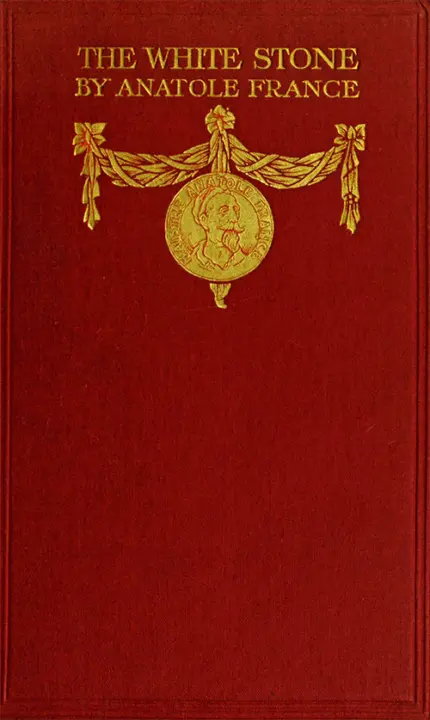
Anatole France
BEHIND THE BOOK
This eBook is for the use of anyone anywhere in the United States and most other parts of the world at no cost and with almost no restrictions whatsoever. You may copy it, give it away or re-use it under the terms of the Project Gutenberg License included with this eBook or online at www.gutenberg.org. If you are not located in the United States, you will have to check the laws of the country where you are located before using this eBook. Read the source licence.
The original source file, including credits and licence, is retained by this library. Request an original-format copy at no charge. Please include the book title and Project Gutenberg identifier #50286.
KEEP YOUR CURIOSITY GOING
Coulson Kernahan

Maurice Baring
Frances Wright
Cécile Tormay

Frederic Jesup Stimson

W. H. P. (William Henry Pope) Jarvis