
Mother of Pearl
Anatole France

THE CLASSIC COLLECTION · 1922
"The Wicker Work Woman: A Chronicle of Our Own Times" by Anatole France is a novel written in the late 19th century. The story opens with M. Bergeret, a professor of literature, who reflects on his life and surroundings while preparing his lesson on Virgil's "Æneid". Through his introspective thoughts, we catch a glimpse of a man dissatisfied with his marriage and professional life, grappling with a sense of melancholy and yearning for a more vibrant existence. The opening of the novel introduces us to M. Bergeret in his cramped study, where the dreary environment and the dissonance of his daughters practicing piano contribute to his somber mood. As he muses over the beauty of the classical world and the irony of his mundane life, he is interrupted by his student, M. Roux, and later by a visit from Madame Bergeret, who adds to his troubled thoughts. The interactions reveal the professor's contempt for the military and those glorifying war, as well as his struggle with personal dissatisfaction, framed against the backdrop of societal norms and expectations. The poignant reflections of M. Bergeret set the tone for a narrative steeped in introspection and social critique.
Introduction adapted from the source catalogue; source summaries may be automatically generated.
Free to read · English · 58,823 words · No account needed
MAKE TIME FOR A GOOD BOOK
On by default. Untick to stop anonymous reading totals. Each page counts after 10 seconds in view. How this works.
Anonymous counting is on unless you have switched it off.
“I was thinking that one day we might return to Paris. I like Paris for my part, but there we should hardly count.”
“Yet papa has great abilities. Sister Sainte-Marie-des-Anges said so once in class. She said: ‘Mademoiselle de Clavelin, your father has shown great administrative talents.’”
Madame Worms-Clavelin shook her head. “One wants so much money to live
in style in Paris.”
“You like Paris, mamma, but for my part I like the country best.”
“You know nothing about it, pet.”
“But, mamma, one doesn’t care only for what one knows.”
“There is, perhaps, some truth in what you say.”
“You haven’t heard, mamma?... I have won the prize for history composition. Madame de Saint-Joseph said I was the only one who had treated the subject thoroughly.”
Madame Worms-Clavelin asked gently:
“What subject?”
“The Pragmatic Sanction.”
Madame Worms-Clavelin asked, this time with an accent of real surprise:
“What is that?”
“It was one of Charles VII’s mistakes. It was, indeed, the greatest
mistake he ever made.”
Madame Worms-Clavelin found this answer by no means enlightening. But since she took no interest in the history of the Middle Ages, she was willing to let the matter drop. But Jeanne, who was full of her subject, went on in all seriousness:
“Yes, mamma. It was the greatest crime of that reign, a flagrant violation of the rights of the Holy See, a criminal robbery of the inheritance of St. Peter. But happily the error was set right by Francis I. And whilst we are on this subject, mamma, do you know we have found out that Alice’s governess was an old wanton?...”
Madame Worms-Clavelin begged her daughter anxiously and earnestly not to join her young friends in research work of this kind. Then she flew into a rage:
“You are perfectly absurd, Jeanne, for you use words without paying any
heed...”
Jeanne looked at her in mysterious silence. Then she said suddenly:
“Mamma, I must tell you that my drawers are in such a state that they are a positive sight. You know you have never been overwhelmingly interested in the question of linen. I don’t say this as a reproach, for one person goes in for linen, another for dresses, another for jewels. You, mamma, have always gone in for jewels. For my part it’s linen that I’m mad about.... And besides, we’ve just had a nine days’ prayer. I prayed hard both for you and for papa, I can tell you! And, then, I’ve earned four thousand nine hundred and thirty-seven days of indulgence.”
Your reading position is saved on this browser. Take it to another device with a library code. Reading pages adapt to text, rather than matching a printed edition.
Anatole France

Anatole France
Anatole France
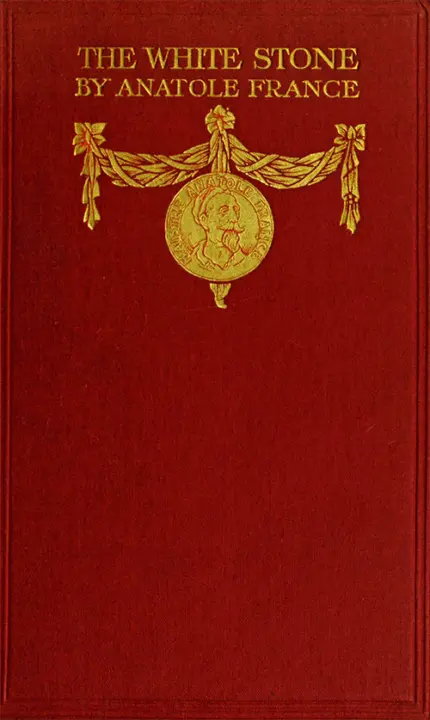
Anatole France
BEHIND THE BOOK
This eBook is for the use of anyone anywhere in the United States and most other parts of the world at no cost and with almost no restrictions whatsoever. You may copy it, give it away or re-use it under the terms of the Project Gutenberg License included with this eBook or online at www.gutenberg.org. If you are not located in the United States, you will have to check the laws of the country where you are located before using this eBook. Read the source licence.
The original source file, including credits and licence, is retained by this library. Request an original-format copy at no charge. Please include the book title and Project Gutenberg identifier #50286.
KEEP YOUR CURIOSITY GOING
Coulson Kernahan

Maurice Baring
Frances Wright
Cécile Tormay

Frederic Jesup Stimson

W. H. P. (William Henry Pope) Jarvis