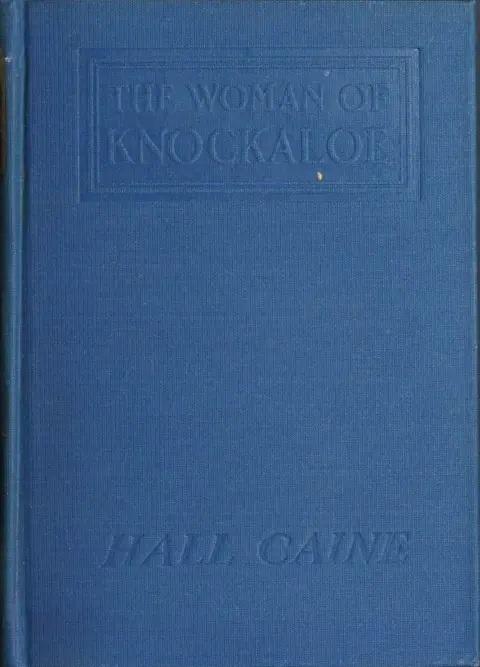
The Woman of Knockaloe: A Parable
Hall, Sir Caine
THE CLASSIC COLLECTION · 1909
"The White Prophet, Volume 2 (of 2)" by Sir Hall Caine is a historical novel written in the early 20th century. The book follows the intertwined lives of its central characters, Helena and Gordon, against a backdrop of political and personal conflict in the Sudan and Egypt. With themes of love, betrayal, vengeance, and the clash of cultures, it explores how individual actions can lead to sweeping consequences amid a volatile setting. At the start of the volume, Helena wakes to a tumultuous scene, as news arrives that Gordon, a key figure from her past, has arrived in Khartoum. Conflicted by her feelings for him and her current situation, she experiences an intense internal struggle, exacerbated by the implications of her recent actions that could lead to disaster for Ishmael, the man she is betrothed to. Meanwhile, Gordon grapples with his own emotions, haunted by the recognition of his role in Helena's misfortunes and the newfound reality of his imminent return to Cairo, which he believes could prevent an innocent man’s downfall. The opening draws readers into a world of tension and impending tragedy as the characters navigate their flawed decisions amidst the fervor of political uprising and personal loyalties.
Introduction adapted from the source catalogue; source summaries may be automatically generated.
Free to read · English · 103,517 words · No account needed
MAKE TIME FOR A GOOD BOOK
On by default. Untick to stop anonymous reading totals. Each page counts after 10 seconds in view. How this works.
Anonymous counting is on unless you have switched it off.
That day the Sirdar had held his secret meeting of the Ulema, the Sheikhs and Notables of Khartoum. Into a room on the ground floor of the Palace, down a dark, arched corridor, in which British soldiers stood on guard, they had been introduced one by one--a group of six or eight unkempt creatures of varying ages, and of different degrees of intelligence, nearly all wearing the farageeyah.
They sat awkwardly on the chairs which had been ranged for them about a mahogany table, and while they waited they talked in whispers. There was a tense, electrical atmosphere among them, as of internal dissension, the rumbling of a sort of subterranean thunder.
But this subsided instantly, when the voice of the sergeant outside, and the clash of saluting arms, announced the coming of the Sirdar. The Governor-General, who was in uniform and booted and spurred as if returning from a ride, was accompanied by his Inspector-General, his Financial Secretary, the Governor of the town, and various minor officers.
He was received by the Sheikhs, all standing, with sweeping salaams from floor to forehead, a circle of smiles and looks of complete accord.
The Sirdar, with his ruddy and cheerful face, took his seat at the head of the table and began by asking, as if casually, who was the stranger that had arrived that day in Khartoum.
"A Bedouin," said the Cadi. "One whom Ishmael Ameer loves and who loves
him."
"Yet a Bedouin, you say?" asked the Sirdar, in an incredulous tone, and with a certain elevation of the eyebrows.
"A Bedouin, O Excellency," repeated the Cadi, whereupon the others,
without a word of further explanation, bent their turbaned heads in
assent.
Then the Sirdar explained the reason for which he had called them
together.
"I am given to understand," he said, "that the idea is abroad that the Government has been trying to introduce changes into the immutable law of Islam, which forms an integral part of your Moslem religion, and is therefore rightly regarded with a high degree of veneration by all followers of the Prophet. If anybody is telling you this, or if any one is saying that there is any prejudice against you because you are Mohammedans, he is a wicked and mischievous person, and I beg of you to tell me who he is."
Saying this, the Sirdar looked sharply round the table, but met nothing but blank and expressionless faces. Then turning to the Cadi, who as Chief Judge of the Mohammedan law-courts had been constituted spokesman, he asked pointedly what Ishmael Ameer was saying.
"Nothing, O Excellency," said the Cadi; "nothing that is contrary to the Sharia--the religious law of Islam."
Your reading position is saved on this browser. Take it to another device with a library code. Reading pages adapt to text, rather than matching a printed edition.
Hall, Sir Caine
Hall, Sir Caine
Hall, Sir Caine
Hall, Sir Caine
BEHIND THE BOOK
This eBook is for the use of anyone anywhere in the United States and most other parts of the world at no cost and with almost no restrictions whatsoever. You may copy it, give it away or re-use it under the terms of the Project Gutenberg License included with this eBook or online at www.gutenberg.org. If you are not located in the United States, you will have to check the laws of the country where you are located before using this eBook. Read the source licence.
The original source file, including credits and licence, is retained by this library. Request an original-format copy at no charge. Please include the book title and Project Gutenberg identifier #52343.
KEEP YOUR CURIOSITY GOING
Cécile Tormay

Moritz Busch
Coulson Kernahan
John L. Ransom

Maurice Baring
Frances Wright