
The Wonderful Year
William John Locke
THE CLASSIC COLLECTION · 1900
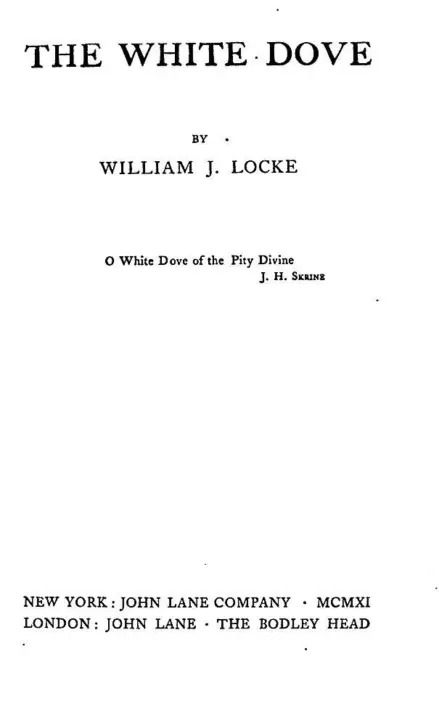
"The White Dove" by William John Locke is a novel written in the late 19th century. The story revolves around Sylvester Lanyon, a dedicated doctor who grapples with the memories of his deceased wife while navigating his relationships with those around him, particularly Ella Defries, a vibrant young woman who challenges his somber outlook on life. The novel explores themes of love, loss, and the complexities of human connection against the backdrop of a slow-paced, reflective life. The beginning of the novel introduces Sylvester in a thoughtful exchange with Ella, revealing their contrasting perspectives on life. While Ella advocates for embracing life's joys despite its struggles, Sylvester appears more guarded and introspective, weighed down by memories of loss. As their conversation unfolds, it becomes clear that Sylvester is on the cusp of significant change, having just sold his medical practice to pursue newfound ambitions in London. This pivotal moment sets the stage for the exploration of his character's internal conflict, laying the groundwork for the unfolding drama of relationships, societal expectations, and personal revelations throughout the story.
Introduction adapted from the source catalogue; source summaries may be automatically generated.
Free to read · English · 72,842 words · No account needed
MAKE TIME FOR A GOOD BOOK
On by default. Untick to stop anonymous reading totals. Each page counts after 10 seconds in view. How this works.
Anonymous counting is on unless you have switched it off.
A picture rose before him of the reprobate cringing before his father, wriggling at each sentence as at a whip lash, and going away with two more bottles of wine that would burn his dirty hands like hot bricks. He laughed, but Matthew thrust both hands in his pockets and stood with feet apart on the hearth-rug.
“Did you ever hear of such a mean skunk?”
“You will never fathom the depth of human meanness, father, if you live
to be a hundred.”
“I thank you for the compliment, Syl,” replied the old man, drily, “but I happen to think otherwise. May you never live to know it as I do.”
“Mr. Usher, sir,” said the servant, suddenly throwing open the door.
Matthew started, and glanced instinctively at his son. Sylvester, who had been struck by an unusual note of emotion in his father's voice, was looking at him curiously. So their eyes met in a mutual sensitive glance, and Matthew flushed slightly beneath his tanned and care-lined skin.
“Confound Usher!” muttered Sylvester, irritably.
An elderly man of about Matthew's age appeared, white-bearded, gold-spectacled, wearing a tightly buttoned frock-coat. He was of heavy build and had loose lips and dull watery eyes, the lids faintly rimmed with blood-red. He came forward into the room with extended hand.
“My dear friend, how are you this evening?” he said with a curious deliberation, as if he had duly sucked each word before he spat it out. “And, Sylvester, my dear lad, how are you? I have been very unwell to-day, and the weather has increased my sufferings. You notice that there is a wheezing in my bronchial tubes. Yet I thought I must come to see you this evening in spite of the weather. I said to Olivia, 'It is a duty, and I must fulfil it.'”
“Pray sit down, Usher,” said Matthew, politely. “Let me pass you the
port.”
“A little port wine would be very good for me. I cannot afford port wine, Matthew, like you, or I should drink it habitually. I should think this was very expensive.”
He smacked his loose lips and held the glass up to the light.
“It is a sound wine,” said Matthew.
“If you would not put too high a price on it,” said the other, in his monotonous voice, “perhaps I might buy some from you. What would you charge?”
“In the market it would fetch about a hundred and eighty shillings a dozen,” said Sylvester, savagely.
But his father raised a hand in courteous deprecation.
Your reading position is saved on this browser. Take it to another device with a library code. Reading pages adapt to text, rather than matching a printed edition.
William John Locke

William John Locke

William John Locke

William John Locke
BEHIND THE BOOK
This eBook is for the use of anyone anywhere in the United States and most other parts of the world at no cost and with almost no restrictions whatsoever. You may copy it, give it away or re-use it under the terms of the Project Gutenberg License included with this eBook or online at www.gutenberg.org. If you are not located in the United States, you will have to check the laws of the country where you are located before using this eBook. Read the source licence.
The original source file, including credits and licence, is retained by this library. Request an original-format copy at no charge. Please include the book title and Project Gutenberg identifier #56013.
KEEP YOUR CURIOSITY GOING
Coulson Kernahan

Maurice Baring
Frances Wright
Cécile Tormay

Frederic Jesup Stimson

W. H. P. (William Henry Pope) Jarvis