
The Wonderful Year
William John Locke
THE CLASSIC COLLECTION · 1900
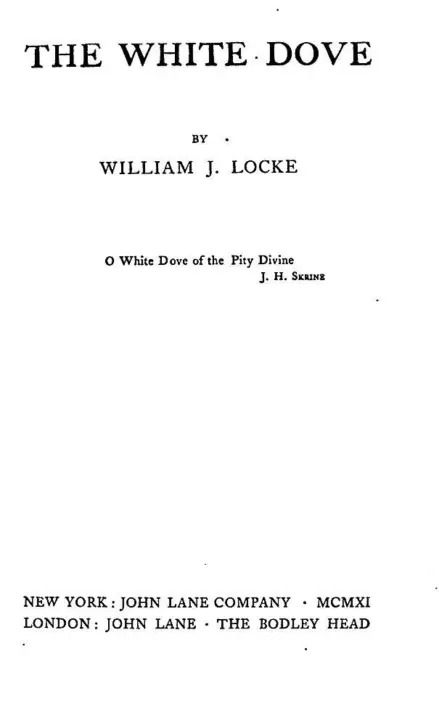
"The White Dove" by William John Locke is a novel written in the late 19th century. The story revolves around Sylvester Lanyon, a dedicated doctor who grapples with the memories of his deceased wife while navigating his relationships with those around him, particularly Ella Defries, a vibrant young woman who challenges his somber outlook on life. The novel explores themes of love, loss, and the complexities of human connection against the backdrop of a slow-paced, reflective life. The beginning of the novel introduces Sylvester in a thoughtful exchange with Ella, revealing their contrasting perspectives on life. While Ella advocates for embracing life's joys despite its struggles, Sylvester appears more guarded and introspective, weighed down by memories of loss. As their conversation unfolds, it becomes clear that Sylvester is on the cusp of significant change, having just sold his medical practice to pursue newfound ambitions in London. This pivotal moment sets the stage for the exploration of his character's internal conflict, laying the groundwork for the unfolding drama of relationships, societal expectations, and personal revelations throughout the story.
Introduction adapted from the source catalogue; source summaries may be automatically generated.
Free to read · English · 72,842 words · No account needed
MAKE TIME FOR A GOOD BOOK
On by default. Untick to stop anonymous reading totals. Each page counts after 10 seconds in view. How this works.
Anonymous counting is on unless you have switched it off.
The desultory talk had drooped. Suddenly Matthew Lanyon plunged his hand in the breast pocket of his dress-coat and drew out an old-fashioned miniature, which, after regarding it for a few moments, he handed to Sylvester.
“I've been rummaging about to-day and found this. Perhaps you'd like to
have it.”
“My mother!” said Sylvester.
It was a portrait, on ivory, of a singularly sweet face, possessing the tender, unearthly purity of one of Lorenzo di Credi's Madonnas, executed when the original was very young, a few months, in fact, before Sylvester was born.
“A very good likeness,” said Matthew.
“I shall be glad to keep it,” replied the son, putting it into his
pocket.
“I thought you would,” assented the elder.
“It will be a companion to my miniature of Constance,” said Sylvester.
And then silence came again; for memories crowded into the minds of each that they knew not how to speak of. Yet each knew that the other was thinking of his dead wife and wished that he could burst the strange bonds of reserve that held him and speak out that which was in his heart.
“It's a devil of a muddle, isn't it?” said Matthew at last.
“What?”
“The cosmos. And the more one tries to establish order, the worse confounded becomes the confusion. The high gods seem to have given it up as a bad job.”
“That reminds me,” said Sylvester, with a laugh. “I found Billings to-day having a glorious drunk on champagne. For a man earning twenty-five shillings a week, with a large family to support and a wife half dying of pneumonia, I thought it rather strong.”
Matthew rose from his chair, his brows bent and his eyes kindling with
sudden anger.
“The damned hound! What did you do with him?”
“I took him outside so as not to disturb his wife and then I kicked him until he was sober,” replied Sylvester, grimly. “I wonder who could have sent the champagne.”
“Some silly fool,” said Matthew, nursing his wrath.
“Yet nearer to heaven than most of us,” said Sylvester, knocking the ash
off his cigar.
“Rubbish!” said Matthew. “Besides, silly fools don't go to heaven. There's no place for 'em.”
“I don't think Billings will rob his wife again,” remarked Sylvester.
“Well, you can send him up to me in the morning.”
“I think he'd sooner have another kicking,” laughed Sylvester.
Your reading position is saved on this browser. Take it to another device with a library code. Reading pages adapt to text, rather than matching a printed edition.
William John Locke

William John Locke

William John Locke

William John Locke
BEHIND THE BOOK
This eBook is for the use of anyone anywhere in the United States and most other parts of the world at no cost and with almost no restrictions whatsoever. You may copy it, give it away or re-use it under the terms of the Project Gutenberg License included with this eBook or online at www.gutenberg.org. If you are not located in the United States, you will have to check the laws of the country where you are located before using this eBook. Read the source licence.
The original source file, including credits and licence, is retained by this library. Request an original-format copy at no charge. Please include the book title and Project Gutenberg identifier #56013.
KEEP YOUR CURIOSITY GOING
Coulson Kernahan

Maurice Baring
Frances Wright
Cécile Tormay

Frederic Jesup Stimson

W. H. P. (William Henry Pope) Jarvis