The Belt of Seven Totems: A Story of Massasoit
Kirk Munroe
THE CLASSIC COLLECTION · 1893
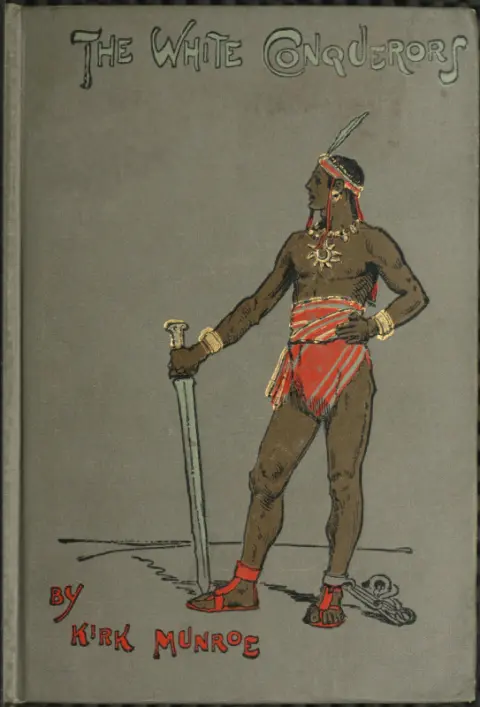
"The White Conquerors: A Tale of Toltec and Aztec" by Kirk Munroe is a historical novel written in the late 19th century. The story unfolds during the time of the Aztec Empire and focuses on the clash between the indigenous peoples and the Spanish conquistadors, specifically centered around the character Tlahuicol, a valorous war-chief of the Tlascala, who becomes a prisoner of the Aztecs. As tensions mount in Tenochtitlan, the narrative explores themes of resistance, identity, and the impact of foreign invaders on ancient cultures. At the start of the tale, the festivities in Tenochtitlan loom over the impending sacrifice of Tlahuicol, who remains defiant despite his capture. The night before the great festival dedicated to the Aztecs’ calendar stone sets a somber tone as Tlahuicol reflects on his family and the harsh reality of the Aztec's oppressive rule. Meanwhile, Montezuma, king of the Aztecs, grapples with the unsettling news of white-skinned beings landing on the coast, heralding impending conflict. The chapter establishes a rich backdrop of Aztec culture and highlights Tlahuicol's complex identity and spirit of rebellion against his captors, setting the stage for the ensuing struggles and the fateful intersection of indigenous and European worlds.
Introduction adapted from the source catalogue; source summaries may be automatically generated.
Free to read · English · 74,499 words · No account needed
MAKE TIME FOR A GOOD BOOK
On by default. Untick to stop anonymous reading totals. Each page counts after 10 seconds in view. How this works.
Anonymous counting is on unless you have switched it off.
The first impulse of Marina's preservers was to escape as quickly as possible from their awful surroundings. The spell that had held them in that vicinity was broken. They had snatched one victim from the jaws of death, and now they must remove her beyond reach of further danger. Instinctively they headed their canoe in the direction of the little hut, on the opposite side of the lake, that had for so long been their home. They had not gone far when, as though moved by a single impulse, both stopped paddling at the same instant.
"It is no longer possible that we should go back," said the old man.
"For we should be taking another into slavery," continued the old woman.
"Nor would we return to slavery for ourselves, even if there were no
other."
"It is certain that we would not," agreed the wife.
"But whither shall we fly?" asked the old man, irresolutely.
"Ask the child; since she called on the son of Tlahuicol for aid she must be of our friends, and also she must be possessed of wisdom."
Marina, who had ceased to sob, and now lay quietly beneath the warm rabbit-hair blanket that the old woman had spread over her, listened to this conversation. Who could these people be? They did not talk like enemies bearing her to the altar of sacrifice. At any rate, a question could do no harm.
"Whither are you taking me?" she asked.
"Whither you would go," replied the gentle voice of the old woman.
"I would go to my friends. To Huetzin, and Sandoval, and Malinche, and the daughters of the king, who are captives."
"Where are they?"
"I know not, but I fear me they are dead. Who are you? You are not
Aztecs."
"We are Tlascalans, and friends of the son of Tlahuicol, whom we seek,"
was the proud answer.
"I thought you were Tlascalans from your speech!" cried the girl, joyfully. "As such you must be my friends, and as friends of Huetzin you must be doubly my friends."
"Is he thy brother?" queried the old man, remembering that Huetzin had
spoken of a sister.
"No."
"Thy husband?"
"No."
"What then----?"
"Hush, thou stupid!" exclaimed the old woman, "and waste not time in idle questionings. We be escaped Tlascalan slaves," she continued, speaking to Marina, "seeking the son of Tlahuicol, who has some knowledge of us, and who we trusted would aid us to freedom. Now we know not which way to turn, and would ask thy counsel."
"Will you in truth do as I advise?" asked Marina, who could scarcely credit her good fortune in falling into such friendly hands.
"In truth we will."
Your reading position is saved on this browser. Take it to another device with a library code. Reading pages adapt to text, rather than matching a printed edition.
BEHIND THE BOOK
This eBook is for the use of anyone anywhere in the United States and most other parts of the world at no cost and with almost no restrictions whatsoever. You may copy it, give it away or re-use it under the terms of the Project Gutenberg License included with this eBook or online at www.gutenberg.org. If you are not located in the United States, you will have to check the laws of the country where you are located before using this eBook. Read the source licence.
The original source file, including credits and licence, is retained by this library. Request an original-format copy at no charge. Please include the book title and Project Gutenberg identifier #47810.
KEEP YOUR CURIOSITY GOING
Wilfrid Scawen Blunt
Wilfrid Scawen Blunt

E. W. (Edgar Watson) Howe
Cécile Tormay

Moritz Busch
Coulson Kernahan