Mary Regan
Leroy Scott
THE CLASSIC COLLECTION · 1905
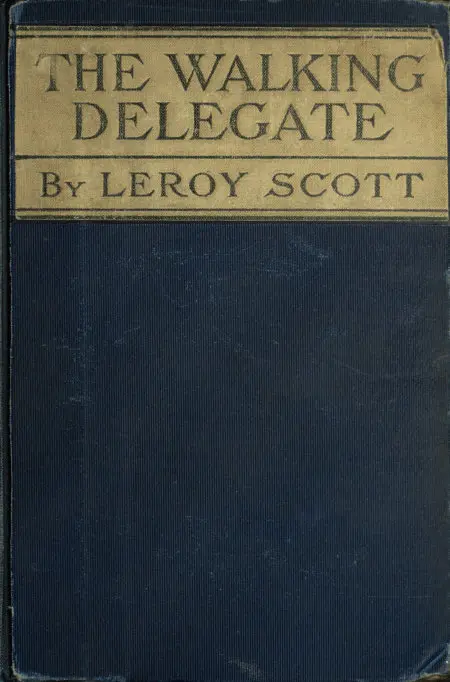
"The Walking Delegate" by Leroy Scott is a novel written in the early 20th century. The story centers around Tom Keating, a foreman in the ironworkers' union, who is embroiled in a power struggle against Buck Foley, the corrupt walking delegate. The narrative delves into themes of labor rights, integrity, and the personal and professional challenges faced by workers in a rapidly industrializing society. At the start of the novel, we find ourselves at the St. Etienne Hotel construction site, where Tom diligently oversees the work of his crew amidst harsh winter winds and the looming presence of Foley. As accidents and tensions mount, it becomes evident that the workers are increasingly frustrated with Foley's iron-fisted control and corruption within the union. The opening chapters introduce key characters and lay the groundwork for the evolving conflict between Tom's desire for honest representation and Foley’s self-serving tactics, setting the stage for a gripping tale of loyalty, struggle, and the quest for justice in the gritty world of labor.
Introduction adapted from the source catalogue; source summaries may be automatically generated.
Free to read · English · 91,212 words · No account needed
MAKE TIME FOR A GOOD BOOK
On by default. Untick to stop anonymous reading totals. Each page counts after 10 seconds in view. How this works.
Anonymous counting is on unless you have switched it off.
Tom, however, had attached Foley to the case--he had seen the reporters start at his words as at a fresh sensation--and he gave a look of satisfaction at Foley as he stepped away from the judge's desk. Foley gave back a half-covered sneer, as if to say, "Just youse wait!"
Arkansas was the first of the prisoners to be called--the reason for which priority, as Tom afterwards guessed, being his anomalous face that would not have ill-suited a vest that buttoned to the chin and a collar that buttoned at the back. Arkansas, replying to the questions of his long-haired attorney, corroborated the testimony of the policemen and the Pinkertons in every detail. When Arkansas had answered the last query the lawyer allowed several seconds to pass, his figure drawn up impressively, his right hand in the breast of his frock coat.
The judge bent over his docket and began to write. "This seems a perfectly plain case. I hold the three prisoners for the grand jury, each in ten thousand----"
The attorney's right hand raised itself theatrically. "Hold!" he cried.
The judge looked up with a start. Tom's eyes, wandering to Foley's face, met there a malign grin.
"The case is not ended, your Honor. The case is just begun." The attorney brushed back his mane with a stagy movement of his hand, and turned upon Arkansas. "You and the other prisoners did this. You do not deny it. But now tell his Honor why you did it."
Arkansas, with honesty fairly obtruding from his every feature, looked nervously at Tom, and then said hesitantly: "Because we had to."
"And why did you have to?"
Again Arkansas showed hesitation.
"Speak out," encouraged the attorney. "You're in no danger. The court
will protect you."
"We was ordered to. If we hadn't done it we'd been thrown out o' the
union, an' been done up."
"Explain to the court what you mean by 'done up'."
"Slugged an' kicked--half killed."
"In other words, what you did was done in fear of your life. Now who ordered you to blow up the Avon, and threatened to have you 'done up' if you didn't?"
"Mr. Keating, the president o' the union."
The judge, who had been leaning forward with kindling eyes, breathed a
prolonged "A-a-ah!"
For a moment Tom was astounded. Then he sprang to Arkansas's side. "You infernal liar!" he shouted, his eyes blazing.
The judge's hammer thundered down. "Silence!" he roared.
"But, your Honor, he's lying!"
"Five dollars for contempt of court! Another word and I'll give you the
full penalty."
Your reading position is saved on this browser. Take it to another device with a library code. Reading pages adapt to text, rather than matching a printed edition.
BEHIND THE BOOK
This eBook is for the use of anyone anywhere in the United States and most other parts of the world at no cost and with almost no restrictions whatsoever. You may copy it, give it away or re-use it under the terms of the Project Gutenberg License included with this eBook or online at www.gutenberg.org. If you are not located in the United States, you will have to check the laws of the country where you are located before using this eBook. Read the source licence.
The original source file, including credits and licence, is retained by this library. Request an original-format copy at no charge. Please include the book title and Project Gutenberg identifier #41154.
KEEP YOUR CURIOSITY GOING
Coulson Kernahan

Maurice Baring
Frances Wright
Cécile Tormay

Frederic Jesup Stimson

W. H. P. (William Henry Pope) Jarvis