
My study windows
James Russell Lowell
THE CLASSIC COLLECTION · 1848
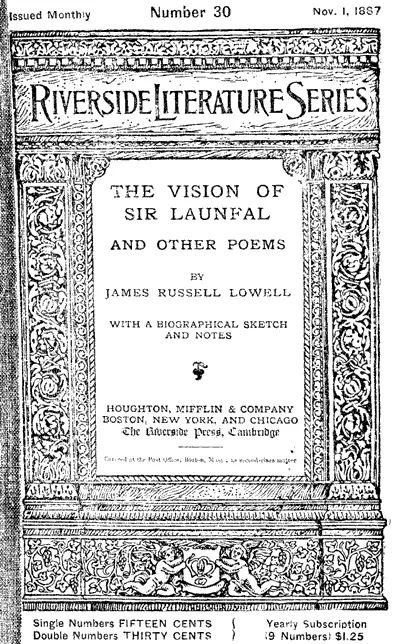
"The Vision of Sir Launfal" by James Russell Lowell is a poem written in the mid-19th century. It draws upon Arthurian legend to convey moral and social themes, focusing on the titular character, Sir Launfal, as he embarks on a quest for the Holy Grail. The poem explores topics such as charity, humanity, and the essence of true nobility, wherein the protagonist learns that true giving transcends material wealth. The opening of this work introduces us to Sir Launfal, a young knight eager to embark on his quest for the Holy Grail, a symbol of divine grace. As Launfal prepares for his journey, he encounters a leper who begs for alms, and upon recoiling in disgust, he gives a piece of gold but fails to recognize the human beneath the man’s suffering. The stark contrast between Launfal’s noble aspirations and his initial disdain for poverty sets the foundation for a life-altering revelation as the story unfolds. This initial encounter emphasizes the poem's central message that true honor lies in compassionate action toward those in need, setting the stage for Launfal's transformative quest.
Introduction adapted from the source catalogue; source summaries may be automatically generated.
Free to read · English · 24,954 words · No account needed
MAKE TIME FOR A GOOD BOOK
On by default. Untick to stop anonymous reading totals. Each page counts after 10 seconds in view. How this works.
Anonymous counting is on unless you have switched it off.
They knew not how he learned at all, 25
For idly, hour by hour,
He sat and watched the dead leaves fall,
Or mused upon a common flower.
It seemed the loveliness of things Did teach him all their use, 30 For, in mere weeds, and stones, and springs, He found a healing power profuse.
Men granted that his speech was wise, But, when a glance they caught Of his slim grace and woman's eyes, 35 They laughed, and called him good-for-naught.
Yet after he was dead and gone,
And e'en his memory dim,
Earth seemed more sweet to live upon,
More full of love, because of him. 40
And day by day more holy grew
Each spot where he had trod,
Till after-poets only knew
Their first-born brother as a god.
[In the year 1844, which is the date of the following poem, the question of the annexation of Texas was pending, and it was made an issue of the presidential campaign then taking place. The anti-slavery party feared and opposed annexation, on account of the added strength which it would give to slavery, and the South desired it for the same reason.]
When a deed is done for Freedom, through the broad earth's aching breast Runs a thrill of joy prophetic, trembling on from east to west, And the slave, where'er he cowers, feels the soul within him climb To the awful verge of manhood, as the energy sublime Of a century bursts full-blossomed on the thorny stem of Time. 5
Through the walls of hut and palace shoots the instantaneous throe, When the travail of the Ages wrings earth's systems to and fro; At the birth of each new Era, with a recognizing start, Nation wildly looks at nation, standing with mute lips apart, And glad Truth's yet mightier man-child leaps beneath the Future's heart. 10
So the Evil's triumph sendeth, with a terror and a chill, Under continent to continent, the sense of coming ill, And the slave, where'er he cowers, feels his sympathies with God In hot tear-drops ebbing earthward, to be drunk up by the sod, Till a corpse crawls round unburied, delving in the nobler clod. 15
For mankind are one in spirit, and an instinct bears along, Round the earth's electric circle, the swift flash of right or wrong;[27] Whether conscious or unconscious, yet Humanity's vast frame Through its ocean-sundered fibres feels the gush of joy or shame;-- In the gain or loss of one race all the rest have equal claim. 20
[Footnote 27: This figure has special force from the fact that Morse's telegraph was first put in operation a few months before the writing of this poem.]
Your reading position is saved on this browser. Take it to another device with a library code. Reading pages adapt to text, rather than matching a printed edition.
James Russell Lowell
James Russell Lowell
James Russell Lowell

James Russell Lowell
BEHIND THE BOOK
This eBook is for the use of anyone anywhere in the United States and most other parts of the world at no cost and with almost no restrictions whatsoever. You may copy it, give it away or re-use it under the terms of the Project Gutenberg License included with this eBook or online at www.gutenberg.org. If you are not located in the United States, you will have to check the laws of the country where you are located before using this eBook. Read the source licence.
The original source file, including credits and licence, is retained by this library. Request an original-format copy at no charge. Please include the book title and Project Gutenberg identifier #17119.
KEEP YOUR CURIOSITY GOING

Maurice Baring
Francis Greenleaf Allinson & Anne C. E. (Anne Crosby Emery) Allinson

Eric Mackay
Edmund Gosse
Sophia Margaretta Hensley
Stuart Dodgson Collingwood