
My study windows
James Russell Lowell
THE CLASSIC COLLECTION · 1848
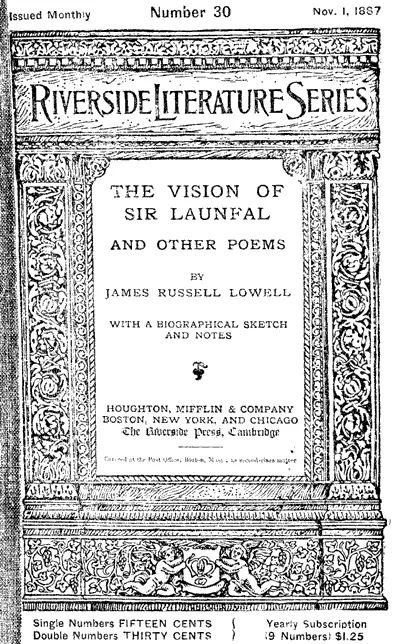
"The Vision of Sir Launfal" by James Russell Lowell is a poem written in the mid-19th century. It draws upon Arthurian legend to convey moral and social themes, focusing on the titular character, Sir Launfal, as he embarks on a quest for the Holy Grail. The poem explores topics such as charity, humanity, and the essence of true nobility, wherein the protagonist learns that true giving transcends material wealth. The opening of this work introduces us to Sir Launfal, a young knight eager to embark on his quest for the Holy Grail, a symbol of divine grace. As Launfal prepares for his journey, he encounters a leper who begs for alms, and upon recoiling in disgust, he gives a piece of gold but fails to recognize the human beneath the man’s suffering. The stark contrast between Launfal’s noble aspirations and his initial disdain for poverty sets the foundation for a life-altering revelation as the story unfolds. This initial encounter emphasizes the poem's central message that true honor lies in compassionate action toward those in need, setting the stage for Launfal's transformative quest.
Introduction adapted from the source catalogue; source summaries may be automatically generated.
Free to read · English · 24,954 words · No account needed
MAKE TIME FOR A GOOD BOOK
On by default. Untick to stop anonymous reading totals. Each page counts after 10 seconds in view. How this works.
Anonymous counting is on unless you have switched it off.
Warm noon brims full the valley's cup, 5
The aspen's leaves are scarce astir;
Only the little mill sends up
Its busy, never-ceasing burr.
Climbing the loose-piled wall that hems The road along the mill-pond's brink, 10 From 'neath the arching barberry-stems, My footstep scares the shy chewink.
Beneath a bony buttonwood
The mill's red door lets forth the din;
The whitened miller, dust-imbued, 15
Flits past the square of dark within.
No mountain torrent's strength is here; Sweet Beaver, child of forest still,[26] Heaps its small pitcher to the ear, And gently waits the miller's will. 20
Swift slips Undine along the race
Unheard, and then, with flashing bound,
Floods the dull wheel with light and grace,
And, laughing, hunts the loath drudge round.
The miller dreams not at what cost 25
The quivering millstones hum and whirl,
Nor how for every turn are tost
Armfuls of diamond and of pearl.
But Summer cleared my happier eyes
With drops of some celestial juice, 30
To see how Beauty underlies,
Forevermore each form of use.
And more; methought I saw that flood, Which now so dull and darkling steals, Thick, here and there, with human blood, 35 To turn the world's laborious wheels.
[Footnote 26: Beaver Brook was within walking distance of the poet's home. See The Nightingale in the Study.]
No more than doth the miller there,
Shut in our several cells, do we
Know with what waste of beauty rare
Moves every day's machinery. 40
Surely the wiser time shall come
When this fine overplus of might,
No longer sullen, slow, and dumb,
Shall leap to music and to light.
In that new childhood of the Earth 45 Life of itself shall dance and play, Fresh blood in Time's shrunk veins make mirth, And labor meet delight half way.
There came a youth upon the earth,
Some thousand years ago,
Whose slender hands were nothing worth,
Whether to plough, or reap, or sow.
Upon an empty tortoise-shell 5 He stretched some chords, and drew Music that made men's bosoms swell Fearless, or brimmed their eyes with dew.
Then King Admetus, one who had
Pure taste by right divine, 10
Decreed his singing not too bad
To hear between the cups of wine:
And so, well pleased with being soothed
Into a sweet half-sleep,
Three times his kingly beard he smoothed, 15
And made him viceroy o'er his sheep.
His words were simple words enough,
And yet he used them so,
That what in other mouths was rough
In his seemed musical and low. 20
Men called him but a shiftless youth,
In whom no good they saw;
And yet, unwittingly, in truth,
They made his careless words their law.
Your reading position is saved on this browser. Take it to another device with a library code. Reading pages adapt to text, rather than matching a printed edition.
James Russell Lowell
James Russell Lowell
James Russell Lowell

James Russell Lowell
BEHIND THE BOOK
This eBook is for the use of anyone anywhere in the United States and most other parts of the world at no cost and with almost no restrictions whatsoever. You may copy it, give it away or re-use it under the terms of the Project Gutenberg License included with this eBook or online at www.gutenberg.org. If you are not located in the United States, you will have to check the laws of the country where you are located before using this eBook. Read the source licence.
The original source file, including credits and licence, is retained by this library. Request an original-format copy at no charge. Please include the book title and Project Gutenberg identifier #17119.
KEEP YOUR CURIOSITY GOING

Maurice Baring
Francis Greenleaf Allinson & Anne C. E. (Anne Crosby Emery) Allinson

Eric Mackay
Edmund Gosse
Sophia Margaretta Hensley
Stuart Dodgson Collingwood