
My study windows
James Russell Lowell
THE CLASSIC COLLECTION · 1848
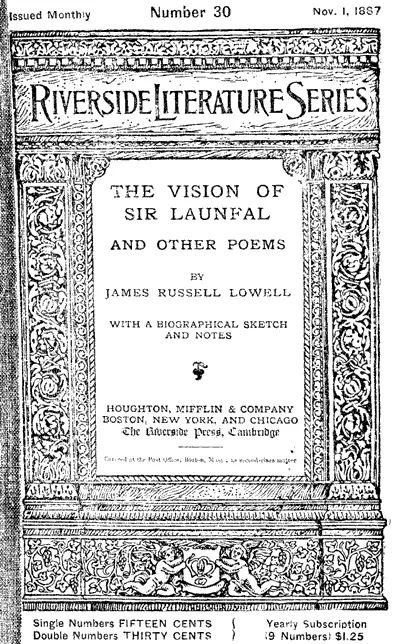
"The Vision of Sir Launfal" by James Russell Lowell is a poem written in the mid-19th century. It draws upon Arthurian legend to convey moral and social themes, focusing on the titular character, Sir Launfal, as he embarks on a quest for the Holy Grail. The poem explores topics such as charity, humanity, and the essence of true nobility, wherein the protagonist learns that true giving transcends material wealth. The opening of this work introduces us to Sir Launfal, a young knight eager to embark on his quest for the Holy Grail, a symbol of divine grace. As Launfal prepares for his journey, he encounters a leper who begs for alms, and upon recoiling in disgust, he gives a piece of gold but fails to recognize the human beneath the man’s suffering. The stark contrast between Launfal’s noble aspirations and his initial disdain for poverty sets the foundation for a life-altering revelation as the story unfolds. This initial encounter emphasizes the poem's central message that true honor lies in compassionate action toward those in need, setting the stage for Launfal's transformative quest.
Introduction adapted from the source catalogue; source summaries may be automatically generated.
Free to read · English · 24,954 words · No account needed
MAKE TIME FOR A GOOD BOOK
On by default. Untick to stop anonymous reading totals. Each page counts after 10 seconds in view. How this works.
Anonymous counting is on unless you have switched it off.
So, from the pinched soil of a churlish fate, True hearts compel the sap of sturdier growth, So between earth and heaven stand simply great, 35 That these shall seem but their attendants both; For nature's forces with obedient zeal Wait on the rooted faith and oaken will; As quickly the pretender's cheat they feel, And turn mad Pucks to flout and mock him still.[18] 40
Lord! all Thy works are lessons; each contains Some emblem of man's all-containing soul; Shall he make fruitless all Thy glorious pains, Delving within Thy grace an eyeless mole? Make me the least of thy Dodona-grove,[19] 45 Cause me some message of thy truth to bring, Speak but a word to me, nor let thy love Among my boughs disdain to perch and sing.
[Footnote 18: See Shakspeare's A Midsummer Night's Dream.]
[Footnote 19: A grove of oaks at Dodona, in ancient Greece, was the
seat of a famous oracle.]
[The classic legend of Prometheus underwent various changes in successive periods of Greek thought. In its main outline the story is the same: that Prometheus, whose name signifies Forethought, stole fire from Zeus, or Jupiter, or Jove, and gave it as a gift to man. For this, the angry god bound him upon Mount Caucasus, and decreed that a vulture should prey upon his liver, destroying every day what was renewed in the night. The struggle of man's thought to free itself from the tyranny of fear and superstition and all monsters of the imagination is illustrated in the myth. The myth is one which has been a favorite with modern poets, as witness Goethe, Shelley, Mrs. Browning, and Longfellow.]
One after one the stars have risen and set, Sparkling upon the hoarfrost on my chain: The Bear, that prowled all night about the fold Of the North-Star, hath shrunk into his den, Scared by the blithesome footsteps of the Dawn, 5 Whose blushing smile floods all the Orient; And now bright Lucifer grows less and less, Into the heaven's blue quiet deep-withdrawn. Sunless and starless all, the desert sky Arches above me, empty as this heart 10 For ages hath been empty of all joy, Except to brood upon its silent hope, As o'er its hope of day the sky doth now. All night have I heard voices: deeper yet The deep low breathing of the silence grew. 15 While all about, muffled in awe, there stood Shadows, or forms, or both, clear-felt at heart, But, when I turned to front them, far along Only a shudder through the midnight ran, And the dense stillness walled me closer round. 20 But still I heard them wander up and down That solitude, and flappings of dusk wings Did mingle with them, whether of those hags Let slip upon me once from Hades deep, Or of yet direr torments, if such be, 25 I could but guess; and then toward me came A shape as of a woman: very pale It was, and calm; its cold eyes did not move, And mine moved not, but only stared on them. Their fixed awe went through my brain like ice; 30 A skeleton hand seemed clutching at my heart, And a sharp chill, as if a dank night fog Suddenly closed me in, was all I felt: And then, methought, I heard a freezing sigh, A long, deep, shivering sigh, as from blue lips 35 Stiffening in death, close to mine ear. I thought Some doom was close upon me, and I looked And saw the red moon through the heavy mist, Just setting, and it seemed as it were falling, Or reeling to its fall, so dim and dead 40 And palsy-struck it looked. Then all sounds merged Into the rising surges of the pines, Which, leagues below me, clothing the gaunt loins Of ancient Caucasus with hairy strength, Sent up a murmur in the morning wind, 45 Sad as the wail that from the populous earth All day and night to high Olympus soars, Fit incense to thy wicked throne, O Jove!
Your reading position is saved on this browser. Take it to another device with a library code. Reading pages adapt to text, rather than matching a printed edition.
James Russell Lowell
James Russell Lowell
James Russell Lowell

James Russell Lowell
BEHIND THE BOOK
This eBook is for the use of anyone anywhere in the United States and most other parts of the world at no cost and with almost no restrictions whatsoever. You may copy it, give it away or re-use it under the terms of the Project Gutenberg License included with this eBook or online at www.gutenberg.org. If you are not located in the United States, you will have to check the laws of the country where you are located before using this eBook. Read the source licence.
The original source file, including credits and licence, is retained by this library. Request an original-format copy at no charge. Please include the book title and Project Gutenberg identifier #17119.
KEEP YOUR CURIOSITY GOING

Maurice Baring
Francis Greenleaf Allinson & Anne C. E. (Anne Crosby Emery) Allinson

Eric Mackay
Edmund Gosse
Sophia Margaretta Hensley
Stuart Dodgson Collingwood