
My study windows
James Russell Lowell
THE CLASSIC COLLECTION · 1848
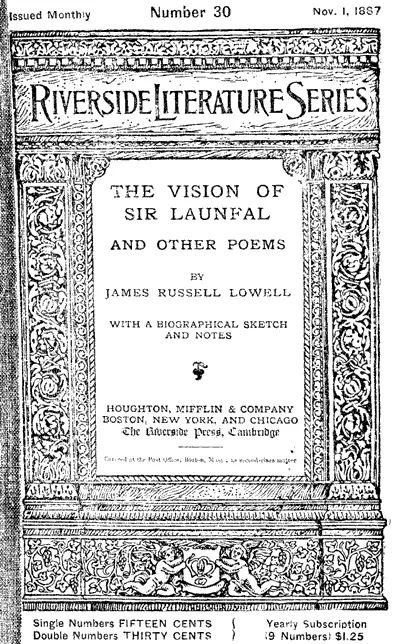
"The Vision of Sir Launfal" by James Russell Lowell is a poem written in the mid-19th century. It draws upon Arthurian legend to convey moral and social themes, focusing on the titular character, Sir Launfal, as he embarks on a quest for the Holy Grail. The poem explores topics such as charity, humanity, and the essence of true nobility, wherein the protagonist learns that true giving transcends material wealth. The opening of this work introduces us to Sir Launfal, a young knight eager to embark on his quest for the Holy Grail, a symbol of divine grace. As Launfal prepares for his journey, he encounters a leper who begs for alms, and upon recoiling in disgust, he gives a piece of gold but fails to recognize the human beneath the man’s suffering. The stark contrast between Launfal’s noble aspirations and his initial disdain for poverty sets the foundation for a life-altering revelation as the story unfolds. This initial encounter emphasizes the poem's central message that true honor lies in compassionate action toward those in need, setting the stage for Launfal's transformative quest.
Introduction adapted from the source catalogue; source summaries may be automatically generated.
Free to read · English · 24,954 words · No account needed
MAKE TIME FOR A GOOD BOOK
On by default. Untick to stop anonymous reading totals. Each page counts after 10 seconds in view. How this works.
Anonymous counting is on unless you have switched it off.
I stood and watched by the window
The noiseless work of the sky,
And the sudden flurries of snow-birds, 15
Like brown leaves whirling by.
I thought of a mound in sweet Auburn
Where a little headstone stood;
How the flakes were folding it gently,
As did robins the babes in the wood. 20
Up spoke our own little Mabel,
Saying, "Father, who makes it snow?"
And I told of the good All-father
Who cares for us here below.
Again I looked at the snow-fall, 25 And thought of the leaden sky That arched o'er our first great sorrow, When that mound was heaped so high.
I remembered the gradual patience
That fell from that cloud like snow, 30
Flake by flake, healing and hiding
The scar of our deep-plunged woe.
And again to the child I whispered,
"The snow that husheth all,
Darling, the merciful Father 35
Alone can make it fall!"
[Footnote 17: The marble of Carrara, Italy, is noted for its purity.]
Then, with eyes that saw not, I kissed her; And she, kissing back, could not know That my kiss was given to her sister, Folded close under deepening snow. 40
What gnarled stretch, what depth of shade, is his! There needs no crown to mark the forest's king; How in his leaves outshines full summer's bliss! Sun, storm, rain, dew, to him their tribute bring, Which he with such benignant royalty 5 Accepts, as overpayeth what is lent; All nature seems his vassal proud to be, And cunning only for his ornament.
How towers he, too, amid the billowed snows, An unquelled exile from the summer's throne, 10 Whose plain, uncinctured front more kingly shows, Now that the obscuring courtier leaves are flown. His boughs make music of the winter air, Jewelled with sleet, like some cathedral front Where clinging snow-flakes with quaint art repair 15 The dints and furrows of time's envious brunt.
How doth his patient strength the rude March wind Persuade to seem glad breaths of summer breeze, And win the soil that fain would be unkind, To swell his revenues with proud increase! 20 He is the gem; and all the landscape wide (So doth his grandeur isolate the sense) Seems but the setting, worthless all beside, An empty socket, were he fallen thence.
So, from oft converse with life's wintry gales, 25 Should man learn how to clasp with tougher roots The inspiring earth; how otherwise avails The leaf-creating sap that sunward shoots? So every year that falls with noiseless flake Should fill old scars up on the stormward side, 30 And make hoar age revered for age's sake, Not for traditions of youth's leafy pride.
Your reading position is saved on this browser. Take it to another device with a library code. Reading pages adapt to text, rather than matching a printed edition.
James Russell Lowell
James Russell Lowell
James Russell Lowell

James Russell Lowell
BEHIND THE BOOK
This eBook is for the use of anyone anywhere in the United States and most other parts of the world at no cost and with almost no restrictions whatsoever. You may copy it, give it away or re-use it under the terms of the Project Gutenberg License included with this eBook or online at www.gutenberg.org. If you are not located in the United States, you will have to check the laws of the country where you are located before using this eBook. Read the source licence.
The original source file, including credits and licence, is retained by this library. Request an original-format copy at no charge. Please include the book title and Project Gutenberg identifier #17119.
KEEP YOUR CURIOSITY GOING

Maurice Baring
Francis Greenleaf Allinson & Anne C. E. (Anne Crosby Emery) Allinson

Eric Mackay
Edmund Gosse
Sophia Margaretta Hensley
Stuart Dodgson Collingwood