THE CLASSIC COLLECTION✦Wild life under the equatorCLASSIC FREE BOOKS
Wild life under the equator
Paul B. (Paul Belloni) Du Chaillu
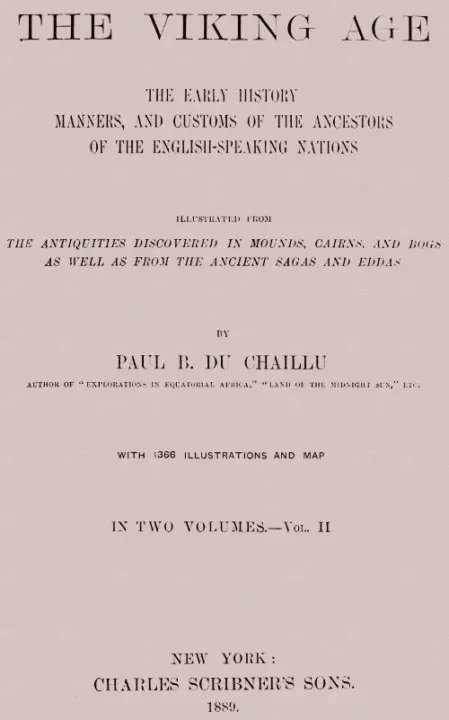
THE CLASSIC COLLECTION · 1889
"The Viking Age. Volume 2 (of 2)" by Paul B. Du Chaillu is a historical account written in the late 19th century. This expansive work delves into various aspects of Viking society, culture, and customs, illuminated by archaeological findings and ancient literary sources such as sagas and Eddas. The book provides insights into the lives of the ancestors of English-speaking nations and examines their practices, including marriage, child-rearing, and warfare. At the start of this volume, the opening chapter focuses on marriage among the Norse people, detailing the high status of women, the civil nature of marriage, and the various customs surrounding it. It highlights the importance of agreements known as "mund" that formalized marriages, the roles of suitors, and the expectations placed upon both men and women in selecting marriage partners. The chapter provides numerous examples from the Sagas to illustrate these practices, shedding light on the intricacies of relationships within Viking society, where marriage and familial bonds were often intertwined with matters of property and social standing.
Introduction adapted from the source catalogue; source summaries may be automatically generated.
Free to read · English · 181,446 words · No account needed
MAKE TIME FOR A GOOD BOOK
On by default. Untick to stop anonymous reading totals. Each page counts after 10 seconds in view. How this works.
Anonymous counting is on unless you have switched it off.
In the preceding chapters we have dealt with the customs of the forefathers of the English-speaking nations of to-day, and will now proceed to give extracts from those Sagas which deal with the lives and deeds of some of the earlier kings of the North who claimed to own part of England, and which mention events that relate to, or took place in, England, France, Ireland, Scotland, and other countries in later times. In quoting from the different Sagas there is necessarily a certain amount of repetition.
Among the earliest kings who claimed to own or have possessions in England were Ivar Vidfadmi, Harald Hilditönn, Sigurd Hring, and Ragnar Lodbrok.
“When Sigurd Hring (7th and 8th centuries, A.D.), father of Ragnar Lodbrok, King of Sweden and Denmark, had made peace in both, and placed over them tax-kings and jarls, he bethought himself of the kingdom which his kinsman Harald Hilditönn (war-tooth) had possessed in England, and before him Ivar Vidfadmi; but it was then ruled by King Ingjald, who it is said was brother of Petr, Saxon king” (Forrmanna Sögur).[370]
“Ingjald was a powerful king.
“King Hring summoned a great levy from his kingdom, went westward to England, and, when he came to Northumberland, asked for help, which many people gave him.
“But when King Ingjald heard of this, he gathered a large host and went against him, and they fought several battles, in the last of which King Ingjald and his son Ubbi, with many of their warriors, fell. Hring thereupon took possession of Northumberland and the whole of Ingjald’s kingdom.
“King Hring left England, placing as tax-king over Northumberland Olaf, son of Kinrik, who was said to be a nephew of Moalda the Stout, mother of Ivar Vidfadmi.
“Then King Hring returned to his realm, and Olaf ruled over Northumberland, until Eava (or Eana), son of Ubbi, gained the throne. He and Olaf had many battles; after the last one King Olaf fled, and Eava won the kingdom.
“Olaf went to Sweden to see King Hring, who then made him chief of Jutland, and for long afterwards he was tax-king there, first under King Hring, and afterwards under Ragnar Lodbrok.
“He was called Olaf the English, and his son was Grim the grey, who got the kingship after his father.
“Grim was father of Audulf the strong, who was tax-king in Jutland under Ragnar Lodbrok; Audulf’s son was Gorm, who was also tax-king in Jutland, and was named Gorm the childless.
“King Gorm had many thralls, and some of these had been sent to Holtsetaland (Holstein) to buy wine, which they carried on many horses” (Fornmanna Sögur, vol. i.).
Your reading position is saved on this browser. Take it to another device with a library code. Reading pages adapt to text, rather than matching a printed edition.
Paul B. (Paul Belloni) Du Chaillu
Paul B. (Paul Belloni) Du Chaillu
Paul B. (Paul Belloni) Du Chaillu
BEHIND THE BOOK
This eBook is for the use of anyone anywhere in the United States and most other parts of the world at no cost and with almost no restrictions whatsoever. You may copy it, give it away or re-use it under the terms of the Project Gutenberg License included with this eBook or online at www.gutenberg.org. If you are not located in the United States, you will have to check the laws of the country where you are located before using this eBook. Read the source licence.
The original source file, including credits and licence, is retained by this library. Request an original-format copy at no charge. Please include the book title and Project Gutenberg identifier #56168.
KEEP YOUR CURIOSITY GOING
Cécile Tormay

Moritz Busch
John L. Ransom
Frances Wright
Cécile Tormay

Mabel Potter Daggett