THE CLASSIC COLLECTION✦Wild life under the equatorCLASSIC FREE BOOKS
Wild life under the equator
Paul B. (Paul Belloni) Du Chaillu
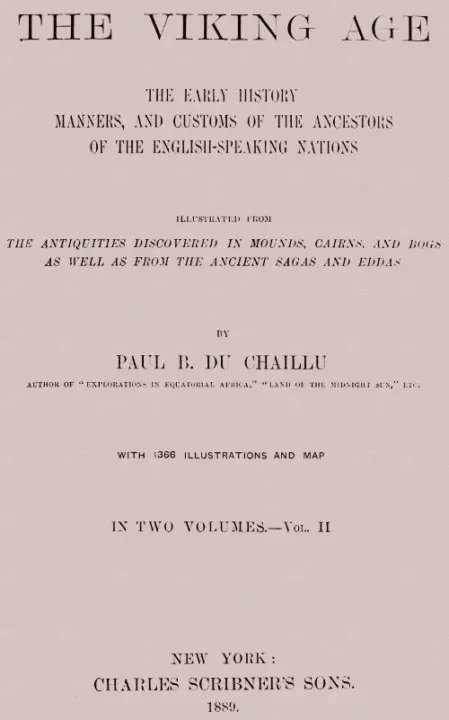
THE CLASSIC COLLECTION · 1889
"The Viking Age. Volume 2 (of 2)" by Paul B. Du Chaillu is a historical account written in the late 19th century. This expansive work delves into various aspects of Viking society, culture, and customs, illuminated by archaeological findings and ancient literary sources such as sagas and Eddas. The book provides insights into the lives of the ancestors of English-speaking nations and examines their practices, including marriage, child-rearing, and warfare. At the start of this volume, the opening chapter focuses on marriage among the Norse people, detailing the high status of women, the civil nature of marriage, and the various customs surrounding it. It highlights the importance of agreements known as "mund" that formalized marriages, the roles of suitors, and the expectations placed upon both men and women in selecting marriage partners. The chapter provides numerous examples from the Sagas to illustrate these practices, shedding light on the intricacies of relationships within Viking society, where marriage and familial bonds were often intertwined with matters of property and social standing.
Introduction adapted from the source catalogue; source summaries may be automatically generated.
Free to read · English · 181,446 words · No account needed
MAKE TIME FOR A GOOD BOOK
On by default. Untick to stop anonymous reading totals. Each page counts after 10 seconds in view. How this works.
Anonymous counting is on unless you have switched it off.
“Wherever a man makes the horse of another fight without the owner’s permission he shall pay the loss that ensues and öfundarbót[255] to the owner, according to lawful judgment. If the hurt is valued at half a mark, he shall pay full rett according to law, as if it were done from hatred or envy. Every man shall answer for himself at a horse-fight, whoever may have the fight. If a man strikes a horse without necessity at a horse-fight, he shall pay öfundarbót to the owner; and if the horse is damaged by it, he shall pay indemnity for damages and rett-of-envy to the owner” (N. G. L., ii. 126).
Footnote 230:
Cf. also Njala, cc. 44, 53.
Footnote 231:
Cf. also Njala, cc. 44, 53, 111; Ragnar Lodbrok.
Footnote 232:
Cf. also Vatnsdæla, c. 22.
Footnote 233:
Orkneyinga Saga.
Footnote 234:
Cf. also c. 21.
Footnote 235:
Forests then existed in Iceland.
Footnote 236:
Din-bells = dyn-bjöllur.
Footnote 237:
Cf. also Gisli Sursson’s Saga, p. 47.
Footnote 238:
Extracted much iron out of iron-ore—haematite.
Footnote 239:
Cf. also St. Olaf’s Saga, c. 234.
Footnote 240:
Among the objects belonging to that find which are preserved in the Old-northern Museum of Copenhagen, were:—
A small (2¾ inches long) anvil of iron of the shape common at the
present day.
A heavy iron hammer, 6 inches long, of similar shape to those now in
use.
A pair of iron shears, 10 inches long, like those used for cutting of
metal plates.
Three iron files, from 7¼ to 8¾ inches long. The cutting of the files being straight across the length of the file. Similar files have been found in the Vimose bog find.
An iron chisel, 5½ inches long.
Soldering spoons of iron, containing remains of a very hard melted metal, which, on examination, has been found to be a whitish alloy of base metals.
Seven fragmentary pieces of scales.
Two bronze bells.
An iron axe, 6 inches long.
A 4½-inch long iron point for an arrow or spear.
An iron spike, 7½ inches long, with head.
An iron key, 5 inches long.
An iron buckle, in which the pin is wanting.
A mass of fragments of iron mountings.
Several fragments of bronze plates covered with thin silver-foil, and of bronze mountings, and thin bronze wire; also lumps of melted bronze.
Three small fragments of bone; the largest piece has snake ornaments
engraved on it.
Footnote 241:
In N. G. L. ii. 145, tar work on the place where tar is made is
mentioned.
Footnote 242:
By Sudrriki seems to be meant the south of Europe.
Footnote 243:
Cf. also Fridthjof’s Saga, c. 11.
Footnote 244:
Hábrók is mentioned in the earlier Edda Grimnismal, 44, as “the best
of hawks.”
Footnote 245:
Cf. also c. 44, ibid.
Footnote 246:
Your reading position is saved on this browser. Take it to another device with a library code. Reading pages adapt to text, rather than matching a printed edition.
Paul B. (Paul Belloni) Du Chaillu
Paul B. (Paul Belloni) Du Chaillu
Paul B. (Paul Belloni) Du Chaillu
BEHIND THE BOOK
This eBook is for the use of anyone anywhere in the United States and most other parts of the world at no cost and with almost no restrictions whatsoever. You may copy it, give it away or re-use it under the terms of the Project Gutenberg License included with this eBook or online at www.gutenberg.org. If you are not located in the United States, you will have to check the laws of the country where you are located before using this eBook. Read the source licence.
The original source file, including credits and licence, is retained by this library. Request an original-format copy at no charge. Please include the book title and Project Gutenberg identifier #56168.
KEEP YOUR CURIOSITY GOING
Cécile Tormay

Moritz Busch
John L. Ransom
Frances Wright
Cécile Tormay

Mabel Potter Daggett