THE CLASSIC COLLECTION✦Wild life under the equatorCLASSIC FREE BOOKS
Wild life under the equator
Paul B. (Paul Belloni) Du Chaillu
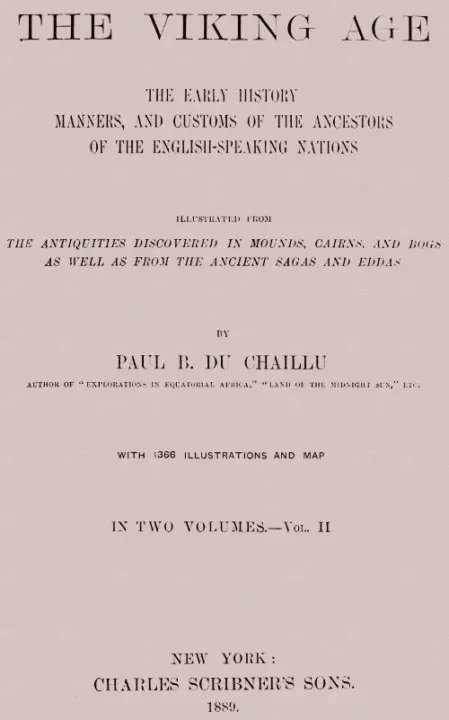
THE CLASSIC COLLECTION · 1889
"The Viking Age. Volume 2 (of 2)" by Paul B. Du Chaillu is a historical account written in the late 19th century. This expansive work delves into various aspects of Viking society, culture, and customs, illuminated by archaeological findings and ancient literary sources such as sagas and Eddas. The book provides insights into the lives of the ancestors of English-speaking nations and examines their practices, including marriage, child-rearing, and warfare. At the start of this volume, the opening chapter focuses on marriage among the Norse people, detailing the high status of women, the civil nature of marriage, and the various customs surrounding it. It highlights the importance of agreements known as "mund" that formalized marriages, the roles of suitors, and the expectations placed upon both men and women in selecting marriage partners. The chapter provides numerous examples from the Sagas to illustrate these practices, shedding light on the intricacies of relationships within Viking society, where marriage and familial bonds were often intertwined with matters of property and social standing.
Introduction adapted from the source catalogue; source summaries may be automatically generated.
Free to read · English · 181,446 words · No account needed
MAKE TIME FOR A GOOD BOOK
On by default. Untick to stop anonymous reading totals. Each page counts after 10 seconds in view. How this works.
Anonymous counting is on unless you have switched it off.
“One day Án met Drifa, Karl’s daughter, and with her three women. She was handsome, and well dressed in a red kirtle with long sleeves, narrow below, and long and tight at the waist. She wore a band (hlad)[222] round her forehead, and her hair was very fine” (An Bogsveigi’s Saga, c. 5).
One kind of head-dress was called fald (fold); others were sveig, motr, and krókfald. The last word probably means a crooked head-dress, perhaps somewhat similar to those now worn in Normandy and Iceland. It must be concluded that the so-called fald was often made of linen, and it was considered stately to wear this head-dress high.
Skupla was another head-dress, which fell down over the face.
“Once when the famous chief and Saga-writer Snorri Sturluson was travelling, he met a woman who wore a blue jacket (ólpa) with a felt hood, which was fastened round her head; she wore it instead of a hat” (Sturlunga, iv., c. 36).
Girls wore the hair, when long, wrapped round their belt; widows also wore their hair hanging down. Long yellow hair, and a delicate complexion, were considered essentials of beauty.
Bui once went to Dofrafjöll (Dovrefjeld) on an errand for King Harald Fairhair, and there met a woman of large stature.
“She was fair to look at, and dressed in a red kirtle, ornamented all over with lace; she wore a broad silver belt; she wore her long and fine hair loose, as is the custom of maidens; she had beautiful hands, and many gold rings on them” (Kjalnesinga Saga, c. 13).
Ermingerd, a queen in Valland, at a feast which she gave to Rögnvald
jarl,
“came into the hall with many women. She had in her hand a drinking-vessel of gold, and was dressed in the finest clothes; her hair was loose, as is the custom of maidens, and on her forehead she had placed a golden band” (Orkneyinga Saga, p. 280).
“Helga was so beautiful, that wise men say she was the most beautiful woman in Iceland. Her hair was so long that it could cover her whole body, and was as fine as gold; no match was then thought equal to her in the whole of Borgarfjord and many other places” (Gunnlaug Ormstunga, c. 4).
“Then Hallgerd was sent for, and came with two women. She wore a blue woven mantle (vefjarmöttul), and under it a scarlet kirtle with a silver belt; her hair reached down to her waist, on both sides, and she tucked it under her belt” (Njala, c. 13).
When Gunnar went to the Althing he met the widow Hallgerd, daughter of
Höskuld, who
Your reading position is saved on this browser. Take it to another device with a library code. Reading pages adapt to text, rather than matching a printed edition.
Paul B. (Paul Belloni) Du Chaillu
Paul B. (Paul Belloni) Du Chaillu
Paul B. (Paul Belloni) Du Chaillu
BEHIND THE BOOK
This eBook is for the use of anyone anywhere in the United States and most other parts of the world at no cost and with almost no restrictions whatsoever. You may copy it, give it away or re-use it under the terms of the Project Gutenberg License included with this eBook or online at www.gutenberg.org. If you are not located in the United States, you will have to check the laws of the country where you are located before using this eBook. Read the source licence.
The original source file, including credits and licence, is retained by this library. Request an original-format copy at no charge. Please include the book title and Project Gutenberg identifier #56168.
KEEP YOUR CURIOSITY GOING
Cécile Tormay

Moritz Busch
John L. Ransom
Frances Wright
Cécile Tormay

Mabel Potter Daggett