THE CLASSIC COLLECTION✦Wild life under the equatorCLASSIC FREE BOOKS
Wild life under the equator
Paul B. (Paul Belloni) Du Chaillu
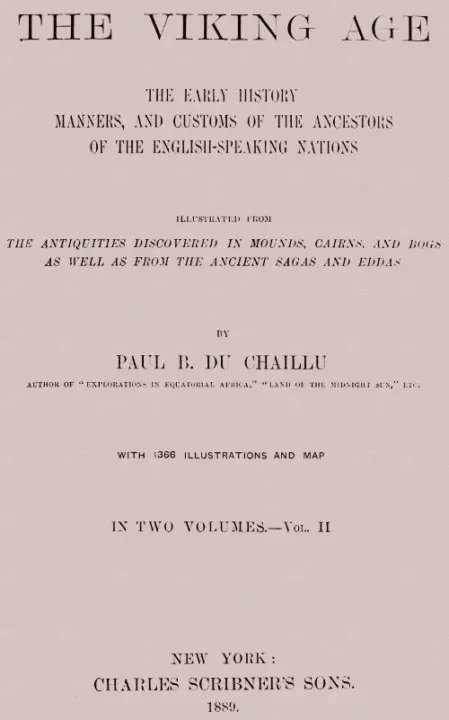
THE CLASSIC COLLECTION · 1889
"The Viking Age. Volume 2 (of 2)" by Paul B. Du Chaillu is a historical account written in the late 19th century. This expansive work delves into various aspects of Viking society, culture, and customs, illuminated by archaeological findings and ancient literary sources such as sagas and Eddas. The book provides insights into the lives of the ancestors of English-speaking nations and examines their practices, including marriage, child-rearing, and warfare. At the start of this volume, the opening chapter focuses on marriage among the Norse people, detailing the high status of women, the civil nature of marriage, and the various customs surrounding it. It highlights the importance of agreements known as "mund" that formalized marriages, the roles of suitors, and the expectations placed upon both men and women in selecting marriage partners. The chapter provides numerous examples from the Sagas to illustrate these practices, shedding light on the intricacies of relationships within Viking society, where marriage and familial bonds were often intertwined with matters of property and social standing.
Introduction adapted from the source catalogue; source summaries may be automatically generated.
Free to read · English · 181,446 words · No account needed
MAKE TIME FOR A GOOD BOOK
On by default. Untick to stop anonymous reading totals. Each page counts after 10 seconds in view. How this works.
Anonymous counting is on unless you have switched it off.
Vigaskúta saw “that a large man in a green cloak rode from Thverá (a farm), and knew that it was Glúm. He alighted from his horse. He had on a cloak of two colours, black and white” (Viga Glum’s Saga, c. 16).
“Hrút started up in a shirt and linen breeches, and threw over himself a grey cloak, and had in his hand a halberd adorned with gold, which King Harald had given him” (Laxdæla, c. 37).
“The king had on a red cloak (möttul)[205] with bands, and a spear in his hand. He twisted the cloak-pin off, and leaned upon the blade of his spear. When Heming came down he took hold of the king’s cloak, but the king bowed down his head, and let go the cloak, so that Heming flew down off the rock” (Flateyjarbok, iii. 409).
Helgi, a Norwegian trader, was invited to stay with Gudmund the powerful, on Mödruvellir, a whole winter. When he left he said to him:—
“‘Now, herra, look at this payment for quarters, though it is less than you deserve.’ It was a cloak, the fur of which was lined with pell, with a golden band on the neck-strap, a most costly thing. Gudmund said: ‘I thank thee for it, I have never received a better gift.’ They parted good friends” (Ljosvetninga Saga, c. 13).
“Ögmund put on a cloak (feld) of two colours, ornamented with bands beneath the shoulder; it was very costly” (Fornmanna Sögur, ii.).
“He (Thormód) had covered himself with a double-furred cloak which he owned. It was black on one side, and white on the other” (Fóstbrædra Saga, c. 32).
The different garments were:—
Skyrta, or serk, the name given to the shirt worn next the body, which was put on by means of a small opening[206] for the head called hofudsmátt.
The kyrtil shaped like a shirt with sleeves, and put over it. Blue, red, and brown seem to have been the favourite colours for this garment.[207] Sometimes the kirtle is called skyrta, or shirt; so both must have been alike in shape. A sleeveless kirtle is mentioned as uncommon.[208]
The hjúp which seems to have been a short kirtle without sleeves, sometimes lined with furs, worn sometimes over the coat of mail.[209]
“Sigurd went up on the island. He wore a red kirtle, and a blue cloak with straps on his shoulders; he was girt with a sword, and had a helmet on his head” (Fœreyinga Saga, c. 57).
Linbrækr (linen drawers) which seem to have been often worn, and were
kept on at night.
Breeches seems to have been of two kinds:—
Your reading position is saved on this browser. Take it to another device with a library code. Reading pages adapt to text, rather than matching a printed edition.
Paul B. (Paul Belloni) Du Chaillu
Paul B. (Paul Belloni) Du Chaillu
Paul B. (Paul Belloni) Du Chaillu
BEHIND THE BOOK
This eBook is for the use of anyone anywhere in the United States and most other parts of the world at no cost and with almost no restrictions whatsoever. You may copy it, give it away or re-use it under the terms of the Project Gutenberg License included with this eBook or online at www.gutenberg.org. If you are not located in the United States, you will have to check the laws of the country where you are located before using this eBook. Read the source licence.
The original source file, including credits and licence, is retained by this library. Request an original-format copy at no charge. Please include the book title and Project Gutenberg identifier #56168.
KEEP YOUR CURIOSITY GOING
Cécile Tormay

Moritz Busch
John L. Ransom
Frances Wright
Cécile Tormay

Mabel Potter Daggett