THE CLASSIC COLLECTION✦Wild life under the equatorCLASSIC FREE BOOKS
Wild life under the equator
Paul B. (Paul Belloni) Du Chaillu
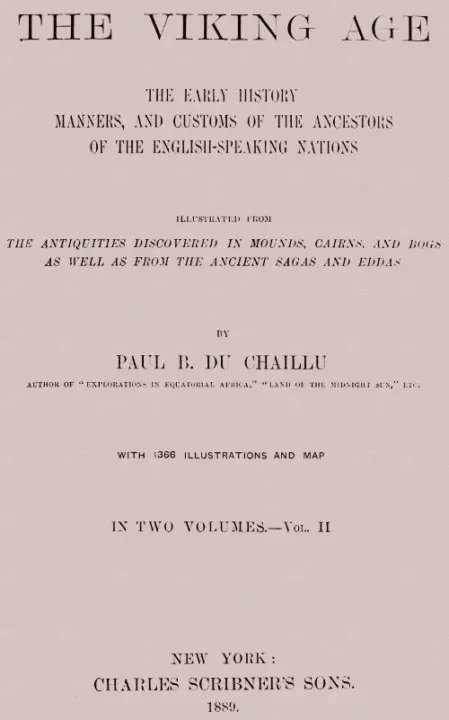
THE CLASSIC COLLECTION · 1889
"The Viking Age. Volume 2 (of 2)" by Paul B. Du Chaillu is a historical account written in the late 19th century. This expansive work delves into various aspects of Viking society, culture, and customs, illuminated by archaeological findings and ancient literary sources such as sagas and Eddas. The book provides insights into the lives of the ancestors of English-speaking nations and examines their practices, including marriage, child-rearing, and warfare. At the start of this volume, the opening chapter focuses on marriage among the Norse people, detailing the high status of women, the civil nature of marriage, and the various customs surrounding it. It highlights the importance of agreements known as "mund" that formalized marriages, the roles of suitors, and the expectations placed upon both men and women in selecting marriage partners. The chapter provides numerous examples from the Sagas to illustrate these practices, shedding light on the intricacies of relationships within Viking society, where marriage and familial bonds were often intertwined with matters of property and social standing.
Introduction adapted from the source catalogue; source summaries may be automatically generated.
Free to read · English · 181,446 words · No account needed
MAKE TIME FOR A GOOD BOOK
On by default. Untick to stop anonymous reading totals. Each page counts after 10 seconds in view. How this works.
Anonymous counting is on unless you have switched it off.
“He measured the ground for his house. It was a belief that if the measurement was the same when it was tried repeatedly, then the well-being of the man whose measuring-yard grew too short would decrease, but increase if it grew longer. The measurement was performed three times and the yard was too short.”
Footnote 184:
Bœr or Bu, meant a dwelling-place occupied by a single family.
Footnote 185:
The name gard, gaard, still signifies all the buildings of a farm.
Footnote 186:
Hrolf Kraki, 34, 40; Jomsvikinga Saga, 5, 22; Volsunga, 3; Half’s
Saga, 12; Egil, 8.
Footnote 187:
The sal is also called Disarsal, a building for sacrifices to the
Disir.
Footnote 188:
Cf. also Heimskringla.
Footnote 189:
“The land-owner shall pay the value of the land at the Karldyr (men’s door).” Gragas ii.
Footnote 190:
Bodyguard.
Footnote 191:
Cf. also Njala, 117.
Footnote 192:
The banqueting halls were called veitsluskali.
Footnote 193:
Njala 120; Fornmanna Sögur.
Footnote 194:
The skali is often called the drinking or the sleeping skali. Orkneyinga, 18, 70, 115; Gisli Sursson, 29; Droplaugarsona Saga, 18, 28; Fornmanna Sögur, i. 288, 292; Kormak, 58; Fostbrœdra, 13; Njala, 78; Gunnlaug, XI.
The eldhús meant a hall or chief room, where fires were kept. Gisli Sursson, 14, 15, 97; Eyrbyggja, 98; Laxdæla, 54.
Footnote 195:
Dyngja—cf. Egil, 159; Gisli Sursson, 15; Njal, 66; Kormak, 10; Bjorn Hitdk, 68. Skemma—Fœreyinga, 259; Gisli Sursson, 7; Kormak, 228; Islendinga Sögur, ii. 28. Herbergi seems to have been a general term for any kind of room.
Footnote 196:
Harald Hardradi, 70.
Footnote 197:
Fœreyinga, 41; Islendinga Sögur, ii. 250; Fostbrœdra, 164. A bad-stofa, or bath room, is mentioned. Eyrbyggja, Forn. Sögur, xiii. In St. Olaf’s Saga, 82, the stofa is said to be in the loft.
Footnote 198:
A house of the latter kind was also called málstofa (speaking-house) (Harald Hardradi’s Saga, c. 45).
Footnote 199:
Ingi’s Saga, 28; Egil’s Saga, 236; Njal,, 114, 199; Fms., 85;
Ynglinga, St. Olaf, 116.
Footnote 200:
Magnus the Good’s Saga, c. 13.
Footnote 201:
Yngl. Saga, c. 14.
Footnote 202:
Ynglinga Saga, 34.
Your reading position is saved on this browser. Take it to another device with a library code. Reading pages adapt to text, rather than matching a printed edition.
Paul B. (Paul Belloni) Du Chaillu
Paul B. (Paul Belloni) Du Chaillu
Paul B. (Paul Belloni) Du Chaillu
BEHIND THE BOOK
This eBook is for the use of anyone anywhere in the United States and most other parts of the world at no cost and with almost no restrictions whatsoever. You may copy it, give it away or re-use it under the terms of the Project Gutenberg License included with this eBook or online at www.gutenberg.org. If you are not located in the United States, you will have to check the laws of the country where you are located before using this eBook. Read the source licence.
The original source file, including credits and licence, is retained by this library. Request an original-format copy at no charge. Please include the book title and Project Gutenberg identifier #56168.
KEEP YOUR CURIOSITY GOING
Cécile Tormay

Moritz Busch
John L. Ransom
Frances Wright
Cécile Tormay

Mabel Potter Daggett