THE CLASSIC COLLECTION✦Wild life under the equatorCLASSIC FREE BOOKS
Wild life under the equator
Paul B. (Paul Belloni) Du Chaillu
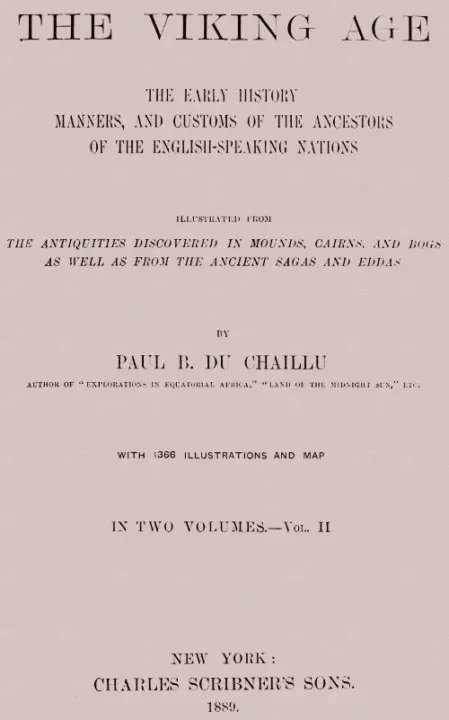
THE CLASSIC COLLECTION · 1889
"The Viking Age. Volume 2 (of 2)" by Paul B. Du Chaillu is a historical account written in the late 19th century. This expansive work delves into various aspects of Viking society, culture, and customs, illuminated by archaeological findings and ancient literary sources such as sagas and Eddas. The book provides insights into the lives of the ancestors of English-speaking nations and examines their practices, including marriage, child-rearing, and warfare. At the start of this volume, the opening chapter focuses on marriage among the Norse people, detailing the high status of women, the civil nature of marriage, and the various customs surrounding it. It highlights the importance of agreements known as "mund" that formalized marriages, the roles of suitors, and the expectations placed upon both men and women in selecting marriage partners. The chapter provides numerous examples from the Sagas to illustrate these practices, shedding light on the intricacies of relationships within Viking society, where marriage and familial bonds were often intertwined with matters of property and social standing.
Introduction adapted from the source catalogue; source summaries may be automatically generated.
Free to read · English · 181,446 words · No account needed
MAKE TIME FOR A GOOD BOOK
On by default. Untick to stop anonymous reading totals. Each page counts after 10 seconds in view. How this works.
Anonymous counting is on unless you have switched it off.
“The fleets closed, and Hakon jarl was with his son Svein to support him against Sigvaldi. A most fierce fight began, and one could find no fault with the onset or attack of either; it is told that it went equally with Sigvaldi and Hakon and Svein, so that neither moved backwards. Then Hakon jarl saw that Búi had forced back a long way some of the northern wing of their array, and those who fought against him drew back with their ships, and thought it better to retreat; he followed up, nevertheless, and dealt heavy blows; they were ill-treated by him, and he was dangerous to men in the battle. The Jarl saw that the fight was equal with Eirík and Vagn in the southern wing. Eirík went thence with his own ship, and his brother Svein with another, up to Búi and fought against him, and put the wing in line again, but could do no more. Hakon meanwhile fought against Sigvaldi, and when Eirík came back to the southern wing Vagn had forced back many of Eirík’s ships, which had retreated and had been separated, so that Vagn went through the line and attacked them fiercely. Eirík became very angry when he saw this, and boarded the skeid which Vagn steered valiantly with his Járnbardi. They came alongside of each other and fought again, and never had the fight been harder than then. Vagn and Áslák Hólmskalli jumped on board Eirík’s Járnbardi from their skeid, and each went along the side of the ship, and Áslák dealt blows on both sides, so to speak, as also did Vagn, and they cleared their way so that all fell back. Eirík saw that these men were so fierce and mad that this would not last long, and that the Jarl’s help must be got as quick as possible. Áslák was bald and had no helmet on his head, and exposed his bare skull; the weather was bright, clear, and warm, and many took off their clothes on account of the heat, and wore only their armour. Now Eirík goaded his men on, and they made an attack on Áslák, and struck his head with swords and axes, thinking it would be most dangerous to him as his head was bare. Nevertheless it is said that the weapons rebounded from his skull, whether they were swords or axes, and did not cut, and sparks flew from the skull at the blows. Whatever they did, he went forward fiercely, and cleared his way by many hard and heavy blows, slaying many a man. Vigfús, son of Vígaglúm, caught up a large beaked anvil which lay on the deck of the Járnbardi, on which he had previously rivetted the guards of his sword as they had been unfastened; he struck at Áslák so that its beak sank into his head; Áslák could not withstand that, and at once fell dead. Vagn went along the other side, and cleared his way, dealing blows on both sides and wounding many; then Thorleif Skúma ran to meet Vagn, struck at him with his club, and hit his helmet; the blow was so strong that the skin under the helmet was grazed, and Vagn leant over and staggered towards Thorleif, and at the same time thrust his sword at Thorleif; then he leapt from the Járnbardi, and came down standing on his skeid, and none made a harder onset than he and all his men. Nevertheless he and Áslák had killed so many on the Járnbardi, that Eirík put men from other ships on it till it was fully manned, as he thought it needful; and a very fierce fight followed. Then Eirík saw that Hakon with his array had landed, and there was some pause in the battle....[163] The sky began to darken in the north, and a dark and black cloud glided up from the sea, spreading quickly; it was about noon, and the cloud soon spread all over the sky, and a shower of hail followed at once, and the Jomsvikings had all to fight with their faces against the hail, which seemed to be followed by lightning and thunder-claps. This hail-shower was so terrible, that some of the men could do no more than stand against it, as they had previously taken off their clothes on account of the heat. They began to shiver, though they fought boldly enough. It is said that Hávard Höggvandi, Búi’s follower, was the first who saw Hördabrúd in the host of Hakon jarl, and many with second sight,[164] and even those who had no second sight, saw. When the hail-shower abated a little, they also saw that an arrow flew from each finger of the Troll, ‘M’tch’ as it seemed to them, and always hit and killed a man. They told Sigvaldi and others; and Hakon and his men made the hardest onset they could when the shower burst and while it lasted. Then Sigvaldi said: ‘It seems to me that it is not men whom we have to fight to-day, but the worst Troll (fiends), and it requires some manliness to go boldly against them, though it is clear that men must take heart as they can.’ It is told of Hakon, that when he saw the shower abate and it was not as violent as it had been, he once more invoked Thorgerd and her sister Irpa, saying that he had made himself deserving by sacrificing his son for victory. Then the hail-shower burst on them again, and when it began Hávard Höggvandi saw that two women were in Hakon jarl’s ship, and that they did the same as he had seen the one do before. Sigvaldi said: ‘Now I will flee, and all my men shall do so, for it is worse than when I spoke of it before, as there was but one Trollwoman then, but now there are two, and I will not stand it any longer; our excuse is that we do not flee from men, though we draw back; but we did not vow to fight against fiends.’ He (Sigvaldi) turned away his ship, and shouted to Vagn and Búi to flee as quickly as they could. When he unfastened his ship and shouted, Thorkel Midlang jumped from his ship on board Búi’s, and at once struck at Búi. In the twinkling of an eye he cut off his lower lip and the whole of his chin downward, so that it fell on the ship, and Búi’s teeth flew off at the blow. Búi said when he got the wound: ‘The Danish woman in Borgundarhólm will not be as fond of kissing me, even though I get home now.’ Búi struck at Thorkel; the deck was slippery from blood, so that Thorkel fell at the shield-row when he tried to escape the blow, which hit him in the middle, and cut him in two at the gunwale. Immediately after this Búi took one of his gold-chests in each hand, and jumped overboard with them; neither he nor the chests came up or were seen thereafter. Some say that when Búi stepped on the gunwale to jump overboard he spoke these words: ‘Overboard, all Búi’s men.’ Sigvaldi left the fleet, and did not know that Búi was gone overboard, and shouted to Vagn and Búi’s to flee, as he was about to do.... Sigvaldi was cold from the shower, and began rowing to warm himself, while another man sat at the rudder. When Vagn saw Sigvaldi he flung a spear at him, thinking it was he who sat at the rudder, but Sigvaldi was rowing, and the man at the rudder was hit. As Vagn flung the spear from his hand he said to Sigvaldi that he should die as the meanest of men. Thorkel the high, Sigvaldi’s brother, went away with six ships as soon as Sigvaldi was dead, and so did Sigurd Kápa, for his brother Búi was gone overboard, and he could wait for him no longer. They both thought they had fulfilled their vows, and went home to Denmark with twenty-four ships. All who could leave the remaining ships jumped on board Vagn’s skeid, and there they defended themselves very valiantly till it was dark; then the battle ended, and very many were still on their feet in Vagn’s skeid. Hakon jarl was overtaken by night and could not make a search as to how many were alive or likely to live in the ships, so he had a watch set during the night that no man should escape from them, and they took all the rigging down. Then Hakon rowed to the land, and pitched tents; they thought they had reason to boast of the victory. Then they weighed the hailstones in order to prove the power of Thorgerd and Irpa; it was well proved, for it is told that each hailstone weighed one eyrir, and they were weighed in scales. Thereafter the wounds of the men were dressed, and Hakon jarl and Gudbrand of Dalir watched during the night” (Jomsvikinga Saga, c. 41–44).
Your reading position is saved on this browser. Take it to another device with a library code. Reading pages adapt to text, rather than matching a printed edition.
Paul B. (Paul Belloni) Du Chaillu
Paul B. (Paul Belloni) Du Chaillu
Paul B. (Paul Belloni) Du Chaillu
BEHIND THE BOOK
This eBook is for the use of anyone anywhere in the United States and most other parts of the world at no cost and with almost no restrictions whatsoever. You may copy it, give it away or re-use it under the terms of the Project Gutenberg License included with this eBook or online at www.gutenberg.org. If you are not located in the United States, you will have to check the laws of the country where you are located before using this eBook. Read the source licence.
The original source file, including credits and licence, is retained by this library. Request an original-format copy at no charge. Please include the book title and Project Gutenberg identifier #56168.
KEEP YOUR CURIOSITY GOING
Cécile Tormay

Moritz Busch
John L. Ransom
Frances Wright
Cécile Tormay

Mabel Potter Daggett