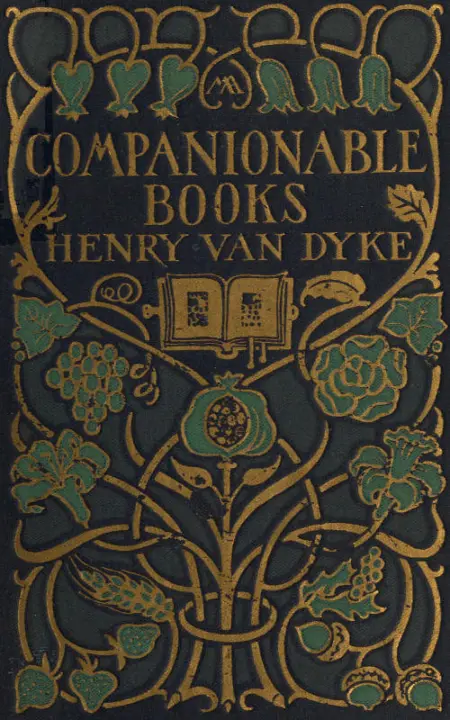
Companionable Books
Henry Van Dyke
THE CLASSIC COLLECTION · 1919
"The Valley of Vision: A Book of Romance and Some Half-Told Tales" by Henry Van Dyke is a collection of romantic tales interwoven with reflections on life, likely written in the early 20th century. The book explores themes of suffering, sacrifice, and the deep insights gained from hardships, beginning with a profound dream that delves into the relationship between humanity and divinity, illustrated through striking imagery and mythic characters. At the start of the narrative, the author introduces a vivid dream that he experienced twenty-five years prior, where he finds himself in an ancient city at midnight. The dream features two heroic figures, representatives of mankind and God, engaged in a poignant dispute that symbolizes the eternal conflict between faith and doubt. As the dream unfolds, the atmosphere descends into chaos, reflecting the turmoil of the human experience, culminating in a desperate effort to flee from a city engulfed in strife. The dream sets the tone for the subsequent stories within the collection, suggesting an exploration of how visions and dreams influence both individual lives and the broader human condition.
Introduction adapted from the source catalogue; source summaries may be automatically generated.
Free to read · English · 50,764 words · No account needed
MAKE TIME FOR A GOOD BOOK
On by default. Untick to stop anonymous reading totals. Each page counts after 10 seconds in view. How this works.
Anonymous counting is on unless you have switched it off.
February, 1917
The “Schools” building, though modern, is one of the stateliest on the Main Street. Here, in old peaceful times, the university examinations used to be held. Now it is transformed into a hospital for the wounded men from the fighting front of freedom.
Sir William Osier, Canadian, and world-renowned physician, is my
guide, an old friend in Baltimore, now Regius Professor of Medicine
in Oxford.
“Come,” he says, “I want you to see an example of the Carrel
treatment of wounds.”
The patient is sitting up in bed--a fine young fellow about twenty years old. A shrapnel-shell, somewhere in France, passed over his head and burst just behind him. His bare back is a mass of scars. The healing fluid is being pumped in through the shattered elbow of his right arm, not yet out of danger.
“Does it hurt,” I ask.
“Not much,” he answers, trying to smile, “at least not too much,
M'sieu'.”
The accent of French Canada is unmistakable. I talk to him in his
own dialect.
“What part of Quebec do you come from?”
“From Trois Rivieres, M'sieu', or rather from a country back of that, the Saint Maurice River.”
“I know it well--often hunted there. But what made you go to the
war?”
“I heard that England fought to save France from the damned Germans. That was enough, M'sieu', to make me march. Besides, I always liked to fight.”
“What did you do before you became a soldier?”
“I was a lumberjack.”
(What he really said was, “J'allais en chantier,” “I went in the shanty.” If he had spoken in classic French he would have said, “J'etais bucheron.” How it brought back the smell of the big spruce forest to hear that word chantier, in Oxford!)
“Well, then, I suppose you will return to the wood-cutting again,
when this war is over.”
“But no, M'sieu', how can I, with this good-for-nothing arm? I shall never be capable of swinging the axe again.”
“But you could be the cook, perfectly. And you know the cook gets the best pay in the whole shanty.”
His face lights up a little.
“Truly,” he replies; “I never thought of that, but it is true. I have seen a bit of cooking at the front and learned some things. I might take up that end of the job. But anyway, Im glad I went to the war.”
So we say good-by--“bonne chance!”
Since that day the good physician who guided me through the hospital has borne without a murmur the greatest of all sacrifices--the loss of his only son, a brave and lovely boy, killed in action against the thievish, brutal German hordes.
Your reading position is saved on this browser. Take it to another device with a library code. Reading pages adapt to text, rather than matching a printed edition.
Henry Van Dyke
Henry Van Dyke
Henry Van Dyke
Henry Van Dyke
BEHIND THE BOOK
This eBook is for the use of anyone anywhere in the United States and most other parts of the world at no cost and with almost no restrictions whatsoever. You may copy it, give it away or re-use it under the terms of the Project Gutenberg License included with this eBook or online at www.gutenberg.org. If you are not located in the United States, you will have to check the laws of the country where you are located before using this eBook. Read the source licence.
The original source file, including credits and licence, is retained by this library. Request an original-format copy at no charge. Please include the book title and Project Gutenberg identifier #6009.
KEEP YOUR CURIOSITY GOING
Coulson Kernahan

Maurice Baring
Frances Wright
Cécile Tormay
Francis Greenleaf Allinson & Anne C. E. (Anne Crosby Emery) Allinson

Frederic Jesup Stimson