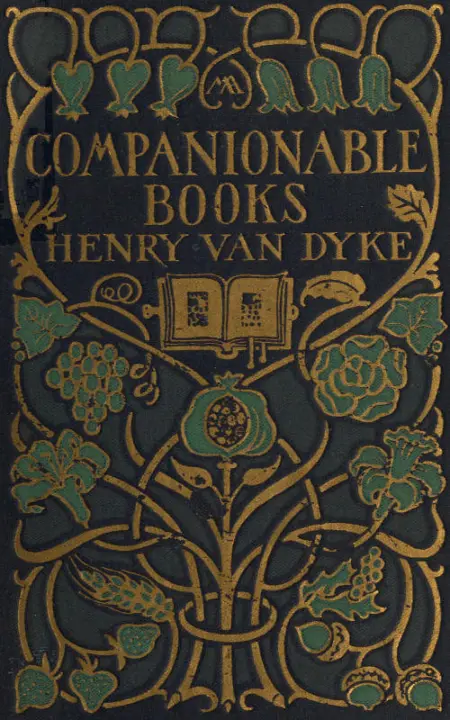
Companionable Books
Henry Van Dyke
THE CLASSIC COLLECTION · 1919
"The Valley of Vision: A Book of Romance and Some Half-Told Tales" by Henry Van Dyke is a collection of romantic tales interwoven with reflections on life, likely written in the early 20th century. The book explores themes of suffering, sacrifice, and the deep insights gained from hardships, beginning with a profound dream that delves into the relationship between humanity and divinity, illustrated through striking imagery and mythic characters. At the start of the narrative, the author introduces a vivid dream that he experienced twenty-five years prior, where he finds himself in an ancient city at midnight. The dream features two heroic figures, representatives of mankind and God, engaged in a poignant dispute that symbolizes the eternal conflict between faith and doubt. As the dream unfolds, the atmosphere descends into chaos, reflecting the turmoil of the human experience, culminating in a desperate effort to flee from a city engulfed in strife. The dream sets the tone for the subsequent stories within the collection, suggesting an exploration of how visions and dreams influence both individual lives and the broader human condition.
Introduction adapted from the source catalogue; source summaries may be automatically generated.
Free to read · English · 50,764 words · No account needed
MAKE TIME FOR A GOOD BOOK
On by default. Untick to stop anonymous reading totals. Each page counts after 10 seconds in view. How this works.
Anonymous counting is on unless you have switched it off.
“No, Rosy,” said Mitchell, thoughtfully running his hand over some nicks on the butt of his rifle in the corner; “you know I'm not a Kaiserite of any kind. I've got seven scored against him already, and I'm going to get some more. But the language question seems to me different. Cut out the German newspapers and the German schools in America by all means! No more teaching of the primary branches in any language but English! Make it absolutely necessary for everybody in the U. S. A. to learn the language of the country the first thing. Then in the high schools and universities let German be studied like any other foreign language, by those who want it--chemists, and philosophers, and historians, and electrical engineers, and so on. We could censor the text-books and keep out all complimentary allusions to the Hohenzollern family.”
“Oh, shut up, Phil,” growled Phipps-Herrick. “You're too soft, you old easy-mark! You don't go half far enough. We may not decide to exterminate the Hun race in Europe. But we have decided to exterminate their language in America.”
His hand was groping inside the biscuit-box. He pulled out a little ditty-bag and carefully extracted a bit of newspaper.
“Listen to this, you fellows. This is from the National Obscurity Society. You know a chap with a German name is president of it, but he's a real patriot, hundred per cent, not fifty-fifty, Philly. 'The following States have abolished the teaching of German: Massachusetts, Connecticut, New York, New Jersey, Pennsylvania, Maryland, Virginia, Georgia, Mississippi, Indiana, Ohio, Illinois, Nebraska, Missouri, Kansas, Iowa, Arkansas, Arizona, Colorado, Montana, California, and Oregon.' Abolished, mind you! What do you think of that?”
“Most excellent Phippick,” nodded Rosenlaube, “I opine, as Horace said to Cicero, 'That's the stuff,' or words to that effect. What saith the senator from Mitchellville?”
“Noble,” grinned Phil, “unmistakably noble! Those Obscurity fellows are a fiery lot. It reminds me that during the late war with Spain, when I was a little, tiny boy, but brimful of ferocity, I refused to eat my favorite dessert because it was called Spanish cream. I felt sure at the time that my heroic conduct was of distinct assistance to Dewey in the battle of Manila Bay.”
“Well, then,” said Phipps-Herrick, grabbing him by the shoulders and shaking him good-humoredly, “you murderous little pacifist with seven nicks on your gun, will you give up your German? Will you forget it?”
Mitchell chuckled and shook his head,
“As far as requisite under military orders. But no further, not by
a--”
Your reading position is saved on this browser. Take it to another device with a library code. Reading pages adapt to text, rather than matching a printed edition.
Henry Van Dyke
Henry Van Dyke
Henry Van Dyke
Henry Van Dyke
BEHIND THE BOOK
This eBook is for the use of anyone anywhere in the United States and most other parts of the world at no cost and with almost no restrictions whatsoever. You may copy it, give it away or re-use it under the terms of the Project Gutenberg License included with this eBook or online at www.gutenberg.org. If you are not located in the United States, you will have to check the laws of the country where you are located before using this eBook. Read the source licence.
The original source file, including credits and licence, is retained by this library. Request an original-format copy at no charge. Please include the book title and Project Gutenberg identifier #6009.
KEEP YOUR CURIOSITY GOING
Coulson Kernahan

Maurice Baring
Frances Wright
Cécile Tormay
Francis Greenleaf Allinson & Anne C. E. (Anne Crosby Emery) Allinson

Frederic Jesup Stimson