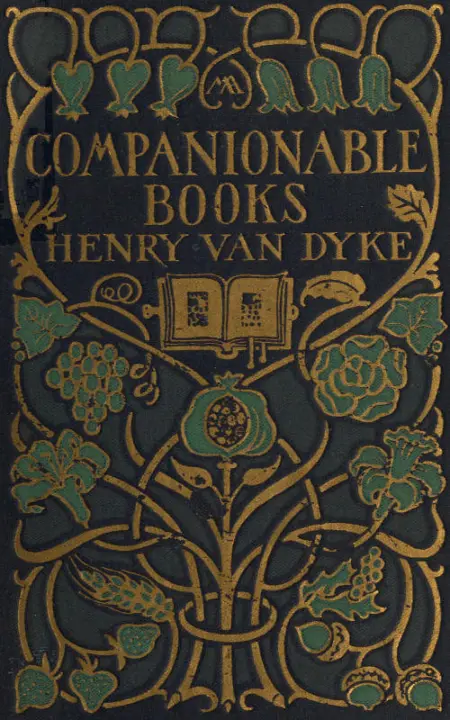
Companionable Books
Henry Van Dyke
THE CLASSIC COLLECTION · 1919
"The Valley of Vision: A Book of Romance and Some Half-Told Tales" by Henry Van Dyke is a collection of romantic tales interwoven with reflections on life, likely written in the early 20th century. The book explores themes of suffering, sacrifice, and the deep insights gained from hardships, beginning with a profound dream that delves into the relationship between humanity and divinity, illustrated through striking imagery and mythic characters. At the start of the narrative, the author introduces a vivid dream that he experienced twenty-five years prior, where he finds himself in an ancient city at midnight. The dream features two heroic figures, representatives of mankind and God, engaged in a poignant dispute that symbolizes the eternal conflict between faith and doubt. As the dream unfolds, the atmosphere descends into chaos, reflecting the turmoil of the human experience, culminating in a desperate effort to flee from a city engulfed in strife. The dream sets the tone for the subsequent stories within the collection, suggesting an exploration of how visions and dreams influence both individual lives and the broader human condition.
Introduction adapted from the source catalogue; source summaries may be automatically generated.
Free to read · English · 50,764 words · No account needed
MAKE TIME FOR A GOOD BOOK
On by default. Untick to stop anonymous reading totals. Each page counts after 10 seconds in view. How this works.
Anonymous counting is on unless you have switched it off.
Presently he has one of them leaning against the inside of each knee, listening ardently to the watch.
“What do you think of that!” he says. “What is your name, youngster?”
“Hendrik,” answers the boy, looking up.
“Hendrik what? You have another name, haven't you?”
The boy shakes his head and looks puzzled, as if the thought of two names were too much for him. “Hendrik,” he repeats more clearly and firmly.
“And what is her name?” asks the commandant, patting the little
girl.
“Sooss,” answers the boy. “Mama say 'ickle angel.'
Hendrik say Sooss.”
All effort to get any more information from the children was fruitless. They were too small to remember much, and what they did remember was of their own size--only very little things, of no importance except to themselves. The commandant looks at the nurse quizzically.
“Now, miss, you have unloaded these vague babies on me. What do you propose that I should do with them? Adopt them?”
“Not yet, anyhow,” she answers, smiling broadly. “Let us take them up to the camp. I'll bet we can find some one there to look after them. What do you say, sir?”
“Well, well,” he sighs, “have your own way as usual! Just ring that bell for the automobile, als't-Ublieft.”
In the busy sewing-room the two children are standing up on one of the tables. The commandant has an arm around each of them, for they are a little frightened by so much noise and so many eyes looking at them. The chatter dies down, as he speaks in his gruff authoritative voice, but with a twinkle in his eyes, rather like a middle-aged Santa Claus.
“Look here! I've got two fine babies.”
A titter runs through the room.
“Ja, Men'eer,” says one of the women, “congratulations! They are lievelingen--darlings!”
“Silence!” growls the commandant amiably. “None of your impudence, you women. Look here! These two children--I want somebody to adopt them, or at least to take care of them. I will pay for them. Their names are Hendrik and--”
A commotion at the lower end of the room. A thin, dark little woman is standing up, waving her piece of sewing like a flag, her big eyes flaming with excitement.
“Stop!” she cries, hurrying and stumbling forward through the crowd of women and girls. “Oh, stop a minute! They are mine--I lost them--mine, I tell you--lost--mine!”
She reaches the head of the table and flings her arms around the
boy, crying: “My Hendrik!”
The boy hesitates a second, startled by the sudden wildness of her caress. Then he presses his hot little face in her neck.
“Lieve moeder!” he murmurs. “Where was you? I looked.”
Your reading position is saved on this browser. Take it to another device with a library code. Reading pages adapt to text, rather than matching a printed edition.
Henry Van Dyke
Henry Van Dyke
Henry Van Dyke
Henry Van Dyke
BEHIND THE BOOK
This eBook is for the use of anyone anywhere in the United States and most other parts of the world at no cost and with almost no restrictions whatsoever. You may copy it, give it away or re-use it under the terms of the Project Gutenberg License included with this eBook or online at www.gutenberg.org. If you are not located in the United States, you will have to check the laws of the country where you are located before using this eBook. Read the source licence.
The original source file, including credits and licence, is retained by this library. Request an original-format copy at no charge. Please include the book title and Project Gutenberg identifier #6009.
KEEP YOUR CURIOSITY GOING
Coulson Kernahan

Maurice Baring
Frances Wright
Cécile Tormay
Francis Greenleaf Allinson & Anne C. E. (Anne Crosby Emery) Allinson

Frederic Jesup Stimson