READ · DISCOVER · ENJOYClassic literature · Always free
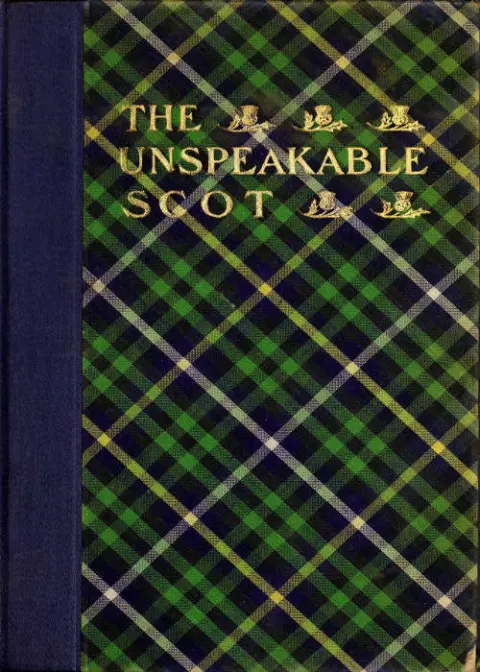
The Unspeakable Scot — digital edition cover

THE CLASSIC COLLECTION · 1902

The Unspeakable Scot

"The Unspeakable Scot" by T. W. H. Crosland is a critical examination of Scottish culture and character written in the early 20th century. This work combines elements of essay and social commentary, showcasing a blend of humor and satire as it dissects various stereotypes and perceptions of Scots. The author expresses a strong personal viewpoint, suggesting a general disdain for Scottish traits and portraying Scotsmen, particularly in their interactions with the English, in a rather unflattering light. The opening of the book introduces the author's perspective, revealing his intention to critique the Scottish character while also acknowledging the fierce pride Scots often hold regarding their identity. He humorously suggests that Scotsmen believe themselves to be the "salt of the earth," but argues that this self-perception is inflated and misleading. The passage contrasts two schools of thought—the Old School that romanticizes Scottish virtues, and the New School that offers a more critical and cynical view. Through anecdotes and observations, the author explores themes such as pride, independence, and the complexities of identity, setting a provocative tone for the essays that follow.

Introduction adapted from the source catalogue; source summaries may be automatically generated.

Start reading ↓

Free to read · English · 37,300 words · No account needed

MAKE TIME FOR A GOOD BOOK

The Unspeakable Scot

On by default. Untick to stop anonymous reading totals. Each page counts after 10 seconds in view. How this works.

Anonymous counting is on unless you have switched it off.

The Unspeakable Scot

It is the Scotchman’s boast that the Scotchman has always figured portentously in the councils of the civilised nations. In France, in Germany, and even in unbeautiful Russia, Scotchmen have established themselves and at time and time risen to positions of considerable political power. And if we are to credit Dr. Hill Burton, this has always been an excellent thing for the nations concerned. According to Dr. Burton, if the Scotch did not entirely build up the France of the Middle Ages they had a mighty big finger in the process, and we are asked to believe by the same authority that it is the strain of Scotch blood in the veins of the French which has assisted very materially in making the fortunes of that singularly fascinating and ingenious people.[14] The subject is a large one, and much that is edifying has been written about it, not only by Scotchmen, but by various foreign authors. On the whole, perhaps, Europe has not done so badly with her Scots, the reason being that she never allowed them to be any Scotcher than she could help, and turned them out the minute they became aggressive. In England, however, the more Scotch and the more aggressive the Scot becomes the more we seem to like him. At the present moment England is virtually being run by the Scotch. In the House of Commons the Leader of the Government—and practically the autocrat of the Assembly—is the Right Honourable Arthur James Balfour, a philosopher from Scotland, who is so Scotch that he plays golf. And the Leader of the Opposition, save the mark! of an Opposition which, in a constitution like the British, carries upon its shoulders the heaviest responsibilities, is Sir Henry Campbell-Bannerman, also a Scotchman, and if the truth must be told, a dullard. And in the way of a third party, which will imperialise with the Government and cackle of reform with the Opposition, we have the Liberal Leaguers, headed by that proud chieftain of the pudding race—the Right Honourable the Earl of Rosebery. So that at the front of each of the three great political forces of Britain—the forces which, when all is said, mean everything to Britain as a nation—there stands firm and erect some sort of a Caledonian. Such a condition of things has never existed in England before, and in the light of recent political happenings it is devoutly to be hoped that it will never exist again. Since Mr. Balfour and Sir Henry Campbell-Bannerman came into the offices they hold, England has been going steadily down-hill. At no period in her history have her enemies been so thick on the ground and so exultant and sure of themselves as they are at present, and at no period in her history has her prestige been at so low an ebb. Politically she has come to count as a little less than France and more than Spain. Formerly she led the nations—now she is content to walk humbly in line with them. Formerly she led the band, now she is merely third trombone player. Formerly, if she went to war, it was with nations of ponderability and for high principles; until the other day, she was draining her best blood and getting rid of one and a half millions of money weekly in a struggle with a handful of freebooters, got up and fomented largely in the interests of the children of Israel. At the time of writing Consols are at 94 and the Income Tax is 1s. 2d. in the pound, which shows what managers the Scotch are. Also Government, in so far as Government means the steady development of the higher interests of the state at home and in the colonies, is at a dead standstill. The march of reform has been checked. Progress in the wide sense of the term is no more thought of. The legislative mill grinds heavily along and the grist amounts to nothing; in the seats of the mighty,—in the seats of Benjamin Disraeli and William Ewart Gladstone,—there blandly smiles Balfour and dodders Campbell-Bannerman. Mr. Balfour, golfer, and, for aught I know to the contrary, curler and hammer-putter, plays what he is pleased to call the game. Now the game is no new thing. Practically it is a development of that childish pastime known as “Jack’s on his Island.” On Mr. Balfour’s island grows the green bay tree of power, and to live snugly under the shade of that tree, no matter what comes, is, in the view of Mr. Balfour, the game. It is with him a question of what can I do for England, having due regard to the exigencies of the game? Hence does he seek and bring along young talent. Having found your young talent, you must make quite sure, not of its talentedness, but of its unwavering disposition to play the game. Will it be loyal to the Balfour? Can you depend upon it to stick by the Balfour though the heavens fall and it thunder to the tune of Green Sleeves? Anything that will subscribe to the Test Act of the Balfour is young talent. Hence it comes to pass that at the War Office we have had that shallow, dandy Wyndham. He is a protégé of the Balfour, even as the Balfour is the nephew of his uncle. And he plays the game. When matters at the War Office became too vasty for him he was shovelled by the Balfour into the Chief Secretaryship for Ireland. Even the Balfour and his friends are fain to admit that Mr. Wyndham has done no more for Ireland than he did for the War Office. Yet he plays the game, and so does the Balfour, and everything is right as right can be. In Mr. Wyndham’s old place at the War Office we have that excellent dabbler, Mr. Brodrick. Mr. Brodrick, like the House of Lords, has always been exceedingly busy doing nothing and doing it very well. Periodically he stands on his hind legs in the Commons and trots out tremendous schemes, all of which end pleasantly in smoke. The rottenness of the British Army is no affair of his; it was rotten when he first made its acquaintance—it will be just as rotten when he leaves Pall Mall. Underneath the terrific expenditure necessitated by the war there are jobs and scandals of the gravest sort, and Mr. Brodrick knows nothing about them. His business is to vindicate the characters of fribbling officers and gentlemen, to lay on praise of the British soldier with a trowel, and to assure the world at large that the persons who have brought charges against army contractors have brought those charges simply because the contractors’ names are un-English and consequently not pleasing to the British commercial mind. He it is, in short, who allows himself to be put up as a sort of sand-bag in front of the Government, guaranteed to ward off all attacks by simply sitting tight and remaining as dumb as an oyster. He was no doubt told when he took up his present dignities that the Balfour would expect him to play the game, and, being a good man, he is playing it.

Your reading position is saved on this browser. Take it to another device with a library code. Reading pages adapt to text, rather than matching a printed edition.

More from this author

BEHIND THE WORDS

About T. W. H. (Thomas William Hodgson) Crosland
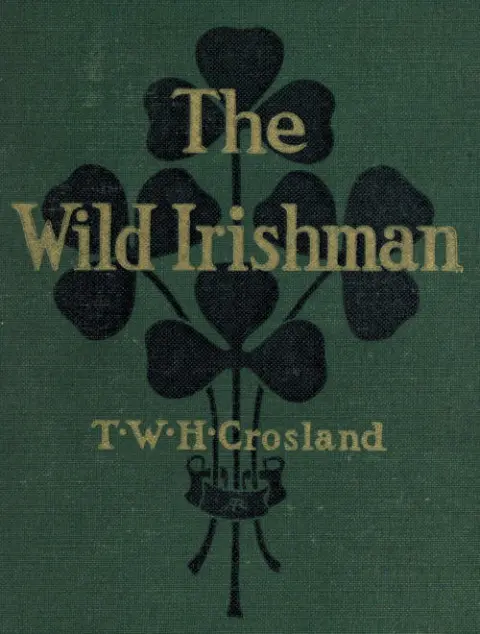
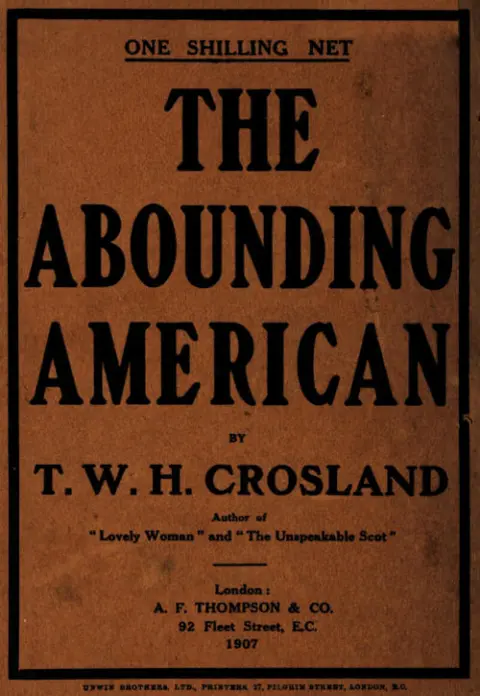
T. W. H. (Thomas William Hodgson) Crosland (1865–1924). Explore The Wild Irishman, The Egregious English, The Unspeakable Scot and other works in this collection. These books span essays & ideas, history.
Explore this author’s books →

THE READERS’ VERDICT

How did this story stay with you?

Not rated yet
Your rating for The Unspeakable Scot

Be the first to share your verdict.

One rating per browser, which you can change or remove. A necessary browser identifier remembers your vote. How ratings work

A GOOD STORY DESERVES COMPANY

Pass this book along.

A great read is even better when it’s shared.

SEND A LITTLE INSPIRATION

Share this book

BEHIND THE BOOK

Edition & source details.

Title
The Unspeakable Scot
Author
T. W. H. (Thomas William Hodgson) Crosland
Publication year
1902
Digital edition publisher
Project Gutenberg
Gutenberg release date
2017-12-18
Language
English
Source edition imprint
Not stated in source catalogue
Source identifier
Project Gutenberg #56204
Contributors
No additional named contributors in source metadata

Public-domain source & licence

This eBook is for the use of anyone anywhere in the United States and most other parts of the world at no cost and with almost no restrictions whatsoever. You may copy it, give it away or re-use it under the terms of the Project Gutenberg License included with this eBook or online at www.gutenberg.org. If you are not located in the United States, you will have to check the laws of the country where you are located before using this eBook. Read the source licence.

Full source licence and obtaining an original copy

The original source file, including credits and licence, is retained by this library. Request an original-format copy at no charge. Please include the book title and Project Gutenberg identifier #56204.

the full Project Gutenberg License must appear
prominently whenever any copy of a Project Gutenberg work (any work
on which the phrase “Project Gutenberg” appears, or with which the
phrase “Project Gutenberg” is associated) is accessed, displayed,
performed, viewed, copied or distributed:

This eBook is for the use of anyone anywhere in the United States and most
other parts of the world at no cost and with almost no restrictions
whatsoever. You may copy it, give it away or re-use it under the terms
of the Project Gutenberg™ License included with this eBook or online
at www.gutenberg.org. If you
are not located in the United States, you will have to check the laws
of the country where you are located before using this eBook.

1.E.2. If an individual Project Gutenberg electronic work is
derived from texts not protected by U.S. copyright law (does not
contain a notice indicating that it is posted with permission of the
copyright holder), the work can be copied and distributed to anyone in
the United States without paying any fees or charges. If you are
redistributing or providing access to a work with the phrase “Project
Gutenberg” associated with or appearing on the work, you must comply
either with the requirements of paragraphs 1.E.1 through 1.E.7 or
obtain permission for the use of the work and the Project Gutenberg
trademark as set forth in paragraphs 1.E.8 or 1.E.9.

1.E.3. If an individual Project Gutenberg electronic work is posted
with the permission of the copyright holder, your use and distribution
must comply with both paragraphs 1.E.1 through 1.E.7 and any
additional terms imposed by the copyright holder. Additional terms
will be linked to the Project Gutenberg License for all works
posted with the permission of the copyright holder found at the
beginning of this work.

1.E.4. Do not unlink or detach or remove the full Project Gutenberg
License terms from this work, or any files containing a part of this
work or any other work associated with Project Gutenberg.

1.E.5. Do not copy, display, perform, distribute or redistribute this
electronic work, or any part of this electronic work, without
prominently displaying the sentence set forth in paragraph 1.E.1 with
active links or immediate access to the full terms of the Project
Gutenberg License.

1.E.6. You may convert to and distribute this work in any binary,
compressed, marked up, nonproprietary or proprietary form, including
any word processing or hypertext form. However, if you provide access
to or distribute copies of a Project Gutenberg work in a format
other than “Plain Vanilla ASCII” or other format used in the official
version posted on the official Project Gutenberg website
(www.gutenberg.org), you must, at no additional cost, fee or expense
to the user, provide a copy, a means of exporting a copy, or a means
of obtaining a copy upon request, of the work in its original “Plain
Vanilla ASCII” or other form. Any alternate format must include the
full Project Gutenberg License as specified in paragraph 1.E.1.

1.E.7. Do not charge a fee for access to, viewing, displaying,
performing, copying or distributing any Project Gutenberg works
unless you comply with paragraph 1.E.8 or 1.E.9.

1.E.8. You may charge a reasonable fee for copies of or providing
access to or distributing Project Gutenberg electronic works
provided that:

• You pay a royalty fee of 20% of the gross profits you derive from
the use of Project Gutenberg works calculated using the method
you already use to calculate your applicable taxes. The fee is owed
to the owner of the Project Gutenberg trademark, but he has
agreed to donate royalties under this paragraph to the Project
Gutenberg Literary Archive Foundation. Royalty payments must be paid
within 60 days following each date on which you prepare (or are
legally required to prepare) your periodic tax returns. Royalty
payments should be clearly marked as such and sent to the Project
Gutenberg Literary Archive Foundation at the address specified in
Section 4, “Information about donations to the Project Gutenberg
Literary Archive Foundation.”

• You provide a full refund of any money paid by a user who notifies
you in writing (or by e-mail) within 30 days of receipt that s/he
does not agree to the terms of the full Project Gutenberg™
License. You must require such a user to return or destroy all
copies of the works possessed in a physical medium and discontinue
all use of and all access to other copies of Project Gutenberg™
works.

• You provide, in accordance with paragraph 1.F.3, a full refund of
any money paid for a work or a replacement copy, if a defect in the
electronic work is discovered and reported to you within 90 days of
receipt of the work.

• You comply with all other terms of this agreement for free
distribution of Project Gutenberg™ works.


1.E.9. If you wish to charge a fee or distribute a Project
Gutenberg™ electronic work or group of works on different terms than
are set forth in this agreement, you must obtain permission in writing
from the Project Gutenberg Literary Archive Foundation, the manager of
the Project Gutenberg™ trademark. Contact the Foundation as set
forth in Section 3 below.

1.F.

1.F.1. Project Gutenberg volunteers and employees expend considerable
effort to identify, do copyright research on, transcribe and proofread
works not protected by U.S. copyright law in creating the Project
Gutenberg™ collection. Despite these efforts, Project Gutenberg™
electronic works, and the medium on which they may be stored, may
contain “Defects,” such as, but not limited to, incomplete, inaccurate
or corrupt data, transcription errors, a copyright or other
intellectual property infringement, a defective or damaged disk or
other medium, a computer virus, or computer codes that damage or
cannot be read by your equipment.

1.F.2. LIMITED WARRANTY, DISCLAIMER OF DAMAGES - Except for the “Right
of Replacement or Refund” described in paragraph 1.F.3, the Project
Gutenberg Literary Archive Foundation, the owner of the Project
Gutenberg™ trademark, and any other party distributing a Project
Gutenberg™ electronic work under this agreement, disclaim all
liability to you for damages, costs and expenses, including legal
fees. YOU AGREE THAT YOU HAVE NO REMEDIES FOR NEGLIGENCE, STRICT
LIABILITY, BREACH OF WARRANTY OR BREACH OF CONTRACT EXCEPT THOSE
PROVIDED IN PARAGRAPH 1.F.3. YOU AGREE THAT THE FOUNDATION, THE
TRADEMARK OWNER, AND ANY DISTRIBUTOR UNDER THIS AGREEMENT WILL NOT BE
LIABLE TO YOU FOR ACTUAL, DIRECT, INDIRECT, CONSEQUENTIAL, PUNITIVE OR
INCIDENTAL DAMAGES EVEN IF YOU GIVE NOTICE OF THE POSSIBILITY OF SUCH
DAMAGE.

1.F.3. LIMITED RIGHT OF REPLACEMENT OR REFUND - If you discover a
defect in this electronic work within 90 days of receiving it, you can
receive a refund of the money (if any) you paid for it by sending a
written explanation to the person you received the work from. If you
received the work on a physical medium, you must return the medium
with your written explanation. The person or entity that provided you
with the defective work may elect to provide a replacement copy in
lieu of a refund. If you received the work electronically, the person
or entity providing it to you may choose to give you a second
opportunity to receive the work electronically in lieu of a refund. If
the second copy is also defective, you may demand a refund in writing
without further opportunities to fix the problem.

1.F.4. Except for the limited right of replacement or refund set forth
in paragraph 1.F.3, this work is provided to you ‘AS-IS’, WITH NO
OTHER WARRANTIES OF ANY KIND, EXPRESS OR IMPLIED, INCLUDING BUT NOT
LIMITED TO WARRANTIES OF MERCHANTABILITY OR FITNESS FOR ANY PURPOSE.

1.F.5. Some states do not allow disclaimers of certain implied
warranties or the exclusion or limitation of certain types of
damages. If any disclaimer or limitation set forth in this agreement
violates the law of the state applicable to this agreement, the
agreement shall be interpreted to make the maximum disclaimer or
limitation permitted by the applicable state law. The invalidity or
unenforceability of any provision of this agreement shall not void the
remaining provisions.

1.F.6. INDEMNITY - You agree to indemnify and hold the Foundation, the
trademark owner, any agent or employee of the Foundation, anyone
providing copies of Project Gutenberg™ electronic works in
accordance with this agreement, and any volunteers associated with the
production, promotion and distribution of Project Gutenberg™
electronic works, harmless from all liability, costs and expenses,
including legal fees, that arise directly or indirectly from any of
the following which you do or cause to occur: (a) distribution of this
or any Project Gutenberg work, (b) alteration, modification, or
additions or deletions to any Project Gutenberg work, and (c) any
Defect you cause.

Section 2. Information about the Mission of Project Gutenberg

Project Gutenberg is synonymous with the free distribution of
electronic works in formats readable by the widest variety of
computers including obsolete, old, middle-aged and new computers. It
exists because of the efforts of hundreds of volunteers and donations
from people in all walks of life.

Volunteers and financial support to provide volunteers with the
assistance they need are critical to reaching Project Gutenberg’s
goals and ensuring that the Project Gutenberg collection will
remain freely available for generations to come. In 2001, the Project
Gutenberg Literary Archive Foundation was created to provide a secure
and permanent future for Project Gutenberg and future
generations. To learn more about the Project Gutenberg Literary
Archive Foundation and how your efforts and donations can help, see
Sections 3 and 4 and the Foundation information page at www.gutenberg.org.

Section 3. Information about the Project Gutenberg Literary Archive Foundation

The Project Gutenberg Literary Archive Foundation is a non-profit
501(c)(3) educational corporation organized under the laws of the
state of Mississippi and granted tax exempt status by the Internal
Revenue Service. The Foundation’s EIN or federal tax identification
number is 64-6221541. Contributions to the Project Gutenberg Literary
Archive Foundation are tax deductible to the full extent permitted by
U.S. federal laws and your state’s laws.

The Foundation’s business office is located at 41 Watchung Plaza #516,
Montclair NJ 07042, USA, +1 (862) 621-9288. Email contact links and up
to date contact information can be found at the Foundation’s website
and official page at www.gutenberg.org/contact

Section 4. Information about Donations to the Project Gutenberg
Literary Archive Foundation

Project Gutenberg™ depends upon and cannot survive without widespread
public support and donations to carry out its mission of
increasing the number of public domain and licensed works that can be
freely distributed in machine-readable form accessible by the widest
array of equipment including outdated equipment. Many small donations
($1 to $5,000) are particularly important to maintaining tax exempt
status with the IRS.

The Foundation is committed to complying with the laws regulating
charities and charitable donations in all 50 states of the United
States. Compliance requirements are not uniform and it takes a
considerable effort, much paperwork and many fees to meet and keep up
with these requirements. We do not solicit donations in locations
where we have not received written confirmation of compliance. To SEND
DONATIONS or determine the status of compliance for any particular state
visit www.gutenberg.org/donate.

While we cannot and do not solicit contributions from states where we
have not met the solicitation requirements, we know of no prohibition
against accepting unsolicited donations from donors in such states who
approach us with offers to donate.

International donations are gratefully accepted, but we cannot make
any statements concerning tax treatment of donations received from
outside the United States. U.S. laws alone swamp our small staff.

Please check the Project Gutenberg web pages for current donation
methods and addresses. Donations are accepted in a number of other
ways including checks, online payments and credit card donations. To
donate, please visit: www.gutenberg.org/donate.

Section 5. General Information About Project Gutenberg electronic works

Professor Michael S. Hart was the originator of the Project
Gutenberg concept of a library of electronic works that could be
freely shared with anyone. For forty years, he produced and
distributed Project Gutenberg eBooks with only a loose network of
volunteer support.

Project Gutenberg eBooks are often created from several printed
editions, all of which are confirmed as not protected by copyright in
the U.S. unless a copyright notice is included. Thus, we do not
necessarily keep eBooks in compliance with any particular paper
edition.

Most people start at our website which has the main PG search
facility: www.gutenberg.org.

This website includes information about Project Gutenberg,
including how to make donations to the Project Gutenberg Literary
Archive Foundation, how to help produce our new eBooks, and how to
subscribe to our email newsletter to hear about new eBooks.


KEEP YOUR CURIOSITY GOING

Your next chapter awaits.





