The well of loneliness
Radclyffe Hall
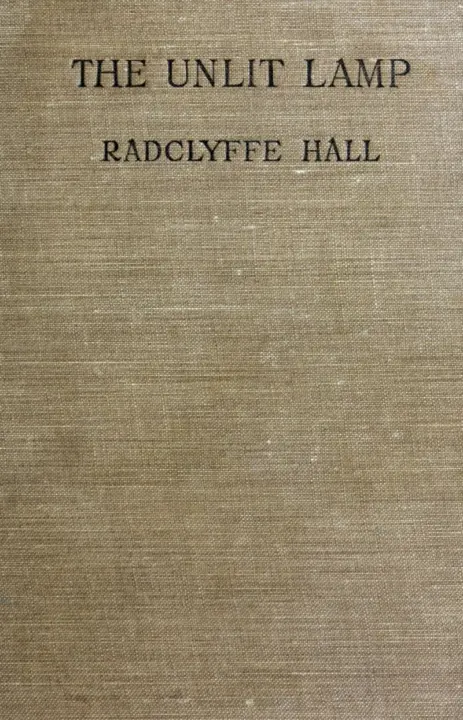
THE CLASSIC COLLECTION · 1924
"The Unlit Lamp" by Radclyffe Hall is a novel written in the early 20th century. The story revolves around the lives of the Ogden family, particularly focusing on the relationship between the parents, Colonel and Mrs. Ogden, and their daughters, Joan and Milly. It depicts the challenges and dynamics within the family, exploring themes of authority, aspirations, and societal expectations. The opening of "The Unlit Lamp" introduces Colonel Ogden, who is characterized by his strictness and overbearing nature, as he scrutinizes household expenses while reflecting on his life in a military context. His wife, Mrs. Ogden, appears weary and is portrayed as a dutiful yet anxious figure, struggling to balance her husband's demands and her sensitivity to her daughters' needs. The two daughters offer contrasting personalities: Milly is depicted as charming and carefree, while Joan stands out as an introspective and strong-minded child, often confronting issues of fairness and justice within their home life. This initial section sets the tone for the conflicts and emotional currents that will define the family's narrative.
Introduction adapted from the source catalogue; source summaries may be automatically generated.
Free to read · English · 112,002 words · No account needed
MAKE TIME FOR A GOOD BOOK
On by default. Untick to stop anonymous reading totals. Each page counts after 10 seconds in view. How this works.
Anonymous counting is on unless you have switched it off.
"Yes, I mean we'd be rich."
She stopped to consider him thoughtfully. A good-looking man, too well dressed; a dull man, too conscious of worldly success; a shy man, too shy not to be over-bold at times. A youngish man still, too pompous to be youthful.
"Would you like to marry a woman who doesn't love you?" she asked him
curiously.
"I'd like to marry you, Elizabeth."
"But why? I can't imagine why anyone should want to marry me."
"I want to marry you because you're everything I love. My dear Elizabeth, if you were seventy I should still love you."
"You think so now, because I'm not seventy."
"Look here;" he said suddenly. "Is it still Joan that's stopping you?"
She stiffened. "I said I didn't love you, isn't that enough?"
He continued in his train of thought. "Because if it is Joan, you know, just think how we could help her, in her career, I mean. She'll need money and I have at least got that. If you'll marry me, Elizabeth, I swear I'll do more for that girl than I'd do for my own sister. Say you'll marry me, Elizabeth----"
She pushed his hand away from her arm rather roughly. "If I married you," she said, "I should have to stop thinking of Joan's career; it would be your career then, not hers; and in any case money will never help Joan."
"Why not?"
"Because she's Joan, I suppose; she's not like anyone else in the
world."
He was silent, his rejected hand hanging limply at his side. Presently he said: "You do love that child. I suppose it's because you've had the making of her."
"I suppose so; she's a very lovable creature."
"I know. Well, think it over."
"You're a patient man, Lawrence."
"There's no help for it."
"I wish you'd marry someone else, that is if you want to marry at all; it may take me such a long time to think it over."
He looked at her stubbornly. "I'll wait," he said. "I'm the waiting kind when I want a thing badly enough."
MILLY'S illness was discussed at every tea-table in Seabourne, and proved a grateful topic in the stiff little club as well. If the Ogdens did nothing else, they certainly provided food for comment. Joan's Short Hair, the Colonel's Death, Mrs. Ogden's Popish Tendencies and now Milly's Consumption were hailed in turn with discreet enthusiasm.
Major Boyle, the doleful politician, killed Milly off at least a dozen
times that spring.
"Family's riddled with it!" he remarked lugubriously. "I happen to know for a fact that three of the mother's brothers died of it."
Your reading position is saved on this browser. Take it to another device with a library code. Reading pages adapt to text, rather than matching a printed edition.
BEHIND THE BOOK
This eBook is for the use of anyone anywhere in the United States and most other parts of the world at no cost and with almost no restrictions whatsoever. You may copy it, give it away or re-use it under the terms of the Project Gutenberg License included with this eBook or online at www.gutenberg.org. If you are not located in the United States, you will have to check the laws of the country where you are located before using this eBook. Read the source licence.
The original source file, including credits and licence, is retained by this library. Request an original-format copy at no charge. Please include the book title and Project Gutenberg identifier #69137.
KEEP YOUR CURIOSITY GOING
Coulson Kernahan

Maurice Baring
Frances Wright
Cécile Tormay

Frederic Jesup Stimson

W. H. P. (William Henry Pope) Jarvis