The well of loneliness
Radclyffe Hall
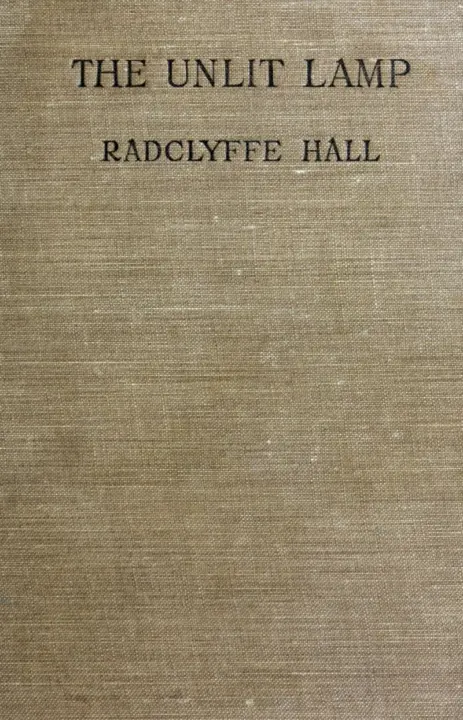
THE CLASSIC COLLECTION · 1924
"The Unlit Lamp" by Radclyffe Hall is a novel written in the early 20th century. The story revolves around the lives of the Ogden family, particularly focusing on the relationship between the parents, Colonel and Mrs. Ogden, and their daughters, Joan and Milly. It depicts the challenges and dynamics within the family, exploring themes of authority, aspirations, and societal expectations. The opening of "The Unlit Lamp" introduces Colonel Ogden, who is characterized by his strictness and overbearing nature, as he scrutinizes household expenses while reflecting on his life in a military context. His wife, Mrs. Ogden, appears weary and is portrayed as a dutiful yet anxious figure, struggling to balance her husband's demands and her sensitivity to her daughters' needs. The two daughters offer contrasting personalities: Milly is depicted as charming and carefree, while Joan stands out as an introspective and strong-minded child, often confronting issues of fairness and justice within their home life. This initial section sets the tone for the conflicts and emotional currents that will define the family's narrative.
Introduction adapted from the source catalogue; source summaries may be automatically generated.
Free to read · English · 112,002 words · No account needed
MAKE TIME FOR A GOOD BOOK
On by default. Untick to stop anonymous reading totals. Each page counts after 10 seconds in view. How this works.
Anonymous counting is on unless you have switched it off.
"No, you're not; do let me call that cab for you; it's awfully unwise to walk on a strained ankle."
"Oh, for goodness' sake," snapped Joan, "do let me know for myself
whether I'm hurt or not!"
She realized that she was behaving badly; she could hear the irritation in her own voice. Moreover, she knew that she was spoiling the walk by limping along and refusing to go home; but some spirit of perverseness was dominating her. She felt that she disliked Lawrence quite enormously, and at that moment she almost disliked Elizabeth. Why had Elizabeth accepted her hat from Lawrence's hand? She should have said something like this: "Give it to Joan, please; I would rather Joan gave me my hat." Ridiculous! She laughed aloud.
"What are you laughing at?" inquired Lawrence.
"Oh, nothing, only my thoughts."
"Can't we share the joke?"
"No, it wouldn't amuse you."
"Oh, do go back, Joan," said Elizabeth irritably. "You're hardly able to
walk."
"Do you want me to go back, then?"
"Yes, of course I do; and put on a cold water bandage as soon as you get
home."
Joan looked at her with darkening eyes, and left them abruptly.
"What on earth's upset her?" asked Lawrence, genuinely concerned.
"Nothing--why? She's not upset."
"She seemed angry about something."
"Oh, I don't think so. Probably her ankle was hurting her rather badly, only she didn't want to admit it."
"Well, I thought she was angry. But never mind, let's talk about you." And he edged a little nearer.
Elizabeth evaded the hand that hovered in the vicinity of her arm. "I'm so dull to talk about," she parried. "Let's talk about metaphysics!"
He gripped her arm now in a grasp that there was no evading. "Why will you always make fun of me, Elizabeth?"
She was silent, her head drooped, and he, misunderstanding the movement,
tightened his fingers.
"I love you!" he said rather loudly in her ear, raising his voice to be heard through the wind. "When will you marry me, dearest?"
"Oh, Lawrence, don't," she protested. "Some day, perhaps, or never. I
don't know!"
"But you do love me a little, Elizabeth, don't you?"
"No, not a bit; I don't love you at all."
"But you would. I'd make you."
"How would you make me?"
He considered. "I don't know," he admitted lamely; "but I'd find a way, try me and see; it's not possible that I shouldn't find a way."
He was very sincere, that was the worst of it. His eyes glowed fondly at
her behind his glasses.
"And, my dear, I could give you all you want," he added.
"All I want, Lawrence?"
Your reading position is saved on this browser. Take it to another device with a library code. Reading pages adapt to text, rather than matching a printed edition.
BEHIND THE BOOK
This eBook is for the use of anyone anywhere in the United States and most other parts of the world at no cost and with almost no restrictions whatsoever. You may copy it, give it away or re-use it under the terms of the Project Gutenberg License included with this eBook or online at www.gutenberg.org. If you are not located in the United States, you will have to check the laws of the country where you are located before using this eBook. Read the source licence.
The original source file, including credits and licence, is retained by this library. Request an original-format copy at no charge. Please include the book title and Project Gutenberg identifier #69137.
KEEP YOUR CURIOSITY GOING
Coulson Kernahan

Maurice Baring
Frances Wright
Cécile Tormay

Frederic Jesup Stimson

W. H. P. (William Henry Pope) Jarvis