
The Writing of News A Handbook with Chapters on Newspaper Correspondence and Copy Reading
Charles G. (Charles Griffith) Ross
THE CLASSIC COLLECTION · 1914
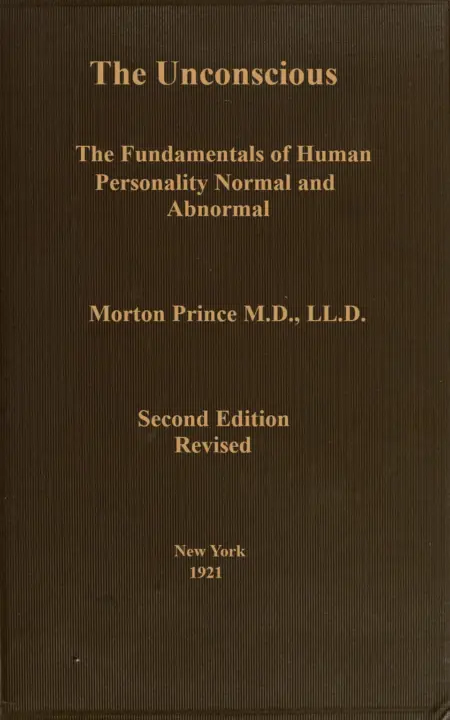
"The Unconscious: The Fundamentals of Human Personality, Normal and Abnormal" by Morton Prince, M.D., LL.D. is a scientific publication written in the early 20th century. This work serves as an introduction to abnormal psychology and discusses the mechanisms of human personality, focusing on both normal and pathological aspects. The author employs the inductive method to gather existing knowledge on the subconscious and aims to clarify foundational concepts for understanding psychological phenomena. The opening portion of the text establishes the groundwork for a thorough exploration of memory and its processes as fundamental to the understanding of the unconscious. Prince outlines the theory of memory not just as conscious recall but as a complex process involving registration, conservation, and reproduction of experiences. He emphasizes the significance of subconscious processes, suggesting that many aspects of human behavior and personality are influenced by elements of past experiences that may not be consciously remembered. Through various examples, including hypnosis and automatic writing, Prince illustrates how forgotten memories can be conserved and subsequently accessed, setting the stage for deeper discussions on the dynamics of human personality in later chapters.
Introduction adapted from the source catalogue; source summaries may be automatically generated.
Free to read · English · 165,396 words · No account needed
MAKE TIME FOR A GOOD BOOK
On by default. Untick to stop anonymous reading totals. Each page counts after 10 seconds in view. How this works.
Anonymous counting is on unless you have switched it off.
Finally, it should be said that much of what is not ordinarily regarded as memory is made up of conserved experiences. A large part of every mental content is memory the source of which is forgotten. Just as our vocabulary is memory, though we do not remember how and where it was acquired, so our judgments, beliefs, and opinions are in large part made up of past experiences which are forgotten but which have left their traces as integral parts of concepts ingrained in our personalities.
Footnote 27:
For a full account of this experiment, see An Experimental Study of Visions, Brain, Winter Number, 1898; The Dissociation, pp. 81, 82.
Footnote 28:
The Dissociation, p. 77.
Footnote 29:
For numerous observations of this kind, see Pierre Janet: The Mental
States of Hystericals.
Footnote 30:
The Mechanism and Interpretation of Dreams, loc. cit.
Footnote 31:
Loc. cit. See p. 51.
Footnote 32:
See Lecture VI, p. 185.
Footnote 33:
Gurney was among the first to demonstrate the induction of several states in the same subject. He was able to obtain three different hypnotic states (Proceedings S. P. R., Vol. IV, p. 515), and Mrs. Sidgwick and Miss Johnson eight in one individual, each with amnesia for the other. Janet, of course, demonstrated the same phenomena. In the cases of Miss B. and B. C. A. I obtained a large number of such states.
Footnote 34:
Morton Prince: The Dissociation, p. 55; also An Experimental Study of Visions, Brain, Winter Number, 1898.
Footnote 35:
Some of the Revelations of Hypnotism, Boston Medical and Surgical
Journal, May 22, 1890.
Footnote 36:
Studien über Hysterie.
Footnote 37:
Of course I am not discussing here the genetic mechanism of the amnesia, being concerned only with the principle of conservation.
Footnote 38:
The Dissociation, pp. 284-5, 456-9.
Footnote 39:
Boris Sidis: The Psychology of Suggestion, p. 224; see also Multiple
Personality, p. 143.
Footnote 40:
The Journal of Abnormal Psychology, Vol. II, p. 93.
Footnote 41:
The Dissociation, pp. 220, 221, 255, 531, 532.
Footnote 42:
The Dissociation, p. 83.
Footnote 43:
The Journal of Abnormal Psychology, Vol. I, No. 3.
Footnote 44:
American Journal of Insanity, July, 1910.
A consideration of all the facts of observation and experiment of the kind which I have recited in the last two lectures—and I might have multiplied them many times—forces us to the conclusion that whether or not we can recall any given experience it may be still conserved. Bear in mind that I have used conservation, thus far, only in the sense that under favoring changes in the moment’s consciousness, or by special methods of stimulation, a past experience may reproduce itself, or may be made to reproduce itself, in one form or another of memory.
Your reading position is saved on this browser. Take it to another device with a library code. Reading pages adapt to text, rather than matching a printed edition.
BEHIND THE BOOK
This eBook is for the use of anyone anywhere in the United States and most other parts of the world at no cost and with almost no restrictions whatsoever. You may copy it, give it away or re-use it under the terms of the Project Gutenberg License included with this eBook or online at www.gutenberg.org. If you are not located in the United States, you will have to check the laws of the country where you are located before using this eBook. Read the source licence.
The original source file, including credits and licence, is retained by this library. Request an original-format copy at no charge. Please include the book title and Project Gutenberg identifier #69930.
KEEP YOUR CURIOSITY GOING
Charles G. (Charles Griffith) Ross
Hannah Webster Foster

Emily Lawless
Edwin Hamlin Carr

Charles De Lano Hine
Andrew Ure