
The Writing of News A Handbook with Chapters on Newspaper Correspondence and Copy Reading
Charles G. (Charles Griffith) Ross
THE CLASSIC COLLECTION · 1914
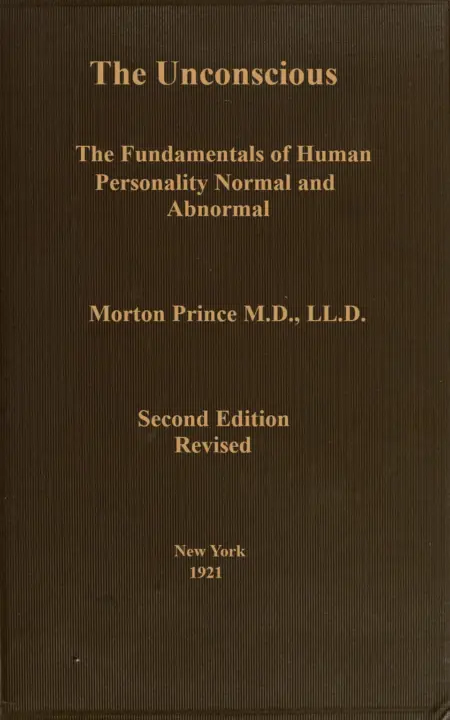
"The Unconscious: The Fundamentals of Human Personality, Normal and Abnormal" by Morton Prince, M.D., LL.D. is a scientific publication written in the early 20th century. This work serves as an introduction to abnormal psychology and discusses the mechanisms of human personality, focusing on both normal and pathological aspects. The author employs the inductive method to gather existing knowledge on the subconscious and aims to clarify foundational concepts for understanding psychological phenomena. The opening portion of the text establishes the groundwork for a thorough exploration of memory and its processes as fundamental to the understanding of the unconscious. Prince outlines the theory of memory not just as conscious recall but as a complex process involving registration, conservation, and reproduction of experiences. He emphasizes the significance of subconscious processes, suggesting that many aspects of human behavior and personality are influenced by elements of past experiences that may not be consciously remembered. Through various examples, including hypnosis and automatic writing, Prince illustrates how forgotten memories can be conserved and subsequently accessed, setting the stage for deeper discussions on the dynamics of human personality in later chapters.
Introduction adapted from the source catalogue; source summaries may be automatically generated.
Free to read · English · 165,396 words · No account needed
MAKE TIME FOR A GOOD BOOK
On by default. Untick to stop anonymous reading totals. Each page counts after 10 seconds in view. How this works.
Anonymous counting is on unless you have switched it off.
Footnote 305:
See Addendum to index on page 654.
Barrows, Ira, 213.
“B. C. A.”, 159, 302.
Bergson, viii.
Bicknel, 428, 429, 430, 431.
Bidder and Schmidt, 427.
Bogen, 429, 430.
Breuer, J., 69.
Cade and Latarjet, 428.
Cannon, W. B., 426, 428, 432, 439, 452, 453.
Charcot, 77, 526.
Coriat, I. H., 76, 145.
De la Paz, D., 432.
Dickenson, C. Lowe, 19.
Emerson, Ralph Waldo, 330.
Féré, Ch., 423, 433, 436.
Flournoy, Th., 304.
Foster, M., 233, 242.
Freud, Sigmund, 45, 71, 196, 203, 221, 509.
Fullerton, G. S., 309.
Goltz, F., 232.
Gurney, Edmund, 62, 157.
Haldane, (Lord), 307.
Hartmann, 250, 251.
Herbart, 250, 251.
Hilton, 453.
Hoernlé, R. F., 322, 325.
“Mrs. Holland,” 22.
Hornborg, 427, 428, 429.
James, William, 223, 224, 260.
Janet, Pierre, 56, 62, 77, 157, 252, 281, 317, 364, 485, 498, 499, 500,
501, 506, 509, 526.
Johnson, (Miss) Alice, 22, 62.
Jung, C. J., 425, 437.
Kant, 250, 251.
Leibnitz, 250, 251.
Loeb, J., 232, 233, 236.
Lucretius, 309.
McDougall, William, 241, 446, 447, 448, 449, 450, 455, 456, 458.
Meltzer, S. J., 123.
Morgan, Lloyd, 234, 237, 238, 241.
Mosso, 423.
Myers, Frederick W. H., 251.
Pawlow, J. P., 139, 235, 426, 427, 428, 429, 430, 431.
Peterson, Frederick, 106, 425, 437, 481.
Pilgrim, C. W., 81.
Ribôt, Th., 133, 144.
Rignano, Eugenio, 127.
Robertson, T. Brailsford, 124, 125, 127, 514.
Rothmann, Von M., 232, 234.
Rumbold, Horace, 223.
Schäfer, E. A., 232.
Schilling, 250.
Schrader, Max E. G., 232, 234, 235, 236.
Semon, Richard, 131.
Shand, 267, 449.
Sharp, Elizabeth A., 297.
Sherrington, C. S., 231, 234, 237.
Shohl, A. T., 432.
Sidgwick, Mrs. Henry, 62.
Sidis, Boris, 75, 104, 145, 183, 315.
Sidis and Kalmas, 104, 437, 438.
Sidis and Nelson, 104, 438.
Tallentyre, 271.
Titchener, E. B., 316, 321.
Turquan, Joseph, 274.
Umber, 427.
Verrall, (Mrs.), 21.
Vigouroux, A., 436.
Waterman, G. A., 169, 209.
Wells and Forbes, 438.
Wright, W. S., 432.
=Absent-minded acts=, conservation of, 50.
=Affective states=, suppression of, by conflict, 455.
=Affects=, see =Emotion=.
as conative force of ideas, 448.
linking of, to ideas fundamental for the pathology of the
psychoneuroses, 449.
=Amnesia=, continuous, 76;
episodic, 69;
epochal, 74.
from conflict, 71, 508–518.
theory of, following emotion, 509–514.
different forms of, following emotion, 514–517.
=Anxiety neurosis=, emergence of emotion from a subconscious idea in,
382, 526.
=Association neuroses=, 279, 527.
=Association psychoses=, 278.
=Bashfulness= as resultant of emotional conflict, 520.
=Behavior=, acquired and instinctive, 237, 238;
conscious and unconscious, 230.
=Coconscious=, the meaning of the, 247–254.
=Coconscious= ideas, 168, 249, 254.
images, 169–171, 178, 208, 210, 374–376.
=Coconscious= processes, auto-analysis of the content of, 171, 176.
=Complex= of ideas, definition of a, 265.
=Complexes= (systematized), dissociated, as phases of multiple
personality, 299–302.
emotional, 267;
organization of emotional, 267–274.
systematized, 283:
Subject systems, 284;
alternation of, 288;
in dissociated personality, 288.
Chronological systems, 290;
differentiated by amnesia, 290–294.
Mood systems, 294;
regarded as a “side to one’s character,” 295;
illustrated by William Sharp, 296.
unconscious, organization of, in hypnotic and other dissociated
conditions, 302–306;
in pathological states, 305;
in psychotherapeutics, 288–289, 304;
underlying the individual, social, civic and national conscience,
public opinion, Sittlichkeit, etc., 307.
=Conflict=, from conative force of emotion, 71, 454.
between conscious and subconscious sentiments, 460, 467–480;
in pathological conditions, 478;
under experimental conditions, 470–478.
=Conflict= between emotional impulses, 454;
and sentiments, 455.
between two subconscious processes, 480.
general phenomena of, 488:
contraction of field of consciousness and personality, 489–492;
the hysterical state, 492;
systematized dissociation, 492–504;
systematized anesthesia, 492;
contracted personality, 496;
change of sentiments, 497;
alternation of personality, 501;
multiple personality, 502;
amnesia, 508–517;
subconscious traumatic memories, 517;
mental confusion, 519–521;
bashfulness, 520;
self-consciousness, 521.
suppression of instincts and affective states by, 454–458.
=Confusion= (mental), as resultant of emotional conflicts, 519;
theory of, 520.
=Conservation=, meaning of, 12.
a residuum of experience, 87.
considered as psychological residua, 110;
as coconscious ideas, 111;
as an undifferentiated psyche, 115;
as physical residua, 117;
as neural dispositions, 117.
evidence of, furnished by automatic writing, 15;
abstraction, 24;
hypnosis, 31;
hallucinatory phenomena, 39;
dreams, 43.
=Conservation=, of absent-minded acts, 50
of forgotten artificial states, 62;
(hypnosis, 62).
of forgotten dreams and somnambulisms, 59.
of forgotten experiences of normal life, 15.
of forgotten pathological states, 68
(amnesia, 68;
deliria, 79;
fugues, 75;
intoxications, 80;
multiple personality, 77).
of inner life, 85.
of subconscious perceptions, 52.
Your reading position is saved on this browser. Take it to another device with a library code. Reading pages adapt to text, rather than matching a printed edition.
BEHIND THE BOOK
This eBook is for the use of anyone anywhere in the United States and most other parts of the world at no cost and with almost no restrictions whatsoever. You may copy it, give it away or re-use it under the terms of the Project Gutenberg License included with this eBook or online at www.gutenberg.org. If you are not located in the United States, you will have to check the laws of the country where you are located before using this eBook. Read the source licence.
The original source file, including credits and licence, is retained by this library. Request an original-format copy at no charge. Please include the book title and Project Gutenberg identifier #69930.
KEEP YOUR CURIOSITY GOING
Charles G. (Charles Griffith) Ross
Hannah Webster Foster

Emily Lawless
Edwin Hamlin Carr

Charles De Lano Hine
Andrew Ure