
The Writing of News A Handbook with Chapters on Newspaper Correspondence and Copy Reading
Charles G. (Charles Griffith) Ross
THE CLASSIC COLLECTION · 1914
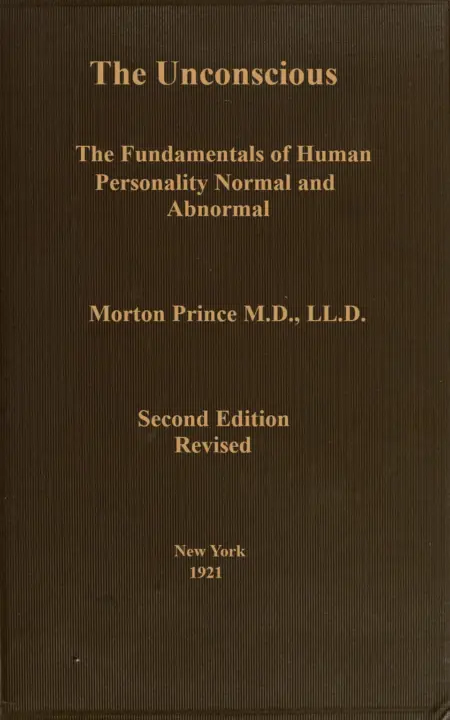
"The Unconscious: The Fundamentals of Human Personality, Normal and Abnormal" by Morton Prince, M.D., LL.D. is a scientific publication written in the early 20th century. This work serves as an introduction to abnormal psychology and discusses the mechanisms of human personality, focusing on both normal and pathological aspects. The author employs the inductive method to gather existing knowledge on the subconscious and aims to clarify foundational concepts for understanding psychological phenomena. The opening portion of the text establishes the groundwork for a thorough exploration of memory and its processes as fundamental to the understanding of the unconscious. Prince outlines the theory of memory not just as conscious recall but as a complex process involving registration, conservation, and reproduction of experiences. He emphasizes the significance of subconscious processes, suggesting that many aspects of human behavior and personality are influenced by elements of past experiences that may not be consciously remembered. Through various examples, including hypnosis and automatic writing, Prince illustrates how forgotten memories can be conserved and subsequently accessed, setting the stage for deeper discussions on the dynamics of human personality in later chapters.
Introduction adapted from the source catalogue; source summaries may be automatically generated.
Free to read · English · 165,396 words · No account needed
MAKE TIME FOR A GOOD BOOK
On by default. Untick to stop anonymous reading totals. Each page counts after 10 seconds in view. How this works.
Anonymous counting is on unless you have switched it off.
It is obvious that when such rearrangements and readjustments have occurred the mental reactions of the individual will vary largely from what they were before. The reaction to the environment will become altered. When systems which give rise to the habitual modes of thought are dissociated, naturally the reactions of the individual will not be influenced by them but by those of the new synthesis, and the character will be correspondingly changed. Inasmuch as out of the great storehouse of the unconscious any number of combinations of systems may be arranged, it is obvious that any number of secondary personalities may be formed in the same person. As many as ten or twelve have been observed.
A study of cases which have come under my personal observation, and the reports to be found in the literature of those cases of multiple personality which have been studied with sufficient intensity and exhaustiveness, allow these general and preliminary statements, which are little more than descriptive of the facts, to be verified.[266] One of the best examples is the case of B. C. A. which I had an opportunity of studying over a long period of time, and to which reference has been frequently made. I shall take this as the object of our study in psychogenesis.[267]
This subject has herself written at my request two introspective analyses of her own case, one by the normal personality and the other by the secondary personality. These analyses are of great value.[268] They give different versions of the same facts in accordance with the differing memories, knowledge and points of view of the differing personalities. The second also gives an account of the claimed co-conscious life as experienced by herself and unknown to the normal personality. We cannot do better than take them as a basis for a genetic study of the case and reproduce portions of them here. In this study I have made use, in addition to this material, of a large number of personal observations extending over five years, of numerous letters and analyses written by the subject at different times in her various phases of personality, of the memories in hypnosis, in which state many subconscious and dissociated perceptions and thoughts not otherwise remembered are brought to light, and of numerous analyses of her memories made on many occasions, at the expense of many hours of labor. Other sources of information have also been made use of. This investigation has resulted in a voluminous collection of records filling several large portfolios. In making the analyses and in many of the letters the subject, with extreme frankness and in the interests of psychology has gone in great detail into and has laid bare the most intimate facts of her mental life. This is true of each of the phases of personality, so that the point of view from which the same facts were seen in different moods has been obtained. This is a matter of no small consequence as the same fact often acquires a different aspect or meaning according to the view point of the mood in which it is experienced. A large amount of data pertaining to the inner life of the subject has thus become accessible. It is obvious that data of this sort are necessary if the psychological status of any given period of an individual’s life is to be related to antecedent mental experiences as etiological factors. But this sort of data is that which usually is most difficult to obtain. Our inner lives we keep hidden as in a sealed book from the world. In all published reports of multiple personality these data are lacking, the studies dealing almost entirely with such facts only as were open to the observation of the investigator. It necessarily results from such a study of the inner life of a person living in the circle to which this subject belongs that many of the data are too intimate and personal for publication. However much one may be interested in science there is a point beyond which one shrinks from exposing one’s self in print. I am, therefore, at many points very properly limited to the use of general phrases and summarizing expressions instead of explicit statements of particular facts which, I am aware, would be more satisfactory to the critic. This limitation cannot be helped, but is probably compensated for by the fact that, if it did not exist, the subject would be one whose introspective observations would be of much less value.
Your reading position is saved on this browser. Take it to another device with a library code. Reading pages adapt to text, rather than matching a printed edition.
BEHIND THE BOOK
This eBook is for the use of anyone anywhere in the United States and most other parts of the world at no cost and with almost no restrictions whatsoever. You may copy it, give it away or re-use it under the terms of the Project Gutenberg License included with this eBook or online at www.gutenberg.org. If you are not located in the United States, you will have to check the laws of the country where you are located before using this eBook. Read the source licence.
The original source file, including credits and licence, is retained by this library. Request an original-format copy at no charge. Please include the book title and Project Gutenberg identifier #69930.
KEEP YOUR CURIOSITY GOING
Charles G. (Charles Griffith) Ross
Hannah Webster Foster

Emily Lawless
Edwin Hamlin Carr

Charles De Lano Hine
Andrew Ure