
The Writing of News A Handbook with Chapters on Newspaper Correspondence and Copy Reading
Charles G. (Charles Griffith) Ross
THE CLASSIC COLLECTION · 1914
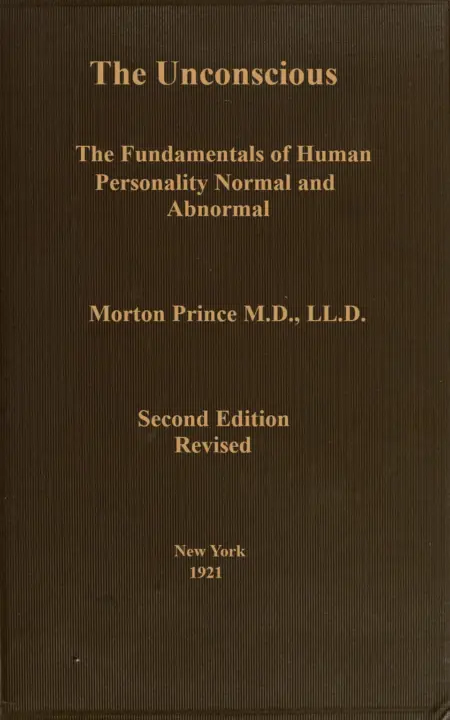
"The Unconscious: The Fundamentals of Human Personality, Normal and Abnormal" by Morton Prince, M.D., LL.D. is a scientific publication written in the early 20th century. This work serves as an introduction to abnormal psychology and discusses the mechanisms of human personality, focusing on both normal and pathological aspects. The author employs the inductive method to gather existing knowledge on the subconscious and aims to clarify foundational concepts for understanding psychological phenomena. The opening portion of the text establishes the groundwork for a thorough exploration of memory and its processes as fundamental to the understanding of the unconscious. Prince outlines the theory of memory not just as conscious recall but as a complex process involving registration, conservation, and reproduction of experiences. He emphasizes the significance of subconscious processes, suggesting that many aspects of human behavior and personality are influenced by elements of past experiences that may not be consciously remembered. Through various examples, including hypnosis and automatic writing, Prince illustrates how forgotten memories can be conserved and subsequently accessed, setting the stage for deeper discussions on the dynamics of human personality in later chapters.
Introduction adapted from the source catalogue; source summaries may be automatically generated.
Free to read · English · 165,396 words · No account needed
MAKE TIME FOR A GOOD BOOK
On by default. Untick to stop anonymous reading totals. Each page counts after 10 seconds in view. How this works.
Anonymous counting is on unless you have switched it off.
The unconscious resistance to suggestion is probably of the same nature. Every one knows that it is difficult to hypnotize a person who resists the suggestion. This resistance may come from a counter auto-suggestion which may be entirely involuntary, perhaps a conviction on the part of the subject that she cannot be hypnotized, or an unwillingness to be—i.e., desire not to be hypnotized or fear. The same is true of waking a person from hypnosis. In other words, an antagonistic preparedness of the mind blocks involuntarily the suggestion. A very pretty illustration is the following: H. O. discovered that she could easily and rapidly hypnotize herself by simply passing her own fingers over her eyelids, but she could not wake herself out of hypnosis. She then discovered that, if she first gave herself the suggestion that she would wake when she desired, she could quickly do so. Likewise, if she suggested to herself that she could not hypnotize herself the customary procedure was without effect. Though this observation is a common phenomenon the rapidity and ease with which the phenomenon was demonstrated were as striking as it was amusing to watch her struggle to awake when the preparatory anticipatory autosuggestion had not been given.
In O. N. more complicated phenomena induced by conflicts with subconscious complexes have been equally precise and striking. In this subject I find, as the result of repeated observations, that, in order that a suggestion, that is antagonistic to a preexisting attitude of mind possessing a strong feeling tone, shall not be resisted in hypnosis, it must be first formally accepted by the personality before hypnosis is induced. If this viewpoint is not preformed, after hypnosis is induced the blocking attitude cannot be altered. Practically this means that the subject shall bring into consciousness and disclose ideas with which the intended suggestion will conflict and shall modify them voluntarily. This she does by first candidly accepting a new point of view, and then, secondly, by a technical procedure of her own, namely, by preparing her mind not to resist in hypnosis. This procedure, briefly stated and simplified, is as follows: she first says to herself, “I will ‘take out’ that [resisting] idea.” Then she arranges in her thoughts the ideas of acceptance which she will substitute. Then she puts herself into a state of abstraction (hypnosis) and suggests to herself that the resisting idea is taken out and that my intended suggestion shall be her viewpoint. Even then, sometimes, when the resisting idea is one harking back to a long past period of life and belonging to a pathologically organized “mood,” known as the “b mood” or state, the acceptance of the suggestion may be ineffectual. Under these circumstances and when the hypnotic dissociation is carried too far, so that the hypnotic state is reduced to the “b mood,” the previously auto-suggested acceptance of the idea by the patient is thereby ostracized from the hypnotic field and is unable to play its part and have effect. So much by way of explanation. Now when the precaution has not been taken to see that any resisting idea has been “taken out” and when the intended suggestion has not been accepted, one of the following phenomena is observed: (1) the hypnotic personality when the suggestion is given becomes “automatically” and unconsciously restless, endeavors, without knowing why, to avoid listening, and to push me away, shifting her attitude and struggling to withdraw herself from contact or proximity—all the time the face expressing hostility and disapproval in its features; or (2) complete obnubilation of consciousness supervenes so that the suggestions are not heard; or (3) the subject suddenly wakes up. The last frequently happens as often as the suggestion is repeated; and yet in hypnosis (and also, of course, when awake), the subject is unaware of what causes the resistance and the resulting phenomena. But if now the subject is warned of what has occurred and accepts the suggestion by the procedure mentioned (unless the “b mood” I have mentioned recurs), the resistance and other phenomena at once cease and the suggestion takes effect. Thus in this case the conflicting ideas can always be precisely determined and the conditions of the experiment arranged at will and the results controlled. It is obvious that all three phenomena are different modes by which the subconscious idea resists the suggested idea and accomplishes its aim.
Your reading position is saved on this browser. Take it to another device with a library code. Reading pages adapt to text, rather than matching a printed edition.
BEHIND THE BOOK
This eBook is for the use of anyone anywhere in the United States and most other parts of the world at no cost and with almost no restrictions whatsoever. You may copy it, give it away or re-use it under the terms of the Project Gutenberg License included with this eBook or online at www.gutenberg.org. If you are not located in the United States, you will have to check the laws of the country where you are located before using this eBook. Read the source licence.
The original source file, including credits and licence, is retained by this library. Request an original-format copy at no charge. Please include the book title and Project Gutenberg identifier #69930.
KEEP YOUR CURIOSITY GOING
Charles G. (Charles Griffith) Ross
Hannah Webster Foster

Emily Lawless
Edwin Hamlin Carr

Charles De Lano Hine
Andrew Ure