
The Writing of News A Handbook with Chapters on Newspaper Correspondence and Copy Reading
Charles G. (Charles Griffith) Ross
THE CLASSIC COLLECTION · 1914
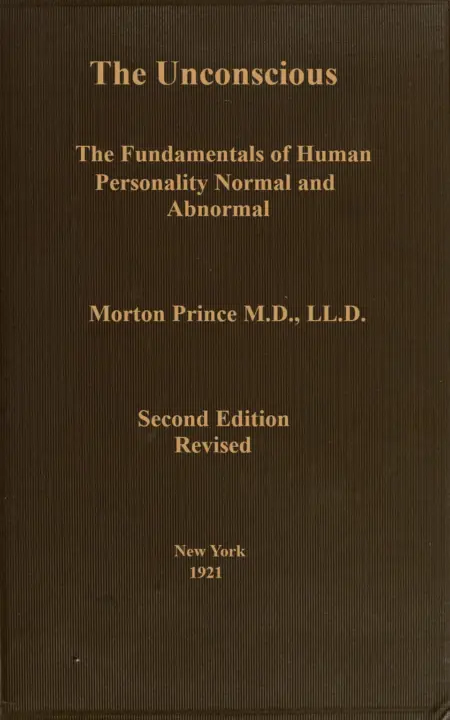
"The Unconscious: The Fundamentals of Human Personality, Normal and Abnormal" by Morton Prince, M.D., LL.D. is a scientific publication written in the early 20th century. This work serves as an introduction to abnormal psychology and discusses the mechanisms of human personality, focusing on both normal and pathological aspects. The author employs the inductive method to gather existing knowledge on the subconscious and aims to clarify foundational concepts for understanding psychological phenomena. The opening portion of the text establishes the groundwork for a thorough exploration of memory and its processes as fundamental to the understanding of the unconscious. Prince outlines the theory of memory not just as conscious recall but as a complex process involving registration, conservation, and reproduction of experiences. He emphasizes the significance of subconscious processes, suggesting that many aspects of human behavior and personality are influenced by elements of past experiences that may not be consciously remembered. Through various examples, including hypnosis and automatic writing, Prince illustrates how forgotten memories can be conserved and subsequently accessed, setting the stage for deeper discussions on the dynamics of human personality in later chapters.
Introduction adapted from the source catalogue; source summaries may be automatically generated.
Free to read · English · 165,396 words · No account needed
MAKE TIME FOR A GOOD BOOK
On by default. Untick to stop anonymous reading totals. Each page counts after 10 seconds in view. How this works.
Anonymous counting is on unless you have switched it off.
It now remains to study the effect of the emotions on the psychical side. This we shall do in the next lecture.
Footnote 196:
I use the word, not in the strict but in the popular and general sense, to include feeling, indeed all affective states, excepting where the context gives the strict meaning.
Footnote 197:
The James-Lange theory is disregarded here as untenable.
Footnote 198:
La Pathologie des Emotions, 1892.
Footnote 199:
Physiological Dilatation and the Mitral Sphincter as Factors in Functional and Organic Disturbances of the Heart, The American Journal of the Medical Sciences, February, 1901; also, The Occurrence and Mechanism of Physiological Heart Murmurs (Endocardial) in Healthy Individuals, The Medical Record, April 20, 1889.
Footnote 200:
The emotional factor is a source of possible fallacy in all observations on arterial tension and must be guarded against.
Footnote 201:
Frederick Peterson and C. G. Jung: Psycho-Physical Investigations with the Galvanometer and Pneumograph, Brain, Vol. XXX, July, 1907, p. 153.
Footnote 202:
The Work of the Digestive Glands (English Translation), London, 02.
Footnote 203:
For a summary of Cannon’s work, see his article, Recent Advances in the Physiology of the Digestive Organs Bearing on Medicine and Surgery, The Medical Journal of Medical Sciences, 1906, New Series, Vol. CXXXI, pp. 563-578.
Footnote 204:
American Journal of Medical Sciences, 1906, p. 566. See also “The Influence of Emotional States on the Functions of the Alimentary Canal,” by the same writer (ibid., April, 1909) for an interesting résumé of the subject.
Footnote 205:
American Journal of the Medical Sciences, April, 1909.
Footnote 206:
Cannon and de la Paz: American Journal of Physiology, April 1, 1911.
Footnote 207:
Cannon, Shohl, and Wright, Ibid., December 1, 1911.
Footnote 208:
These effects of adrenalin suggest that the secretion may take some part in pathological anxiety states.
Footnote 209:
Pathologie des Emotions, 1892.
The influence of emotion on the muscular system need hardly be more than referred to. Tremor, twitchings, particularly of the facial muscles, and other involuntary movements, as well as modifications of the tonus of the muscles, are common effects. All sorts of disturbances occur, ranging from increase of excitability to paralysis. Everyone knows that under the influence of powerful emotion, whether of joy, anger, or fear, there is discharged an increase of energy to the muscles, sometimes of an intensity which enables an individual to
Footnote 210:
The Integrative Action of the Nervous System, p. 266.
Footnote 211:
Note sur les modifications de la résistance électrique sous l’influence des excitations sensorielles et des émotions, C. R. Soc. de Biologie, 1888, p. 217.
Footnote 212:
Psycho-Physical Investigations with the Galvanometer and Pneumograph in Normal and Insane Individuals, Brain, Vol. XXX, July, 1907.
Footnote 213:
Psychological Review, November, 1908, and January, 1909.
Footnote 214:
The Nature and Causation of the Galvanic Phenomena, Psychological
Review, March, 1910, Journal of Abnormal Psychology, June-July,
1910.
Footnote 215:
Your reading position is saved on this browser. Take it to another device with a library code. Reading pages adapt to text, rather than matching a printed edition.
BEHIND THE BOOK
This eBook is for the use of anyone anywhere in the United States and most other parts of the world at no cost and with almost no restrictions whatsoever. You may copy it, give it away or re-use it under the terms of the Project Gutenberg License included with this eBook or online at www.gutenberg.org. If you are not located in the United States, you will have to check the laws of the country where you are located before using this eBook. Read the source licence.
The original source file, including credits and licence, is retained by this library. Request an original-format copy at no charge. Please include the book title and Project Gutenberg identifier #69930.
KEEP YOUR CURIOSITY GOING
Charles G. (Charles Griffith) Ross
Hannah Webster Foster

Emily Lawless
Edwin Hamlin Carr

Charles De Lano Hine
Andrew Ure