THE CLASSIC COLLECTION✦A Christmas greetingCLASSIC FREE BOOKS
A Christmas greeting
Marie Corelli
THE CLASSIC COLLECTION · 1906
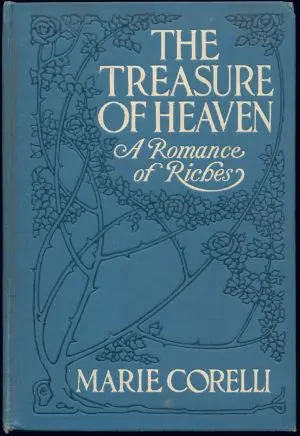
"The Treasure of Heaven: A Romance of Riches" by Marie Corelli is a novel written in the early 20th century. The story revolves around David Helmsley, a wealthy but deeply unhappy man, who reflects on his life, love, and the true value of wealth. As the narrative unfolds, it examines themes of love, loss, and the emptiness of material success, particularly through Helmsley's interactions with the young Lucy Sorrel, whom he has cared for since childhood. At the start of the novel, readers are introduced to the bustling atmosphere of London on a June night, juxtaposed against Helmsley's feelings of solitude and despair. After a lively evening event celebrating Lucy's twenty-first birthday, Helmsley grapples with his aging and the futility of his wealth. The opening chapters depict a conversation between Helmsley and his solicitor, Sir Francis Vesey, revealing Helmsley's disillusionment with life and the superficiality of society. As he ruminates on his past, including the painful memories of lost love and family, he begins to ponder his legacy, feeling an existential dread as he contemplates who will inherit his fortune. The rich descriptive language and the introspective dialogue set the stage for a poignant exploration of the human condition.
Introduction adapted from the source catalogue; source summaries may be automatically generated.
Free to read · English · 166,551 words · No account needed
MAKE TIME FOR A GOOD BOOK
On by default. Untick to stop anonymous reading totals. Each page counts after 10 seconds in view. How this works.
Anonymous counting is on unless you have switched it off.
"It is exactly as if I had murdered somebody and had sunk a body into the well instead of a coat!" he said--"and--perhaps I have! Perhaps I am killing my Self,--getting rid of my Self,--which would be a good thing, if I could only find Some one or Some thing better than my Self in my Self's place!"
When he had finally disposed of every article that could suggest any possibility of his ever having been clothed as a gentleman, he unripped the lining of his rough "workman's" vest, and made a layer of the banknotes he had with him between it and the cloth, stitching it securely over and over with coarse needle and thread, being satisfied by this arrangement to carry all his immediate cash hidden upon his person, while for the daily needs of hunger and thirst he had a few loose shillings and coppers in his pocket. He had made up his mind not to touch a single one of the banknotes, unless suddenly overtaken by accident or illness. When his bit of silver and copper came to an end, he meant to beg alms along the road and prove for himself how far it was true that human beings were in the main kind and compassionate, and ready to assist one another in the battle of life. With these ideas and many others in his mind, he started on his "tramp"--and during the first two or three days of it suffered acutely. Many years had passed since he had been accustomed to long sustained bodily exercise, and he was therefore easily fatigued. But by the time he reached the open country between the Quantocks and the Brendon Hills, he had got somewhat into training, and had begun to feel a greater lightness and ease as well as pleasure in walking. He had found it quite easy to live on very simple food,--in fact one of the principal charms of the strange "holiday" he had planned for his own entertainment was to prove for himself beyond all dispute that no very large amount of money is required to sustain a man's life and health. New milk and brown bread had kept him going bravely every day,--fruit was cheap and so was cheese, and all these articles of diet are highly nourishing, so that he had wanted for nothing. At night, the weather keeping steadily fine and warm, he had slept in the open, choosing some quiet nook in the woodland under a tree, or else near a haystack in the fields, and he had benefited greatly by thus breathing the pure air during slumber, and getting for nothing the "cure" prescribed by certain Artful Dodgers of the medical profession who take handfuls of guineas from credulous patients for what Mother Nature willingly gives gratis. And he was beginning to understand the joys of "loafing,"--so much so indeed that he felt a certain sympathy with the lazy varlet who prefers to stroll aimlessly about the country begging his bread rather than do a stroke of honest work. The freedom of such a life is self-evident,--and freedom is the broadest and best way of breathing on earth. To "tramp the road" seems to the well-dressed, conventional human being a sorry life; but it may be questioned whether, after all, he with his social trammels and household cares, is not leading a sorrier one. Never in all his brilliant, successful career till now had David Helmsley, that king of modern finance, realised so intensely the beauty and peace of being alone with Nature,--the joy of feeling the steady pulse of the Spirit of the Universe throbbing through one's own veins and arteries,--the quiet yet exultant sense of knowing instinctively beyond all formulated theory or dogma, that one is a vital part of the immortal Entity, as indestructible as Itself. And a great calm was gradually taking possession of his soul,--a smoothing of all the waves of his emotional and nervous temperament. Under this mystic touch of unseen and uncomprehended heavenly tenderness, all sorrows, all disappointments, all disillusions sank out of sight as though they had never been. It seemed to him that he had put away his former life for ever, and that another life had just begun,--and his brain was ready and eager to rid itself of old impressions in order to prepare for new. Nothing of much moment had occurred to him as yet. A few persons had said "good-day " or "good-night" to him in passing,--a farmer had asked him to hold his horse for a quarter of an hour, which he had done, and had thereby earned threepence,--but he had met with no interesting or exciting incidents which could come under the head of "adventures." Nevertheless he was gathering fresh experiences,--experiences which all tended to show him how the best and brightest part of life is foolishly wasted and squandered by the modern world in a mad rush for gain.
Your reading position is saved on this browser. Take it to another device with a library code. Reading pages adapt to text, rather than matching a printed edition.
Marie Corelli
Marie Corelli

Marie Corelli

Marie Corelli
BEHIND THE BOOK
This eBook is for the use of anyone anywhere in the United States and most other parts of the world at no cost and with almost no restrictions whatsoever. You may copy it, give it away or re-use it under the terms of the Project Gutenberg License included with this eBook or online at www.gutenberg.org. If you are not located in the United States, you will have to check the laws of the country where you are located before using this eBook. Read the source licence.
The original source file, including credits and licence, is retained by this library. Request an original-format copy at no charge. Please include the book title and Project Gutenberg identifier #18449.
KEEP YOUR CURIOSITY GOING
Coulson Kernahan

Maurice Baring
Frances Wright
Cécile Tormay

Frederic Jesup Stimson

W. H. P. (William Henry Pope) Jarvis