THE CLASSIC COLLECTION✦A Christmas greetingCLASSIC FREE BOOKS
A Christmas greeting
Marie Corelli
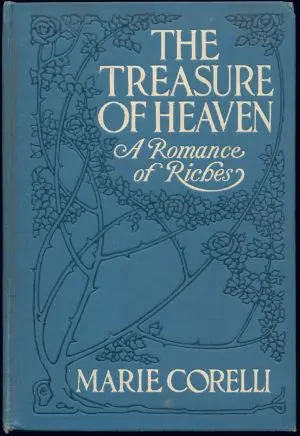
THE CLASSIC COLLECTION · 1906
"The Treasure of Heaven: A Romance of Riches" by Marie Corelli is a novel written in the early 20th century. The story revolves around David Helmsley, a wealthy but deeply unhappy man, who reflects on his life, love, and the true value of wealth. As the narrative unfolds, it examines themes of love, loss, and the emptiness of material success, particularly through Helmsley's interactions with the young Lucy Sorrel, whom he has cared for since childhood. At the start of the novel, readers are introduced to the bustling atmosphere of London on a June night, juxtaposed against Helmsley's feelings of solitude and despair. After a lively evening event celebrating Lucy's twenty-first birthday, Helmsley grapples with his aging and the futility of his wealth. The opening chapters depict a conversation between Helmsley and his solicitor, Sir Francis Vesey, revealing Helmsley's disillusionment with life and the superficiality of society. As he ruminates on his past, including the painful memories of lost love and family, he begins to ponder his legacy, feeling an existential dread as he contemplates who will inherit his fortune. The rich descriptive language and the introspective dialogue set the stage for a poignant exploration of the human condition.
Introduction adapted from the source catalogue; source summaries may be automatically generated.
Free to read · English · 166,551 words · No account needed
MAKE TIME FOR A GOOD BOOK
On by default. Untick to stop anonymous reading totals. Each page counts after 10 seconds in view. How this works.
Anonymous counting is on unless you have switched it off.
To see people eating is understood to be a very interesting and "brilliant" spectacle, and however insignificant you may be in the social world, you get a reflex of its "brilliancy" when you allow people in their turn to see you eating likewise. A well-cooked, well-served supper is a "function," in which every man and woman who can move a jaw takes part, and though in plain parlance there is nothing uglier than the act of putting food into one's mouth, we have persuaded ourselves that it is a pretty and pleasant performance enough for us to ask our friends to see us do it. Byron's idea that human beings should eat privately and apart, was not altogether without aesthetic justification, though according to medical authority such a procedure would be very injurious to health. The slow mastication of a meal in the presence of cheerful company is said to promote healthy digestion--moreover, custom and habit make even the most incongruous things acceptable, therefore the display of tables, crowded with food-stuffs and surrounded by eating, drinking, chattering and perspiring men and women, does not affect us to any sense of the ridiculous or the unseemly. On the contrary, when some of us see such tables, we exclaim "How lovely!" or "How delightful!" according to our own pet vocabulary, or to our knowledge of the humour of our host or hostess,--or perhaps, if we are young cynics, tired of life before we have confronted one of its problems, we murmur, "Not so bad!" or "Fairly decent!" when we are introduced to the costly and appetising delicacies heaped up round masses of flowers and silver for our consideration and entertainment. At the supper given by David Helmsley for Lucy Sorrel's twenty-first birthday, there was, however, no note of dissatisfaction--the blase breath of the callow critic emitted no withering blight, and even latter-day satirists in their teens, frosted like tender pease-blossom before their prime, condescended to approve the lavish generosity, combined with the perfect taste, which made the festive scene a glowing picture of luxury and elegance. But Helmsley himself, as he led his beautiful partner, "the" guest of the evening, to the head of the principal table, and took his place beside her, was conscious of no personal pleasure, but only of a dreary feeling which seemed lonelier than loneliness and more sorrowful than sorrow. The wearied scorn that he had lately begun to entertain for himself, his wealth, his business, his influence, and all his surroundings, was embittered by a disappointment none the less keen because he had dimly foreseen it. The child he had petted, the girl he had indulged after the fashion of a father who seeks to make the world pleasant to a young life just entering it, she, even she, was, or seemed to be, practically as selfish as any experienced member of the particular set of schemers and intriguers who compose what is sometimes called "society" in the present day. He had no wish to judge her harshly, but he was too old and knew too much of life to be easily deceived in his estimation of character. A very slight hint was sufficient for him. He had seen a great deal of Lucy Sorrel as a child--she had always been known as his "little favourite"--but since she had attended a fashionable school at Brighton, his visits to her home had been less frequent, and he had had very few opportunities of becoming acquainted with the gradual development of her mental and moral self. During her holidays he had given her as many little social pleasures and gaieties as he had considered might be acceptable to her taste and age, but on these occasions other persons had always been present, and Lucy herself had worn what are called "company" manners, which in her case were singularly charming and attractive, so much so, indeed, that it would have seemed like heresy to question their sincerity. But now--whether it was the slight hint dropped by Sir Francis Vesey on the previous night as to Mrs. Sorrel's match-making proclivities, or whether it was a scarcely perceptible suggestion of something more flippant and assertive than usual in the air and bearing of Lucy herself that had awakened his suspicions,--he was certainly disposed to doubt, for the first time in all his knowledge of her, the candid nature of the girl for whom he had hitherto entertained, half-unconsciously, an almost parental affection. He sat by her side at supper, seldom speaking, but always closely observant. He saw everything; he watched the bright, exulting flash of her eyes as she glanced at her various friends, both near her and at a distance, and he fancied he detected in their responsive looks a subtle inquiry and meaning which he would not allow himself to investigate. And while the bubbling talk and laughter eddied round him, he made up his mind to combat the lurking distrust that teased his brain, and either to disperse it altogether or else confirm it beyond all mere shadowy misgiving. Some such thought as this had occurred to him, albeit vaguely, when he had, on a sudden unpremeditated impulse, asked Lucy to give him a few minutes' private conversation with her after supper, but now, what had previously been a mere idea formulated itself into a fixed resolve.
Your reading position is saved on this browser. Take it to another device with a library code. Reading pages adapt to text, rather than matching a printed edition.
Marie Corelli
Marie Corelli

Marie Corelli

Marie Corelli
BEHIND THE BOOK
This eBook is for the use of anyone anywhere in the United States and most other parts of the world at no cost and with almost no restrictions whatsoever. You may copy it, give it away or re-use it under the terms of the Project Gutenberg License included with this eBook or online at www.gutenberg.org. If you are not located in the United States, you will have to check the laws of the country where you are located before using this eBook. Read the source licence.
The original source file, including credits and licence, is retained by this library. Request an original-format copy at no charge. Please include the book title and Project Gutenberg identifier #18449.
KEEP YOUR CURIOSITY GOING
Coulson Kernahan

Maurice Baring
Frances Wright
Cécile Tormay

Frederic Jesup Stimson

W. H. P. (William Henry Pope) Jarvis