THE CLASSIC COLLECTION✦A Christmas greetingCLASSIC FREE BOOKS
A Christmas greeting
Marie Corelli
THE CLASSIC COLLECTION · 1906
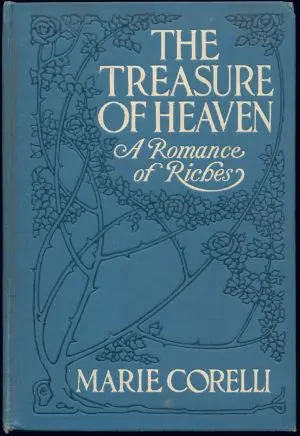
"The Treasure of Heaven: A Romance of Riches" by Marie Corelli is a novel written in the early 20th century. The story revolves around David Helmsley, a wealthy but deeply unhappy man, who reflects on his life, love, and the true value of wealth. As the narrative unfolds, it examines themes of love, loss, and the emptiness of material success, particularly through Helmsley's interactions with the young Lucy Sorrel, whom he has cared for since childhood. At the start of the novel, readers are introduced to the bustling atmosphere of London on a June night, juxtaposed against Helmsley's feelings of solitude and despair. After a lively evening event celebrating Lucy's twenty-first birthday, Helmsley grapples with his aging and the futility of his wealth. The opening chapters depict a conversation between Helmsley and his solicitor, Sir Francis Vesey, revealing Helmsley's disillusionment with life and the superficiality of society. As he ruminates on his past, including the painful memories of lost love and family, he begins to ponder his legacy, feeling an existential dread as he contemplates who will inherit his fortune. The rich descriptive language and the introspective dialogue set the stage for a poignant exploration of the human condition.
Introduction adapted from the source catalogue; source summaries may be automatically generated.
Free to read · English · 166,551 words · No account needed
MAKE TIME FOR A GOOD BOOK
On by default. Untick to stop anonymous reading totals. Each page counts after 10 seconds in view. How this works.
Anonymous counting is on unless you have switched it off.
"I think," he murmured, addressing himself to a tiny brown bird which had alighted on a branch of briar-rose hard by, and was looking at him with bold and lively inquisitiveness,--"I think I have managed the whole thing very well! I have left no clue anywhere. My portmanteau will tell no tales, locked up in the cloak-room at Bristol. If it is ever sold with its contents 'to defray expenses,' nothing will be found in it but some unmarked clothes. And so far as all those who know me are concerned, every trace of me ends at Southampton. Beyond Southampton there is a blank, into which David Helmsley, the millionaire, has vanished. And David Helmsley, the tramp, sits here in his place!"
The little brown bird preened its wing, and glanced at him sideways intelligently, as much as to say: "I quite understand! You have become one of us,--a wanderer, taking no thought for the morrow, but letting to-morrow take thought for the things of itself. There is a bond of sympathy between me, the bird, and you, the man--we are brothers!"
A sudden smile illumined his face. The situation was novel, and to him enjoyable. He was greatly fatigued,--he had over-exerted himself during the past three or four days, walking much further than he had ever been accustomed to, and his limbs ached sorely--nevertheless, with the sense of rest and relief from strain, came a certain exhilaration of spirit, like the vivacious delight of a boy who has run away from school, and is defiantly ready to take all the consequences of his disobedience to the rules of discipline and order. For years he had wanted a "new" experience of life. No one would give him what he sought. To him the "social" round was ever the same dreary, heartless and witless thing, as empty under the sway of one king or queen as another, and as utterly profitless to peace or happiness as it has always been. The world of finance was equally uninteresting so far as he was concerned; he had exhausted it, and found it no more than a monotonous grind of gain which ended in a loathing of the thing gained. Others might and would consume themselves in fevers of avarice, and surfeits of luxury,--but for him such temporary pleasures were past. He desired a complete change,--a change of surroundings, a change of associations--and for this, what could be more excellent or more wholesome than a taste of poverty? In his time he had met men who, worn out with the constant fight of the body's materialism against the soul's idealism, had turned their backs for ever on the world and its glittering shows, and had shut themselves up as monks of "enclosed" or "silent" orders,--others he had known, who, rushing away from what we call civilisation, had encamped in the backwoods of America, or high up among the Rocky Mountains, and had lived the lives of primeval savages in their strong craving to assert a greater manliness than the streets of cities would allow them to enjoy,--and all were moved by the same mainspring of action,--the overpowering spiritual demand within themselves which urged them to break loose from cowardly conventions and escape from Sham. He could not compete with younger men in taking up wild sport and "big game" hunting in far lands, in order to give free play to the natural savage temperament which lies untamed at the root of every man's individual being,--and he had no liking for "monastic" immurements. But he longed for liberty,--liberty to go where he liked without his movements being watched and commented upon by a degraded "personal" press,--liberty to speak as he felt and do as he wished, without being compelled to weigh his words, or to consider his actions. Hence--he had decided on his present course, though how that course was likely to shape itself in its progress he had no very distinct idea. His actual plan was to walk to Cornwall, and there find out the native home of his parents, not so much for sentiment's sake as for the necessity of having a definite object or goal in view. And the reason of his determination to go "on the road," as it were, was simply that he wished to test for himself the actual happiness or misery experienced by the very poor as contrasted with the supposed joys of the very wealthy. This scheme had been working in his brain for the past year or more,--all his business arrangements had been made in such a way as to enable him to carry it out satisfactorily to himself without taking any one else into his confidence. The only thing that might possibly have deterred him from his quixotic undertaking would have been the moral triumph of Lucy Sorrel over the temptation he had held out to her. Had she been honest to her better womanhood,--had she still possessed the "child's heart," with which his remembrance and imagination had endowed her, he would have resigned every other thought save that of so smoothing the path of life for her that she might tread it easily to the end. But now that she had disappointed him, he had, so he told himself, done with fine illusions and fair beliefs for ever. And he had started on a lonely quest,--a search for something vague and intangible, the very nature of which he himself could not tell. Some glimmering ghost of a notion lurked in his mind that perhaps, during his self-imposed solitary ramblings, he might find some new and unexplored channel wherein his vast wealth might flow to good purpose after his death, without the trammels of Committee-ism and Red-Tape-ism. But he expected and formulated nothing,--he was more or less in a state of quiescence, awaiting adventures without either hope or fear. In the meantime, here he sat in the shady Somersetshire lane, resting,--the multi-millionaire whose very name shook the money-markets of the world, but who to all present appearances seemed no more than a tramp, footing it wearily along one of the many winding "short cuts" through the country between Somerset and Devon, and as unlike the actual self of him as known to Lombard Street and the Stock Exchange as a beggar is unlike a king.
Your reading position is saved on this browser. Take it to another device with a library code. Reading pages adapt to text, rather than matching a printed edition.
Marie Corelli
Marie Corelli

Marie Corelli

Marie Corelli
BEHIND THE BOOK
This eBook is for the use of anyone anywhere in the United States and most other parts of the world at no cost and with almost no restrictions whatsoever. You may copy it, give it away or re-use it under the terms of the Project Gutenberg License included with this eBook or online at www.gutenberg.org. If you are not located in the United States, you will have to check the laws of the country where you are located before using this eBook. Read the source licence.
The original source file, including credits and licence, is retained by this library. Request an original-format copy at no charge. Please include the book title and Project Gutenberg identifier #18449.
KEEP YOUR CURIOSITY GOING
Coulson Kernahan

Maurice Baring
Frances Wright
Cécile Tormay

Frederic Jesup Stimson

W. H. P. (William Henry Pope) Jarvis