THE CLASSIC COLLECTION✦A Christmas greetingCLASSIC FREE BOOKS
A Christmas greeting
Marie Corelli
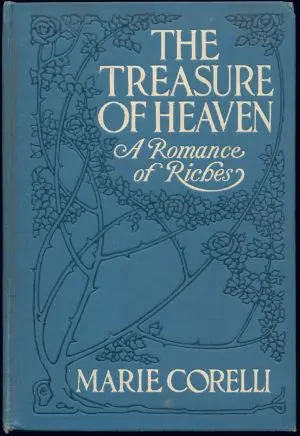
THE CLASSIC COLLECTION · 1906
"The Treasure of Heaven: A Romance of Riches" by Marie Corelli is a novel written in the early 20th century. The story revolves around David Helmsley, a wealthy but deeply unhappy man, who reflects on his life, love, and the true value of wealth. As the narrative unfolds, it examines themes of love, loss, and the emptiness of material success, particularly through Helmsley's interactions with the young Lucy Sorrel, whom he has cared for since childhood. At the start of the novel, readers are introduced to the bustling atmosphere of London on a June night, juxtaposed against Helmsley's feelings of solitude and despair. After a lively evening event celebrating Lucy's twenty-first birthday, Helmsley grapples with his aging and the futility of his wealth. The opening chapters depict a conversation between Helmsley and his solicitor, Sir Francis Vesey, revealing Helmsley's disillusionment with life and the superficiality of society. As he ruminates on his past, including the painful memories of lost love and family, he begins to ponder his legacy, feeling an existential dread as he contemplates who will inherit his fortune. The rich descriptive language and the introspective dialogue set the stage for a poignant exploration of the human condition.
Introduction adapted from the source catalogue; source summaries may be automatically generated.
Free to read · English · 166,551 words · No account needed
MAKE TIME FOR A GOOD BOOK
On by default. Untick to stop anonymous reading totals. Each page counts after 10 seconds in view. How this works.
Anonymous counting is on unless you have switched it off.
"I'll wait a month," she said--"No longer, Angus! By that time, if you don't marry me, I shall summons you for breach of promise!"
She smiled--but he still remained thoughtful.
"Angus!" she said suddenly--"I want to tell you--I shall have to go away from Weircombe for a day--perhaps two days."
He looked surprised.
"Go away!" he echoed. "What for? Where to?"
She told him then of "old David's" last request to her, and of the duty she had undertaken to perform.
He listened gravely.
"You must do it, of course," he said. "But will you have to travel far?"
"Some distance from Weircombe," she answered, evasively.
"May I not go with you?" he asked.
She hesitated.
"I promised----" she began.
"And you shall not break your word," he said, kissing her. "You are so true, my Mary, that I wouldn't tempt you to change one word or even half a word of what you have said to any one, living or dead. When do you want to take this journey?"
"To-morrow, or the next day," she said. "I'll ask Mrs. Twitt to see to the house and look after Charlie, and I'll be back again as quickly as I can. Because, when I've given the papers over to David's friend, whoever he is, I shall have nothing more to do but just come home."
This being settled, it was afterwards determined that the next day but one would be the most convenient for her to go, as she could then avail herself of the carrier's cart to take her as far as Minehead. But she was not allowed to start on her unexpected travels without a burst of prophecy from Mrs. Twitt.
"As I've said an' allus thought," said that estimable lady--"Old David 'ad suthin' 'idden in 'is 'art wot 'e never giv' away to nobody. Mark my words, Mis' Deane!--'e 'ad a sin or a sorrer at the back of 'im, an' whichever it do turn out to be I'm not a-goin' to blame 'im either way, for bein' dead 'e's dead, an' them as sez unkind o' the dead is apt to be picked morsels for the devil's gridiron. But now that you've got a packet to take to old David's friends somewheres, you may take my word for 't, Mis' Deane, you'll find out as 'e was wot ye didn't expect. Onny last night, as I was a-sittin' afore the kitchen fire, for though bein' summer I'm that chilly that I feels the least change in the temper o' the sea,--as I was a-sittin', I say, out jumps a cinder as long as a pine cone, red an' glowin' like a candle at the end. An' I stares at the thing, an' I sez: 'That's either a purse o' money, or a journey with a coffin at the end'--an' the thing burns an' shines like a reg'lar spark of old Nick's cookin' stove, an' though I pokes an' pokes it, it won't go out, but lies on the 'erth, frizzlin' all the time. An' I do 'ope, Mis' Deane, as now yer goin' off to 'and over old David's effecks to the party interested, ye'll come back safe, for the poor old dear 'adn't a penny to bless 'isself with, so the cinder must mean the journey, an' bein' warned, ye'll guard agin the coffin at the end."
Your reading position is saved on this browser. Take it to another device with a library code. Reading pages adapt to text, rather than matching a printed edition.
Marie Corelli
Marie Corelli

Marie Corelli

Marie Corelli
BEHIND THE BOOK
This eBook is for the use of anyone anywhere in the United States and most other parts of the world at no cost and with almost no restrictions whatsoever. You may copy it, give it away or re-use it under the terms of the Project Gutenberg License included with this eBook or online at www.gutenberg.org. If you are not located in the United States, you will have to check the laws of the country where you are located before using this eBook. Read the source licence.
The original source file, including credits and licence, is retained by this library. Request an original-format copy at no charge. Please include the book title and Project Gutenberg identifier #18449.
KEEP YOUR CURIOSITY GOING
Coulson Kernahan

Maurice Baring
Frances Wright
Cécile Tormay

Frederic Jesup Stimson

W. H. P. (William Henry Pope) Jarvis