THE CLASSIC COLLECTION✦A Christmas greetingCLASSIC FREE BOOKS
A Christmas greeting
Marie Corelli
THE CLASSIC COLLECTION · 1906
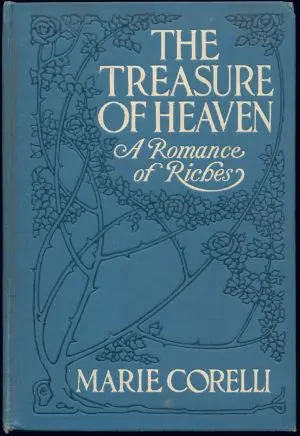
"The Treasure of Heaven: A Romance of Riches" by Marie Corelli is a novel written in the early 20th century. The story revolves around David Helmsley, a wealthy but deeply unhappy man, who reflects on his life, love, and the true value of wealth. As the narrative unfolds, it examines themes of love, loss, and the emptiness of material success, particularly through Helmsley's interactions with the young Lucy Sorrel, whom he has cared for since childhood. At the start of the novel, readers are introduced to the bustling atmosphere of London on a June night, juxtaposed against Helmsley's feelings of solitude and despair. After a lively evening event celebrating Lucy's twenty-first birthday, Helmsley grapples with his aging and the futility of his wealth. The opening chapters depict a conversation between Helmsley and his solicitor, Sir Francis Vesey, revealing Helmsley's disillusionment with life and the superficiality of society. As he ruminates on his past, including the painful memories of lost love and family, he begins to ponder his legacy, feeling an existential dread as he contemplates who will inherit his fortune. The rich descriptive language and the introspective dialogue set the stage for a poignant exploration of the human condition.
Introduction adapted from the source catalogue; source summaries may be automatically generated.
Free to read · English · 166,551 words · No account needed
MAKE TIME FOR A GOOD BOOK
On by default. Untick to stop anonymous reading totals. Each page counts after 10 seconds in view. How this works.
Anonymous counting is on unless you have switched it off.
He turned away with an effort--and, lifting the latch of the garden gate, opened it and closed it softly behind him. Then he began the ascent of the coombe. Not a soul was in sight,--the actual day had not yet begun. The hill torrent flowed along with a subdued purling sound over the rough stones and pebbles,--there had been little rain of late and the water was shallow, though clear and bright enough to gleam like a wavering silver ribbon in the dimness of the early morning,--and as he followed it upward and finally reached a point from whence the open sea was visible he rested a moment, leaning on his stick and looking backward on the way he had come. Strangely beautiful and mystical was the scene his eyes dwelt upon,--or rather perhaps it should be said that he saw it in a somewhat strange and mystical fashion of his own. There, out beyond the furthest edge of land, lay the ocean, shadowed just now by a delicate dark grey mist, which, like a veil, covered its placid bosom,--a mist which presently the rising sun would scatter with its glorious rays of gold;--here at his feet nestled Weircombe,--a cluster of simple cottages, sweetly adorned by nature with her fairest garlanding of springtime flowers,--and behind him, just across a length of barren moor, was the common highroad leading to the wider, busier towns. And he thought as he stood alone,--a frail and solitary figure, gazing dreamily out of himself, as it were, to things altogether beyond himself,--that the dim and shadowy ocean was like the vast Unknown which we call Death,--which we look upon tremblingly,--afraid of its darkness, and unable to realise that the sun of Life will ever rise again to pierce its gloom with glory. And the little world--the only world that can be called a world,--namely, that special corner of the planet which holds the hearts that love us--a world which for him, the multi-millionaire, was just a tiny village with one sweet woman living in it--resembled a garland of flowers flung down from the rocks as though to soften their ruggedness,--a garland broken asunder at the shoreline, even as all earthly garlands must break and fade at the touch of the first cold wave of the Infinite. As for the further road in which he was about to turn and go, that, to his fancy, was a nearer similitude of an approach to hell than any scene ever portrayed in Dante's Divine Comedy. For it led to the crowded haunts of men--the hives of greedy business,--the smoky, suffocating centres where each human unit seeks to over-reach and outrival the other--where there is no time to be kind--no room to be courteous; where the passion for gain and the worship of self are so furious and inexhaustible, that all the old fair virtues which make nations great and lasting, are trampled down in the dust, and jeered at as things contemptible and of no value,--where, if a man is honourable, he is asked "What do you get by it?"--and where, if a woman would remain simple and chaste, she is told she is giving herself "no chance." In this whirl of avarice, egotism, and pushfulness, Helmsley had lived nearly all his life, always conscious of, and longing for, something better--something truer and more productive of peace and lasting good. Almost everything he had touched had turned to money,--while nothing he had ever gained had turned to love. Except now--now when the end was drawing nigh--when he must soon say farewell to the little earth, so replete with natural beauty--farewell to the lovely sky, which whether in storm or calm, ever shows itself as a visible reflex of divine majesty and power--farewell to the sweet birds, which for no thanks at all, charm the ear by their tender songs and graceful winged ways--farewell to the flowers, which, flourishing in the woods and fields without care, lift their cups to the sun, and fill the air with fragrance,--and above all, farewell to the affection which he had found so late!--to the heart whose truth he had tested--to the woman for whose sake, could he in some way have compassed her surer and greater happiness, he would gladly have lived half his life over again, working with every moment of it to add to her joy. But an instinctive premonition warned him that the sands in Time's hour-glass were for him running to an end,--there was no leisure left to him now for any new scheme or plan by which he could improve or strengthen that which he had already accomplished. He realised this fully, with a passing pang of regret which soon tempered itself into patient resignation,--and as the first arrowy beam of the rising sun shot upwards from the east, he slowly turned his back on the quiet hamlet where in a few months he had found what he had vainly sought for in many long and weary years, and plodded steadily across the moor to the highroad. Here he sat down on the bank to wait till some conveyance going to Minehead should pass by--for he knew he had not sufficient strength to walk far. "Tramping it" now was for him impossible,--moreover, his former thirst for adventure was satisfied; he had succeeded in his search for "a friend" without going so far as Cornwall. There was no longer any cause for him to endure unnecessary fatigue--so he waited patiently, listening to the first wild morning carol of a skylark, which, bounding up from its nest hard by, darted into the air with quivering wings beating against the dispersing vapours of the dawn, and sang aloud in the full rapture of a joy made perfect by innocence. And he thought of the lovely lines of George Herbert:--
Your reading position is saved on this browser. Take it to another device with a library code. Reading pages adapt to text, rather than matching a printed edition.
Marie Corelli
Marie Corelli

Marie Corelli

Marie Corelli
BEHIND THE BOOK
This eBook is for the use of anyone anywhere in the United States and most other parts of the world at no cost and with almost no restrictions whatsoever. You may copy it, give it away or re-use it under the terms of the Project Gutenberg License included with this eBook or online at www.gutenberg.org. If you are not located in the United States, you will have to check the laws of the country where you are located before using this eBook. Read the source licence.
The original source file, including credits and licence, is retained by this library. Request an original-format copy at no charge. Please include the book title and Project Gutenberg identifier #18449.
KEEP YOUR CURIOSITY GOING
Coulson Kernahan

Maurice Baring
Frances Wright
Cécile Tormay

Frederic Jesup Stimson

W. H. P. (William Henry Pope) Jarvis