THE CLASSIC COLLECTION✦A Christmas greetingCLASSIC FREE BOOKS
A Christmas greeting
Marie Corelli
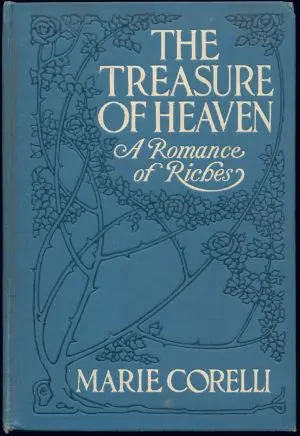
THE CLASSIC COLLECTION · 1906
"The Treasure of Heaven: A Romance of Riches" by Marie Corelli is a novel written in the early 20th century. The story revolves around David Helmsley, a wealthy but deeply unhappy man, who reflects on his life, love, and the true value of wealth. As the narrative unfolds, it examines themes of love, loss, and the emptiness of material success, particularly through Helmsley's interactions with the young Lucy Sorrel, whom he has cared for since childhood. At the start of the novel, readers are introduced to the bustling atmosphere of London on a June night, juxtaposed against Helmsley's feelings of solitude and despair. After a lively evening event celebrating Lucy's twenty-first birthday, Helmsley grapples with his aging and the futility of his wealth. The opening chapters depict a conversation between Helmsley and his solicitor, Sir Francis Vesey, revealing Helmsley's disillusionment with life and the superficiality of society. As he ruminates on his past, including the painful memories of lost love and family, he begins to ponder his legacy, feeling an existential dread as he contemplates who will inherit his fortune. The rich descriptive language and the introspective dialogue set the stage for a poignant exploration of the human condition.
Introduction adapted from the source catalogue; source summaries may be automatically generated.
Free to read · English · 166,551 words · No account needed
MAKE TIME FOR A GOOD BOOK
On by default. Untick to stop anonymous reading totals. Each page counts after 10 seconds in view. How this works.
Anonymous counting is on unless you have switched it off.
It was difficult not to laugh at this statement, Prue's eyes were so round, her cheeks were so red, and she breathed so spasmodically as she spoke. David Helmsley bit his lips to hide a broad smile, and poured out his tea.
"Have you no father?"
"No, never 'ad," declared Prue, quite jubilantly. "'E droonk 'isself to death an' tumbled over a cliff near 'ere one dark night an' was drowned!" This, with the most thrilling emphasis.
"That's very sad! But you can't say you never had a father," persisted Helmsley. "You had him before he was drowned?"
"No, I 'adn't," said Prue. "'E never comed 'ome at all. When 'e seed me 'e didn't know me, 'e was that blind droonk. When my little brother was born 'e was 'owlin' wild down Watchet way, an' screechin' to all the folks as 'ow the baby wasn't his'n!"
This was a doubtful subject,--a "delicate and burning question," as reviewers for the press say when they want to praise some personal friend's indecent novel and pass it into decent households,--and Helmsley let it drop. He devoted himself to the consideration of his breakfast, which was excellent, and found that he had an appetite to enjoy it thoroughly.
Prue watched him for a minute or two in silence.
"Ye likes yer food?" she demanded, presently.
"Very much!"
"Thought yer did! I'll tell Mis' Tranter."
With that she retired, and shutting the door behind her left Helmsley to
himself.
Many and conflicting were the thoughts that chased one another through his brain during the quiet half-hour he gave to his morning meal,--a whole fund of new suggestions and ideas were being generated in him by the various episodes in which he was taking an active yet seemingly passive part. He had voluntarily entered into his present circumstances, and so far, he had nothing to complain of. He had met with friendliness and sympathy from persons who, judged by the world's conventions, were of no social account whatever, and he had seen for himself men in a condition of extreme poverty, who were nevertheless apparently contented with their lot. Of course, as a well-known millionaire, his secretaries had always had to deal with endless cases of real or assumed distress, more often the latter,--and shoals of begging letters from people representing themselves as starving and friendless, formed a large part of the daily correspondence with which his house and office were besieged,--but he had never come into personal contact with these shameless sort of correspondents, shrewdly judging them to be undeserving simply by the very fact that they wrote begging letters. He knew that no really honest or plucky-spirited man or woman would waste so much as a stamp in asking money from a stranger, even if such a stranger were twenty times a millionaire. He had given huge sums away to charitable institutions anonymously; and he remembered with a thrill of pain the "Christian kindness" of some good "Church" people, who, when the news accidentally slipped out that he was the donor of a particularly munificent gift to a certain hospital, remarked that "no doubt Mr. Helmsley had given it anonymously at first, in order that it might be made public more effectively afterwards, by way of a personal advertisement!" Such spiteful comment often repeated, had effectually checked the outflow of his naturally warm and generous spirit, nevertheless he was always ready to relieve any pressing cases of want which were proved genuine, and many a wretched family in the East End of London had cause to bless him for his timely and ungrudging aid. But this present kind of life,--the life of the tramp, the poacher, the gypsy, who is content to be "on the road" rather than submit to the trammels of custom and ordinance, was new to him and full of charm. He took a peculiar pleasure in reflecting as to what he could do to make these men, with whom he had casually foregathered, happier? Did it lie in his power to give them any greater satisfaction than that which they already possessed? He doubted whether a present of money to Matt Peke, for instance, would not offend that rustic philosopher, more than it would gratify him;--while, as for Tom o' the Gleam, that handsome ruffian was more likely to rob a man of gold than accept it as a gift from him. Then involuntarily, his thoughts reverted to the "kiddie." He recalled the look in Tom's wild eyes, and the almost womanish tremble of tenderness in his rough voice, when he had spoken of this little child of his on whom he openly admitted he had set all his love.
Your reading position is saved on this browser. Take it to another device with a library code. Reading pages adapt to text, rather than matching a printed edition.
Marie Corelli
Marie Corelli

Marie Corelli

Marie Corelli
BEHIND THE BOOK
This eBook is for the use of anyone anywhere in the United States and most other parts of the world at no cost and with almost no restrictions whatsoever. You may copy it, give it away or re-use it under the terms of the Project Gutenberg License included with this eBook or online at www.gutenberg.org. If you are not located in the United States, you will have to check the laws of the country where you are located before using this eBook. Read the source licence.
The original source file, including credits and licence, is retained by this library. Request an original-format copy at no charge. Please include the book title and Project Gutenberg identifier #18449.
KEEP YOUR CURIOSITY GOING
Coulson Kernahan

Maurice Baring
Frances Wright
Cécile Tormay

Frederic Jesup Stimson

W. H. P. (William Henry Pope) Jarvis