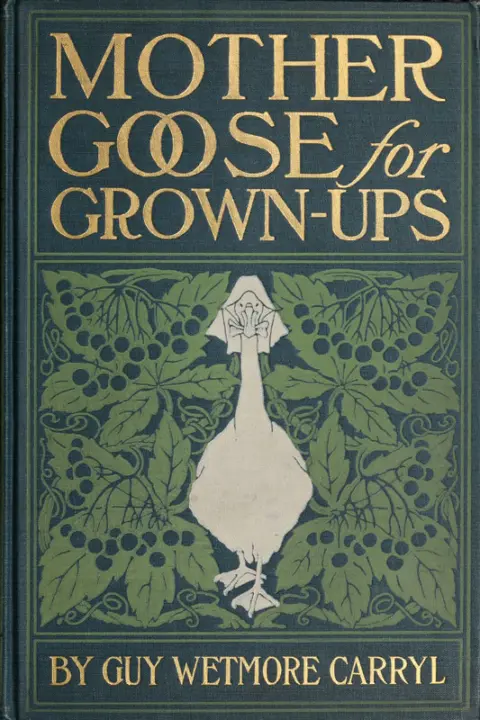
Mother Goose for Grown-ups
Guy Wetmore Carryl
THE CLASSIC COLLECTION · 1904
"The Transgression of Andrew Vane" by Guy Wetmore Carryl is a novel written in the early 20th century. The book explores themes of love, despair, and human relationships, primarily focusing on Andrew Vane, a young man navigating the complexities of life, love, and societal expectations, especially as he grapples with the aftermath of his family's struggles and personal failures. The narrative promises to delve into the contrast between idealism and reality, particularly through Andrew's interactions and evolving dynamics with other characters. At the start of the story, readers are introduced to Helen Sterling, who reflects on her deteriorating marriage with John Vane, Andrew's father. Helen's life embodies a difficult journey filled with disillusionment and heartbreak as she waits for her husband, consumed by his failures and alcoholism. As she grapples with the drastic change in her circumstances, a chance encounter with a stranger hints at potential companionship and change. Meanwhile, Andrew Vane arrives in Paris, freshly released from his past and in search of direction, underscoring the generational and existential conflicts that permeate the narrative. The opening sets a tone of melancholy mixed with hope, positioning both Helen and Andrew at crossroads in their lives.
Introduction adapted from the source catalogue; source summaries may be automatically generated.
Free to read · English · 76,615 words · No account needed
MAKE TIME FOR A GOOD BOOK
On by default. Untick to stop anonymous reading totals. Each page counts after 10 seconds in view. How this works.
Anonymous counting is on unless you have switched it off.
"You'll remember," said Andrew, falling in with her whim, "that the transgressing monarch rarely understood what the prophet was driving at in his parable. I, too, must follow precedent."
"Shall I speak plainly?" asked Mrs. Carnby, laying her hand for an
instant on his arm.
"Very, please. There seems to be something rather serious back of all
this."
"Eh bien! You're a young man, Andrew Vane, to whom fate has been uncommonly civil. Your family is rather exceptionally good, on--er--on both sides. Your means are, or will be, some day, almost uncomfortably ample. You're more than passably good-looking, and you're surprisingly clever. Your health is magnificent, and, finally, nature chose America as your environment."
"A mixed blessing, that last!"
"Five words, with Thomas Radwalader in every letter!" said Mrs. Carnby. "I should think you'd find the role of phonograph rather unsatisfying."
"I thought you liked him," said Andrew, flushing.
"And I like the obelisk!" nodded Mrs. Carnby, "but that doesn't necessarily imply that I should like half a hundred tin facsimiles set up in its immediate vicinity, and making the Place de la Concorde look like a colossal asparagus-bed! There are only three ways in which a man can be distinguished, nowadays. He must be unimaginably rich, unspeakably immoral, or unquestionably original. You're not the first, as yet, and you've just proved that you're not the last."
"I'm not the second, I hope?"
Mrs. Carnby pursed her lips, and wrinkled her forehead.
"Perhaps not unspeakably immoral," she said, "but immoral--yes, I think you're that. Of course, there are many different conceptions of immorality, and mine may be unique. Let us come back to my parable. What I mean is this. You were born with every natural good fortune, and your breeding and education secure to you every social advantage which one could possibly desire. You've been placed, like the sea-urchins or the starfish, in a situation preeminently befitting you. You're American in every detail of your sane, clean make-up, my friend, and you've been given America, the sanest, cleanest country on God's globe, in which to develop and achieve. Might one ask what you're doing over here? Getting a finish?--that's what it's called, isn't it? Allowing yourself, that is to say, to be tied up with the baby-ribbon and decorated with the gilt paint of Parisian frivolity! And when you go back--if you ever do--to live in America, what will you be? 'A Souvenir of Paris,' my good sir, 'A Present from the Invalides,' as undeniably as if somebody had lettered the words on your forehead in ornamental script, and pasted a photograph of Napoleon's tomb on your shirt-bosom. That's what I call immoral. I like you better as an American; I like you better with the sheen of the salt water on you; I like you better in your element, Mr. Andrew Vane!"
Your reading position is saved on this browser. Take it to another device with a library code. Reading pages adapt to text, rather than matching a printed edition.
Guy Wetmore Carryl
Guy Wetmore Carryl
Guy Wetmore Carryl
Guy Wetmore Carryl
BEHIND THE BOOK
This eBook is for the use of anyone anywhere in the United States and most other parts of the world at no cost and with almost no restrictions whatsoever. You may copy it, give it away or re-use it under the terms of the Project Gutenberg License included with this eBook or online at www.gutenberg.org. If you are not located in the United States, you will have to check the laws of the country where you are located before using this eBook. Read the source licence.
The original source file, including credits and licence, is retained by this library. Request an original-format copy at no charge. Please include the book title and Project Gutenberg identifier #38020.
KEEP YOUR CURIOSITY GOING
Coulson Kernahan

Maurice Baring
Frances Wright
Cécile Tormay

Frederic Jesup Stimson

W. H. P. (William Henry Pope) Jarvis