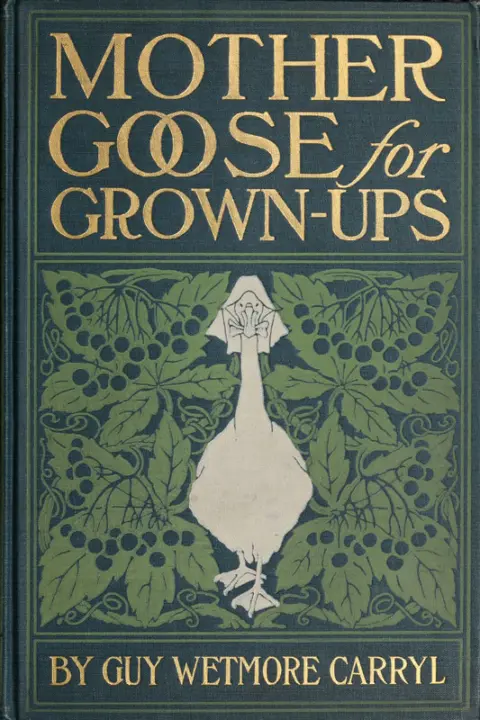
Mother Goose for Grown-ups
Guy Wetmore Carryl
THE CLASSIC COLLECTION · 1904
"The Transgression of Andrew Vane" by Guy Wetmore Carryl is a novel written in the early 20th century. The book explores themes of love, despair, and human relationships, primarily focusing on Andrew Vane, a young man navigating the complexities of life, love, and societal expectations, especially as he grapples with the aftermath of his family's struggles and personal failures. The narrative promises to delve into the contrast between idealism and reality, particularly through Andrew's interactions and evolving dynamics with other characters. At the start of the story, readers are introduced to Helen Sterling, who reflects on her deteriorating marriage with John Vane, Andrew's father. Helen's life embodies a difficult journey filled with disillusionment and heartbreak as she waits for her husband, consumed by his failures and alcoholism. As she grapples with the drastic change in her circumstances, a chance encounter with a stranger hints at potential companionship and change. Meanwhile, Andrew Vane arrives in Paris, freshly released from his past and in search of direction, underscoring the generational and existential conflicts that permeate the narrative. The opening sets a tone of melancholy mixed with hope, positioning both Helen and Andrew at crossroads in their lives.
Introduction adapted from the source catalogue; source summaries may be automatically generated.
Free to read · English · 76,615 words · No account needed
MAKE TIME FOR A GOOD BOOK
On by default. Untick to stop anonymous reading totals. Each page counts after 10 seconds in view. How this works.
Anonymous counting is on unless you have switched it off.
"Margery," she said, "you're quite old enough to take care of yourself; though, to speak frankly, you have a somewhat peculiar method of doing so. Let us abandon the monkeys for the present. I have something to say to you. I--I--"
She hesitated for an instant, and then proceeded resolutely.
"I've been thinking of you a great deal, of late, and you must forgive me if I speak unreservedly to you. It's because of my affection for you, and my deep interest in your welfare."
She did not see the slight contraction of her daughter's eyebrows, and it was well for her peace of mind that she did not. It argued ill for a sympathetic reception of her carefully formulated appeal.
"I'm sure, my dear mother, that it's very far from my desire to resent anything you say. Why should I? Has any one a better right to speak--er--unreservedly?"
"I've been more than proud of you always," continued Madame Palffy, "more than proud, my dear. You've been a great comfort to me, and, if I do say it, a wonderful success in the Colony. I remember no debutante in ten years who has received so much attention, and the fact that it has not spoiled you shows how worthy of it all you are. And now," she added, with an uneasy smile, "for la grande serieux."
Again that curious drawing together of Miss Palffy's eyebrows.
"Le grand serieux?" she repeated. She detested feeling her way in the dark, and now groped dexterously for a clue. "That's usually taken to mean something quite alien to our present conversation."
"Not at all," said her mother, catching at this opening, "not at all alien, my dear. In fact, Margery, what I want to ask you is this. Er--have you ever thought of marrying?"
"Yes--often," said Margery promptly.
The two words were characteristic of their curious relations, as Madame Palffy realized, with a little inward sigh of despair. They answered her question fully, and they answered it not at all.
"You don't understand me, perhaps," she went on. "I mean, have you ever seen--here in Paris, for instance--any particular man whom it has seemed to you you might--er--love? Now--there is De Boussac--"
"Ah!"
"Wait a moment, my dear. Let me finish. I'll not conceal from you that it has been a dear wish of mine to see you married to him. I've known him since he was a baby. He's titled, rich, very talented, and more than moderately good-looking. His position is irreproachable, and his family goes straight back indefinitely."
Your reading position is saved on this browser. Take it to another device with a library code. Reading pages adapt to text, rather than matching a printed edition.
Guy Wetmore Carryl
Guy Wetmore Carryl
Guy Wetmore Carryl
Guy Wetmore Carryl
BEHIND THE BOOK
This eBook is for the use of anyone anywhere in the United States and most other parts of the world at no cost and with almost no restrictions whatsoever. You may copy it, give it away or re-use it under the terms of the Project Gutenberg License included with this eBook or online at www.gutenberg.org. If you are not located in the United States, you will have to check the laws of the country where you are located before using this eBook. Read the source licence.
The original source file, including credits and licence, is retained by this library. Request an original-format copy at no charge. Please include the book title and Project Gutenberg identifier #38020.
KEEP YOUR CURIOSITY GOING
Coulson Kernahan

Maurice Baring
Frances Wright
Cécile Tormay

Frederic Jesup Stimson

W. H. P. (William Henry Pope) Jarvis