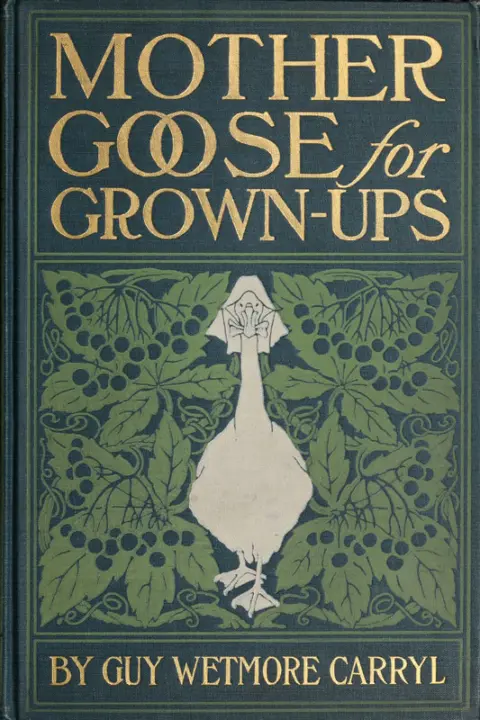
Mother Goose for Grown-ups
Guy Wetmore Carryl
THE CLASSIC COLLECTION · 1904
"The Transgression of Andrew Vane" by Guy Wetmore Carryl is a novel written in the early 20th century. The book explores themes of love, despair, and human relationships, primarily focusing on Andrew Vane, a young man navigating the complexities of life, love, and societal expectations, especially as he grapples with the aftermath of his family's struggles and personal failures. The narrative promises to delve into the contrast between idealism and reality, particularly through Andrew's interactions and evolving dynamics with other characters. At the start of the story, readers are introduced to Helen Sterling, who reflects on her deteriorating marriage with John Vane, Andrew's father. Helen's life embodies a difficult journey filled with disillusionment and heartbreak as she waits for her husband, consumed by his failures and alcoholism. As she grapples with the drastic change in her circumstances, a chance encounter with a stranger hints at potential companionship and change. Meanwhile, Andrew Vane arrives in Paris, freshly released from his past and in search of direction, underscoring the generational and existential conflicts that permeate the narrative. The opening sets a tone of melancholy mixed with hope, positioning both Helen and Andrew at crossroads in their lives.
Introduction adapted from the source catalogue; source summaries may be automatically generated.
Free to read · English · 76,615 words · No account needed
MAKE TIME FOR A GOOD BOOK
On by default. Untick to stop anonymous reading totals. Each page counts after 10 seconds in view. How this works.
Anonymous counting is on unless you have switched it off.
"I don't seem to understand what you're driving at," he said presently, "but, somehow--well, I don't like the sound of it, Radwalader. Of course, I know you don't mean it that way, but it sounds rather--rather unfriendly, if you'll allow me to say so. Oh, damn it all!"
"What?" asked Radwalader, surprised at the sudden exclamation.
"There goes my knife. I ought to have known better than to hew at this stuff with it. I suppose that's the last I shall ever see of it--and a new one, too. Why--that's queer! Did you notice? There wasn't any splash."
He peered over the rail.
"Hello!" he added, "here's a ladder--leading down."
"There's a little garden down there," explained Radwalader, peering over in his turn. "I remember now. It's on part of the foundations of another old house, and the chap who lives in this one grows flowers there, oddly enough, and goes up and down on the ladder. Your knife's down there, somewhere. Jove! but it's dark!"
But Andrew already had one leg across the railing, one foot on the top
round of the ladder.
"This is easy," he said, "and I have my match-box, too. You see--well, Margery bought the knife only this morning in the bazar, and I wouldn't lose it for the world. And, by the way, Radwalader, forget what I said just now, will you? It wasn't very decent."
Then, with a short laugh of embarrassment, he descended into the
shadows.
The shadows! They were very deep below there, until broken by the flicker of Andrew's match. Then the shadows under the doorway of the old house, up by the top of the bridge, were deeper, and--what was this?--one shadow moved--moved--drew near to the man who leaned upon the rail, whistling "Au Clair de la Lune."
"All right!" called Andrew. "I have it. Now we come up again."
"Go slow," advised Radwalader. "You'll find it darker than ever, after
the match. Why--what--"
A hand on his shoulder had spun him round, but he had no more than recognized the white face grinning into his, no more than time to comprehend the words, "You've whistled for the last time, by God!" before the steel-shod butt of a revolver crashed three times in succession on--and through--his forehead.
"Once for me!" said Jules Vicot, between his teeth, "and once for my wife, and once for your son!"
He hurled Radwalader from him, ran a few feet, turned at the rail to see the smitten man writhing and groping blindly on the cobbles of the driveway, and then, emptying the entire contents of the revolver in his direction, vaulted with a laugh into the swirling Seine below.
Your reading position is saved on this browser. Take it to another device with a library code. Reading pages adapt to text, rather than matching a printed edition.
Guy Wetmore Carryl
Guy Wetmore Carryl
Guy Wetmore Carryl
Guy Wetmore Carryl
BEHIND THE BOOK
This eBook is for the use of anyone anywhere in the United States and most other parts of the world at no cost and with almost no restrictions whatsoever. You may copy it, give it away or re-use it under the terms of the Project Gutenberg License included with this eBook or online at www.gutenberg.org. If you are not located in the United States, you will have to check the laws of the country where you are located before using this eBook. Read the source licence.
The original source file, including credits and licence, is retained by this library. Request an original-format copy at no charge. Please include the book title and Project Gutenberg identifier #38020.
KEEP YOUR CURIOSITY GOING
Coulson Kernahan

Maurice Baring
Frances Wright
Cécile Tormay

Frederic Jesup Stimson

W. H. P. (William Henry Pope) Jarvis