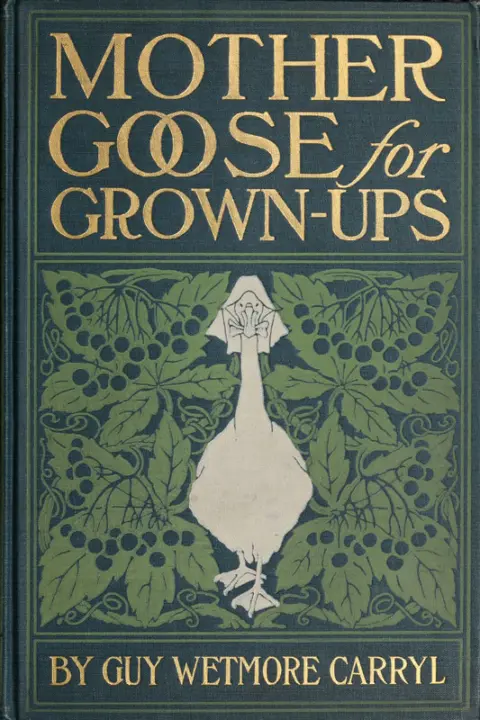
Mother Goose for Grown-ups
Guy Wetmore Carryl
THE CLASSIC COLLECTION · 1904
"The Transgression of Andrew Vane" by Guy Wetmore Carryl is a novel written in the early 20th century. The book explores themes of love, despair, and human relationships, primarily focusing on Andrew Vane, a young man navigating the complexities of life, love, and societal expectations, especially as he grapples with the aftermath of his family's struggles and personal failures. The narrative promises to delve into the contrast between idealism and reality, particularly through Andrew's interactions and evolving dynamics with other characters. At the start of the story, readers are introduced to Helen Sterling, who reflects on her deteriorating marriage with John Vane, Andrew's father. Helen's life embodies a difficult journey filled with disillusionment and heartbreak as she waits for her husband, consumed by his failures and alcoholism. As she grapples with the drastic change in her circumstances, a chance encounter with a stranger hints at potential companionship and change. Meanwhile, Andrew Vane arrives in Paris, freshly released from his past and in search of direction, underscoring the generational and existential conflicts that permeate the narrative. The opening sets a tone of melancholy mixed with hope, positioning both Helen and Andrew at crossroads in their lives.
Introduction adapted from the source catalogue; source summaries may be automatically generated.
Free to read · English · 76,615 words · No account needed
MAKE TIME FOR A GOOD BOOK
On by default. Untick to stop anonymous reading totals. Each page counts after 10 seconds in view. How this works.
Anonymous counting is on unless you have switched it off.
Andrew appeared in the doorway of the bathroom, diligently towelling his head. As he looked up, his eyes, so curiously like Radwalader's own, were not less coolly non-committal than they.
"How is Mrs. Carnby?" he added.
"A good bit out of patience with you, I gather," said Radwalader. "You've pretty well deserted her of late, haven't you?"
Andrew was drying his fingers, one by one, with somewhat exaggerated
attention.
"One can't serve God and Mammon," he observed, with that new flippancy of his. "I won't stoop to the pettiness of fencing with you, Radwalader. You're not blind, I take it. You must know as well as I why I don't want to go to Poissy, and why, if I did, they wouldn't care to have me."
"Yes," said the other, "I suppose I do. If I didn't, it wouldn't be for lack of hearing you talked about. Gossip is tolerably busy with your name, these days."
"Gossip is rarely busy with one name," retorted Andrew dryly.
"Obviously. I didn't mean to ignore Mademoiselle Tremonceau: as you say, a lack of candour between us would be merely petty: but I wasn't quite sure how far you were prepared to concede me the license of a friend. These are ticklish subjects, even between intimates. I'm not inclined to meddle, but I've thought more than once of asking you if you thought the game worth while."
"I make a point of not thinking about it, one way or another," said Andrew. "Why should I? I've youth, health, money, the sunshine, Paris--and her. Why should I think? It's nobody's business but my own. Don't be a prig, Radwalader."
"God forbid!" ejaculated Radwalader. "I see I've been mistaken. I had an idea that it was somebody's business, other than yours--very much so, in fact. Of course, if it isn't--"
He stopped abruptly, and made a little signal of warning. An instant later Monsieur Vicot entered the room, and began to lay out Andrew's evening dress. His presence was an effective check upon further conversation along the direct line they had been pursuing, and, as Andrew hurried through his dressing, Radwalader plunged into generalities.
In another fifteen minutes Vicot opened the apartment door for them, and, as they passed out, closed it and stepped into the salon. The first object which met his eye was the miniature of Helen Vane, lying, face downward, on the table where Radwalader had left it. He picked it up and set it, upright, on the mantel, under the brilliant light of an electric bulb. Then, idly curious, he leaned forward and stared at it.
Your reading position is saved on this browser. Take it to another device with a library code. Reading pages adapt to text, rather than matching a printed edition.
Guy Wetmore Carryl
Guy Wetmore Carryl
Guy Wetmore Carryl
Guy Wetmore Carryl
BEHIND THE BOOK
This eBook is for the use of anyone anywhere in the United States and most other parts of the world at no cost and with almost no restrictions whatsoever. You may copy it, give it away or re-use it under the terms of the Project Gutenberg License included with this eBook or online at www.gutenberg.org. If you are not located in the United States, you will have to check the laws of the country where you are located before using this eBook. Read the source licence.
The original source file, including credits and licence, is retained by this library. Request an original-format copy at no charge. Please include the book title and Project Gutenberg identifier #38020.
KEEP YOUR CURIOSITY GOING
Coulson Kernahan

Maurice Baring
Frances Wright
Cécile Tormay

Frederic Jesup Stimson

W. H. P. (William Henry Pope) Jarvis