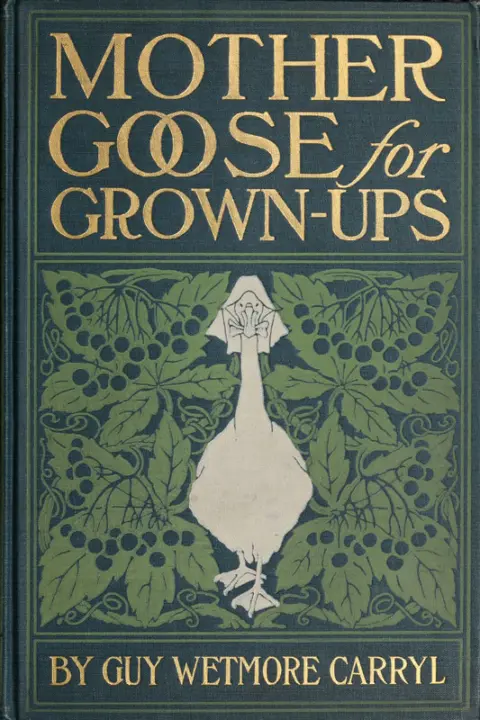
Mother Goose for Grown-ups
Guy Wetmore Carryl
THE CLASSIC COLLECTION · 1904
"The Transgression of Andrew Vane" by Guy Wetmore Carryl is a novel written in the early 20th century. The book explores themes of love, despair, and human relationships, primarily focusing on Andrew Vane, a young man navigating the complexities of life, love, and societal expectations, especially as he grapples with the aftermath of his family's struggles and personal failures. The narrative promises to delve into the contrast between idealism and reality, particularly through Andrew's interactions and evolving dynamics with other characters. At the start of the story, readers are introduced to Helen Sterling, who reflects on her deteriorating marriage with John Vane, Andrew's father. Helen's life embodies a difficult journey filled with disillusionment and heartbreak as she waits for her husband, consumed by his failures and alcoholism. As she grapples with the drastic change in her circumstances, a chance encounter with a stranger hints at potential companionship and change. Meanwhile, Andrew Vane arrives in Paris, freshly released from his past and in search of direction, underscoring the generational and existential conflicts that permeate the narrative. The opening sets a tone of melancholy mixed with hope, positioning both Helen and Andrew at crossroads in their lives.
Introduction adapted from the source catalogue; source summaries may be automatically generated.
Free to read · English · 76,615 words · No account needed
MAKE TIME FOR A GOOD BOOK
On by default. Untick to stop anonymous reading totals. Each page counts after 10 seconds in view. How this works.
Anonymous counting is on unless you have switched it off.
The restlessness of a curious dissatisfaction suddenly laid hold upon him, and he rose and began to pace the salon once more. He would have given something to fling himself out of the chaos of conflicting thoughts which beset him, to ride, for example, five miles at a gallop, as he had been wont to do at Beverly, with the wind tearing at his hair and a thoroughbred lunging between his knees.
Presently he became aware that Mirabelle was watching him curiously, and was puzzled to find that for the first time he was not ready to meet her eyes. He seated himself at the piano, and for a moment fingered the music on the rack, without actually taking in the title--"Rhapsodie Hongroise, No. 2." Then he smiled, with a little nod as if he had been greeting an acquaintance on the street, and his hands fell upon the keys.
Majestically, with ponderous bass notes and a deeper comment of short, staccato chords, the Rhapsodie began. It was as solemn as a dirge in its adagio movement, till the high treble began to flutter into the motif, and dragged it upward, with a brilliant run, into a suggestion of running water. Plunging again into the bass, the music marched firmly on, varied with higher chords, until, through the monotonous throb, a bird chirped, twittered, and trilled, and cadenza followed cadenza, plashing in and over the main theme. This variation was presently gone again in a swiftly descending arpeggio, and the adagio reasserted itself, beating out across the salon with the lingering quality of tolled bells, freeing itself at last by another run into the crystal sparkle of the treble, where the motif was repeated, ringing with fresh vigour. The bass replied with a brief word now and again, correcting the new rendering of the air that it had taught, or patiently repeating a whole phrase. But, petulantly, the treble threw off the sombre spirit of what had gone before. Again it thrilled with bird-music, and ran into the gay babble of brooks, punctuated rarely by a deeper chord, as if the water swerved round a stone, and slid, murmuring, across a level, before swinging again down a shelving reach. But, almost immediately, a new element stole in--a tremulous flutter of one note, potently suggestive of mad music to follow. Faster--faster! The flutter was interrupted by a dripping of stray notes, an octave lower, dotted, presently, with a tiny tinkling above. Then, without warning, the whole plunged into a mad vivace movement, that galloped like a living thing, was interrupted by whimsically coupled notes, gabbling up and down, and then seemed to lengthen and bound forward as if it had been spurred. There was a thunder of chromatics--hoofs pounding on a long bridge--then the tinkle of water broke in again--right at his elbow--lingered briefly, and was gone, and the hoofs were thudding on a muffling stretch of soft road. The suggestion, at first merely a fancy, grew upon him as he played. This was the gallop of which he had felt a need! He could almost see the wiry mare snapping in the wind, smell the horse and the saddle, and hear the stirrup-leathers squeaking against his boots. In spirit, at least, he put into the music the exultation, which is near to delirium, of a ride at nightfall or at dawn. The earth, which never sighs save when falling asleep or waking, sighs then, and her breath is sweet. Scents and sounds step to the roadside, and are gone again in a moment. The wind whips and whistles. And the triplicate hoof-beats pound, pound, pound out of life all that is stale, morbid, and unclean, so that it becomes a crystal dome inverted on a perfume-breathing garden, and one man whirling through space like a god, with a laugh on his lips!
Your reading position is saved on this browser. Take it to another device with a library code. Reading pages adapt to text, rather than matching a printed edition.
Guy Wetmore Carryl
Guy Wetmore Carryl
Guy Wetmore Carryl
Guy Wetmore Carryl
BEHIND THE BOOK
This eBook is for the use of anyone anywhere in the United States and most other parts of the world at no cost and with almost no restrictions whatsoever. You may copy it, give it away or re-use it under the terms of the Project Gutenberg License included with this eBook or online at www.gutenberg.org. If you are not located in the United States, you will have to check the laws of the country where you are located before using this eBook. Read the source licence.
The original source file, including credits and licence, is retained by this library. Request an original-format copy at no charge. Please include the book title and Project Gutenberg identifier #38020.
KEEP YOUR CURIOSITY GOING
Coulson Kernahan

Maurice Baring
Frances Wright
Cécile Tormay

Frederic Jesup Stimson

W. H. P. (William Henry Pope) Jarvis